Nvidia runs a 75% gross margin. It is the most profitable large company in semiconductors, and it has spent three years being the one that sets the price. On Saturday, Bloomberg reported that its biggest customers have been told the servers built around its AI chips are going up more than 15% in many cases — because memory costs are soaring and Nvidia is not eating them.
The increases apply to systems shipped early next year, including those built on the flagship Vera Rubin and Grace Blackwell parts. How much depends on the chip generation and the memory configuration. The notices did not come from Nvidia directly: the contract manufacturers that assemble servers for large data centre operators — Microsoft, Alphabet’s Google and Oracle among them — passed the word to their customers. Nvidia did not respond to Bloomberg’s request for comment.
Read that sequence again, because it is the story. The company with 75% margins, a de facto monopoly on AI accelerators and a queue of desperate buyers decided it could not absorb an input cost. Not would not — three years of pricing behaviour say Nvidia takes margin wherever it can find it. Something changed on the input side.
Who actually has the leverage
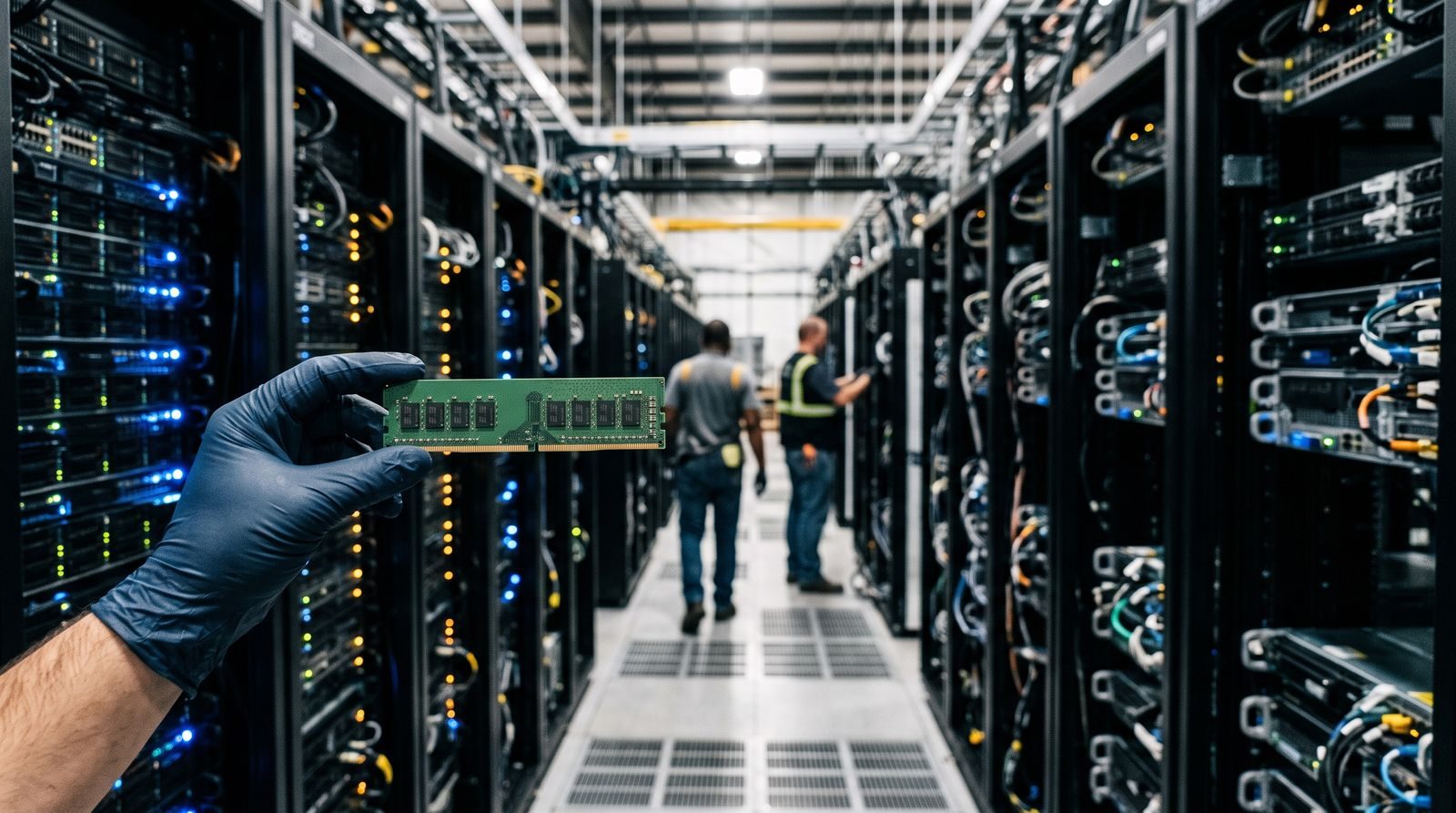
What changed is DRAM. An Nvidia accelerator is only as useful as the memory paired with it, and most of the world’s supply of that memory comes from three companies: Samsung Electronics, SK hynix and Micron. All three have been adding output. None has caught up. That gap has handed a commodity business the kind of pricing power it has not had in decades — and it is now strong enough to move the cost base of the most powerful company in the industry.
The consumer side already shows what this looks like when it reaches a shelf. Median US prices on Nvidia’s RTX 50-series gaming cards have jumped as much as 39% since early summer, according to Tom’s Hardware’s tracking of Newegg listings: the RTX 5070 up 36% from about $660 to about $900, the RTX 5060 up 27%, the 16GB RTX 5060 Ti up 39%. Apple and Qualcomm have both told investors that chip shortages are forcing them to charge more. The data centre was the last place the squeeze had not visibly landed. It has landed.
Our take: For two years the AI trade has been priced on the assumption that compute gets cheaper per unit of work every generation. A 15% hardware increase does not break that assumption, but it does something more awkward — it moves the profit pool. If Nvidia is passing memory costs through rather than absorbing them, the marginal dollar of AI capex is flowing to Samsung, SK hynix and Micron, and the hyperscalers financing this buildout on borrowed money are the ones holding the bill. The bottleneck in AI is no longer the accelerator. It is the thing sitting next to it.
What to watch
- Wednesday. Nvidia reports fiscal Q2 after the close on 26 August. Gross margin guidance now matters more than the revenue line — it tells you how much of the memory bill Nvidia expects to keep passing on.
- Whether hyperscaler capex guidance moves. Microsoft, Google, Amazon and Meta all committed to build schedules priced before this. A 15% hardware increase either shrinks the buildout or widens the funding gap. There is no third option.
- In-house silicon timelines. Every major customer has its own chip programme. Those chips need the same DRAM from the same three suppliers, so escaping Nvidia does not escape the shortage.
- Memory supplier signals. Samsung, SK hynix and Micron are the ones capturing this. Watch whether they announce capacity additions that would end the squeeze — or hold the line and keep the pricing power.
None of this is a view on any share price. It is a description of where the money in the AI buildout is starting to move, and the direction is away from the company everyone will be watching on Wednesday.