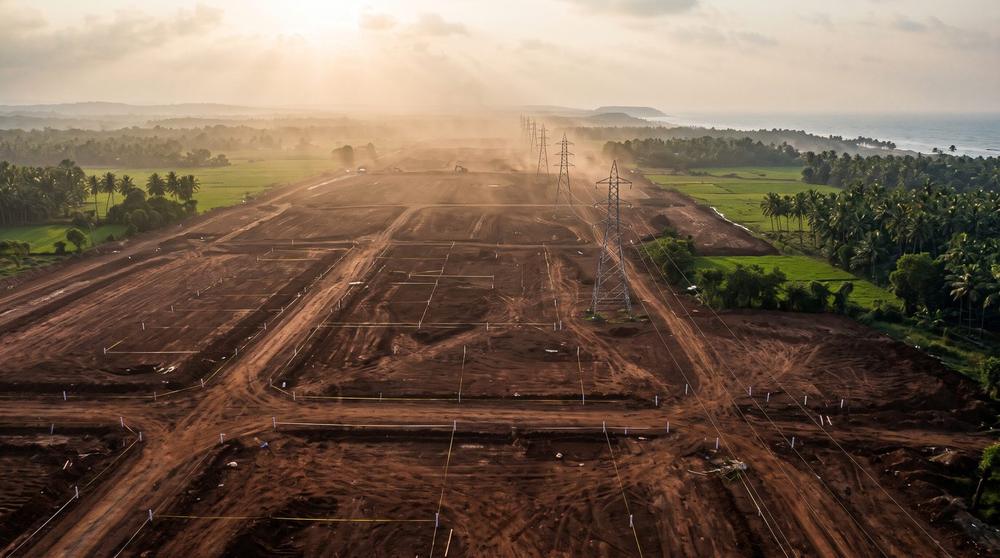
AirTrunk, the Blackstone-backed hyperscale data-centre operator, has put forward a plan for two campuses in Andhra Pradesh totalling up to 1.8 gigawatts, with a stated total investment of about 1.03 trillion rupees, or roughly $11 billion. The figure comes from the company’s own emailed statement.
What is not settled is what stage the thing is at. One account has AirTrunk signing a memorandum of understanding with Andhra Pradesh Chief Minister Nara Chandrababu Naidu, naming a 400 MW campus at Rambilli and a 1,400 MW campus at Tootipala, both in Anakapalli district. Other accounts describe a plan that has been filed and is under consideration by state authorities, and use the word “if approved.” No report gives a signing date, and none states whether the MoU — if there is one — binds anybody to anything.
Also absent from every version: a construction start date, a commissioning date, any phasing, any power purchase agreement or grid connection detail, and any named tenant. AirTrunk has said the campuses would use low-water air-cooled systems drawing on industrial rather than municipal water. Naidu has said the state is increasing renewable capacity and reinforcing water supply to support the build-out — a state commitment, not a company one.
Our take: 1.8 gigawatts is not a data centre, it is a mid-sized country’s worth of baseload, and the gap between “signed an MoU with the chief minister” and “filed a plan the state is reviewing” is the entire question of whether this is news. Indian state-level data-centre MoUs have a long history of being announced at full headline value and arriving at a fraction of it, years late, because the binding constraint was never the capital — it was power, land and water. Treat the $11 billion as an ambition with a press release attached. The number that will tell you it is real is the first signed power agreement, and nobody has published one.
Why announced gigawatts and delivered gigawatts diverge
A gigawatt of announced capacity commits a developer to nothing. A gigawatt of contracted power commits a utility to build generation and transmission, and that is where these projects live or die. Andhra Pradesh is actively courting this industry — Google has a separate $15 billion AI hub in the state — which means several very large power requests are queuing against the same grid at the same time.
This is the same arithmetic that produced SoftBank’s $3.7 billion turbine writedown against 13 gigawatts of plans: equipment and capital were ordered against capacity that could not be energised on schedule. Announced capacity is a claim on the future. Energised capacity is a fact. The industry quotes the first and gets measured on the second.
The missing tenant is the missing story
Hyperscale campuses of this size are normally built against demand, not into it. No anchor customer has been named, which is the pattern we flagged when Naver announced a two-trillion-won AI factory for an unnamed customer. There are honest reasons for the silence — hyperscalers routinely require confidentiality, and AirTrunk’s whole business model is building for exactly those customers. But without a tenant, the $11 billion is a number the developer intends to raise, not a number anybody has committed, and the Fed spent Friday pointing out how much of this build-out is now debt-funded.
AirTrunk itself is well capitalised: Blackstone and partner capital acquired it in a deal reported at over A$24 billion. That is a genuine advantage over a speculative developer. It does not make an unapproved plan an approved one.
What to watch
- A signed power agreement with Andhra Pradesh’s distribution companies. This is the only milestone that converts the announcement into a project.
- Land allotment orders for Rambilli and Tootipala. Public, dated, and specific — unlike the MoU.
- Whether the 400 MW and 1,400 MW split survives. It currently rests on a single report. Phase-one capacity is usually the honest number.
- Any named anchor tenant. One named hyperscaler would be worth more than the whole $11 billion headline.
- How the rupee figure is funded. No timeframe and no funding source has been disclosed for the 1.03 trillion rupees.