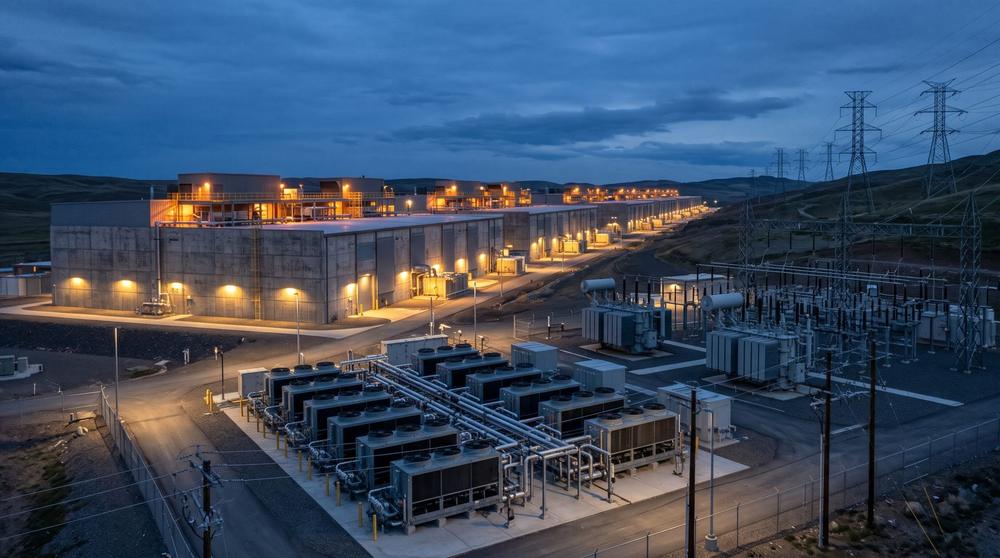
Naver said on Thursday it has signed a 2 trillion won computing services supply contract — about $1.5 billion — with a US artificial intelligence inference company. The direction matters: Naver is the seller. The counterparty becomes the first customer of the AI factory Naver is building with Brookfield and Nvidia, and Naver will not say who it is.
The same filing day brought third-quarter results. Revenue was 3.47 trillion won, up 10.7% year on year and a sixth consecutive quarterly record. Operating profit was 451.3 billion won, down 20.9%, for a 13% operating margin. Naver attributed the decline to AI-related investment alongside higher spending on content and offline data. It did not quantify the AI infrastructure cost.
By segment, platform revenue was 1.95 trillion won (+7.3%), the financial platform 487.7 billion won (+14.1%) and global business 1.04 trillion won (+15.9%).
Our take: This is a timing mismatch dressed as a win. The 2 trillion won does not start arriving until commercial services launch in the first half of 2027, and the Korea Herald puts the contract at roughly 20 megawatts over four to five years — so call it a few hundred billion won a year against a build whose costs are already landing in the P&L, as the 20.9% profit drop shows. Meanwhile the anchor tenant is unnamed. On a four-to-five-year capacity contract, the tenant’s balance sheet is the asset quality, and nobody outside Naver can assess it. “US AI inference company” covers both a hyperscaler subsidiary and a startup running on venture funding, and those are not the same contract. Chief executive Choi Soo-yeon called it “a meaningful contract that confirms actual market demand,” which is fair on its own terms — one signature is evidence of demand. It is not yet evidence of a durable business.
The capacity arithmetic, and a discrepancy
Naver plans 55 megawatts of AI factory capacity in 2027, with commercial launch in the first half of that year, expanding to 200 megawatts by 2028. Chief financial officer Kim Hee-cheol said the company is in talks with more than ten prospective customers outside Asia for the remaining capacity.
Here the reporting diverges, and readers should know it. The Korea Herald describes this deal as about 20 megawatts and has the CFO negotiating over “the remaining 180 MW.” The Korea Times, covering the same announcement, says Naver had secured contracted capacity “exceeding its initial 200-megawatt target for 2028.” Those cannot both be right. A 20-megawatt first deal with 180 to sell is an early-stage leasing business; a fully contracted 200 megawatts is a sold-out one. We are not able to resolve it from the available filings, and the distinction is the single most important number in the story.
Choi also pointed to a supply constraint as a competitive argument: shortages of liquid-cooled data centre space for Nvidia’s Vera Rubin chips, she said, could strengthen Naver’s position. Separately, Naver will establish a dedicated logistics subsidiary, with delivery and fulfilment investment expected to approach 1 trillion won through 2030, financed to limit the cash-flow and earnings impact.
What to watch
- The customer’s name. It may surface in a Korea Exchange disclosure or the annual report. Until it does, the contract cannot be credit-assessed from outside.
- Which capacity figure is right. 20 megawatts or 200. Naver’s next investor materials should settle it.
- Revenue recognition. No source states how the 2 trillion won is recognised across the four-to-five-year term. Straight-line and usage-based look very different in 2027.
- The next signature. Ten prospects in talks is a pipeline. A second named deal would turn the AI factory from a project into a book of business.
Figures are drawn from Naver’s 12 November 2026 announcement and third-quarter results as reported by the Korea Times, Korea Herald and KED Global; the capacity discrepancy noted above appears in those reports and is flagged rather than resolved. Nothing here is investment advice.