For two months the running story in AI infrastructure has been American companies buying their way to the front of a queue. Anthropic paid $3.4 billion to take over somebody else's generator orders. Riot leased 910 megawatts to a tenant it will not name. Google committed $17 billion in Wyoming and is bringing its own fuel cells. The constraint is never the chips. It is the power, and the years it takes to get it.
SemiAnalysis went to see what the same build looks like in Inner Mongolia. Its report, published Friday and picked up today, describes Envision Group's “Galaxy” campus at Ulanqab: planned for up to 800 megawatts of IT capacity, with the full site expected by the end of 2027. The first 120-megawatt phase was delivered in August, inside a year.
For scale, Stargate Abilene is around 820 megawatts of critical IT. This is the same order of campus.
The owner builds the power
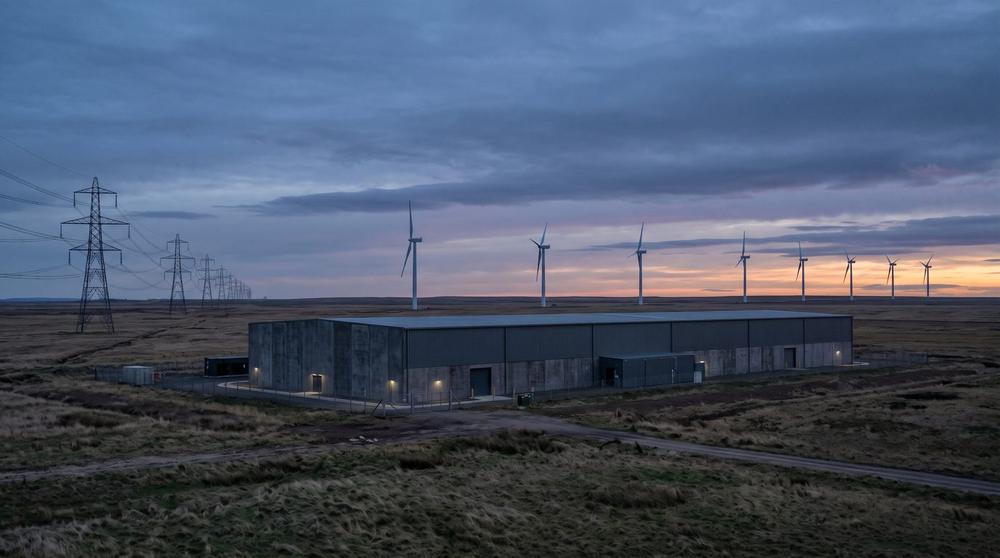
Envision is a renewable systems integrator, and that is the whole design. Rather than queue for grid capacity, it built its own wind farms and a dedicated line — a “source-grid-load-storage” model. Two farms about 80 kilometres apart give 420 megawatts of wind capacity against a first-two-phase load of 240 megawatts, with a four-hour battery system behind it. The stated aim is more than 60% of those phases' power from Envision's own turbines.
Wind at Ulanqab runs a 35–40% capacity factor, against roughly 32% for Inner Mongolia generally, or about 2,800 full-load hours. SemiAnalysis's own modelling suggests wind covers something like 40% of a year's energy at 1:1 sizing — its estimate, not a measured figure from the site.
The contrast it draws with Abilene is blunt: Abilene leans on the grid and on gas turbines standing in the yard. Galaxy leans on wind.
Vertical integration shows up in the dull parts too. A prefabricated substation goes in in under three months against roughly six for a conventional indoor build. Across the surrounding Chahar high-tech zone, a local report counts nearly 30,000 workers on 22 data centre projects.
One hall is doing something nobody in America is doing
In a single 5-megawatt hall, solid-state transformers take 10kV AC and convert it straight to 800-volt DC for the racks. That removes the low-voltage transformers, the UPS and the rectifier stages — the whole conversion chain that sits between the yard and the server in a conventional design. A larger version is planned for the next phase.
It is a pilot, at 5 megawatts of 800. But the context is the point: China has run DC power in data centres since around 2007, roughly a quarter of its recent builds are DC, and about 97% of US data centres run AC with UPS. Cooling follows the same logic — liquid- and air-cooled servers share one water loop with no central chiller plant at all.
Our take: the number everyone will repeat is “a fifth of US costs,” and it is the softest figure in the report. Neither SemiAnalysis nor the coverage specifies a fifth of what — per megawatt, per rack, capex, all-in — or against which American baseline. Treat it as a direction, not a multiple. The harder fact sits one line away: SemiAnalysis says project returns are thin and IRRs are squeezed, so “the reward often comes from elsewhere.” That is a sentence about industrial policy wearing a spreadsheet.
The missing fact
Not one account of this campus says what it runs. All four phases are built-to-suit for two unnamed internet giants, and no source names a chip or an accelerator. Given US export controls on the top Nvidia parts, that is the number that decides whether 800 megawatts in Ulanqab is 800 megawatts of frontier training or a very large amount of something slower.
Eight hundred megawatts of shell and substation is a real achievement in under two years. It is not the same achievement as 800 megawatts of compute.
What to watch
- Any disclosure of the silicon. Until a chip is named, capacity figures are building figures.
- Whether the 800V DC pilot scales past 5 megawatts. If the next phase runs it campus-wide, the US AC-plus-UPS default starts looking expensive.
- The two unnamed tenants. Built-to-suit across all four phases is heavy counterparty concentration, the same structure that made Riot's Corsicana lease interesting.
- Wind through winter. A 60% self-supply target and a four-hour battery is a thesis, not a track record.
America is paying a premium for position in a queue. Envision skipped the queue by owning the thing the queue is for.