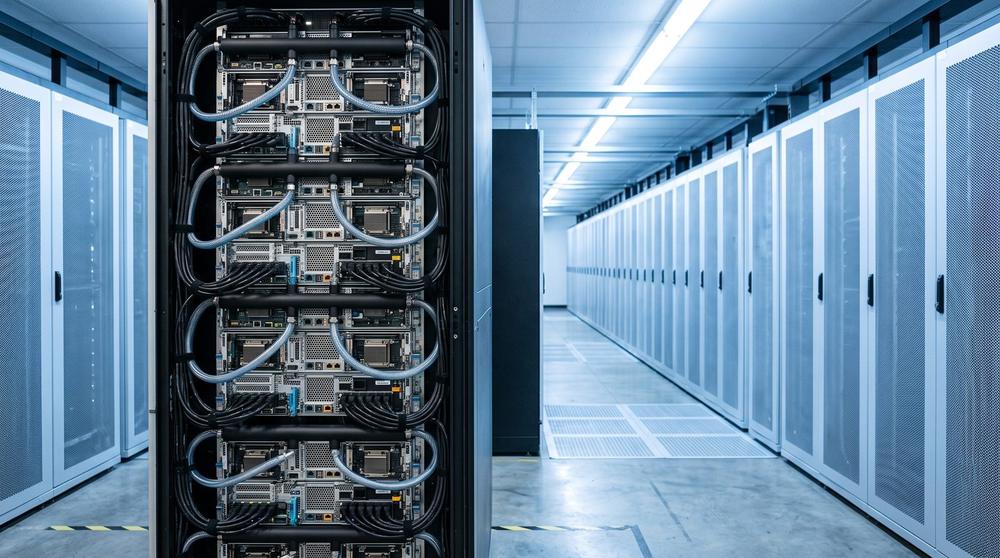
AMD has put out an open blueprint for a rack built to run AI agents, and the configuration it led with has no GPUs in it at all.
The design is called Helion, announced Monday and positioned as an extension of AMD’s existing Helios rack-scale work. It comes in two shapes. The CPU-only rack uses sixth-generation EPYC processors and scales to 32,768 CPU cores, aimed at hyperscalers that want dedicated capacity for executing agents while keeping model inference on separate infrastructure. The all-in-one rack combines EPYC CPU nodes, Instinct MI350P GPU nodes and general-purpose compute, aimed at enterprises doing both in one cabinet. Both come liquid-cooled and air-cooled, and Supermicro describes the architecture as ORv3 compliant.
The piece worth reading twice is the integrated token router, which directs an agent’s model calls across frontier and open-source models. AMD says it plans to contribute the Helion specification to the Open Compute Project. Partner configurations are under development with Cisco, Dell, Hon Hai, HPE, Lenovo, QCT, Supermicro and Wiwynn, and are planned for November 2026.
The argument AMD is making
Dan McNamara, AMD’s senior vice president and general manager for Compute and Enterprise AI, put the thesis in five words: “Agentic AI is not a single workload.”
That is the whole bet. A frontier model answering a prompt is matrix multiplication, and GPUs own it. An agent doing a job is something else: parsing, planning, calling tools, hitting APIs, retrying failures, holding state, waiting. Measured in wall-clock time, a large share of an agent’s run is not the model thinking — it is ordinary general-purpose compute and memory bandwidth around the model, which is what a CPU is for. If that is right, agents at scale add a server-CPU line item to AI budgets that almost nobody has been modelling, and AMD is the vendor with the EPYC franchise to sell into it.
Two things are not in the announcement, and both matter. There is no pricing. And the specification has been promised to OCP rather than contributed — which means “open” currently describes an intention. Nothing here ships before November.
Our take: The CPU-only rack is the honest product and the token router is the strategic one. Routing a single agent’s calls across frontier and open-source models in hardware is a margin decision being moved into the infrastructure layer: every call sent to an open model instead of a frontier API is money that does not leave the building. Sell that as a feature of the rack and you are no longer competing with Nvidia on tokens per second — you are competing with the frontier labs’ price list. The risk is symmetric and obvious. If agent workloads really are CPU-and-orchestration-shaped, this is the right rack two years early. If the industry instead collapses agent work back into bigger models doing more per call, Helion is a cabinet of general-purpose compute parked next to the GPUs that do the actual work. Nothing in a blueprint with no price and no shipped unit resolves that.
What to watch
- Whether the spec actually reaches OCP, and in what state. An open blueprint that stays an AMD document is a marketing asset, not a standard.
- November’s partner systems, and their prices. Eight vendors issued quotes; none issued a number.
- Any customer naming CPU cores in an agent deployment. That is the single datapoint that would turn this thesis from plausible to real.
- How Nvidia answers. It spent the same week contributing rack and tray designs to open MGX — the fight over who defines the open rack is now running in parallel with the fight over the silicon inside it.