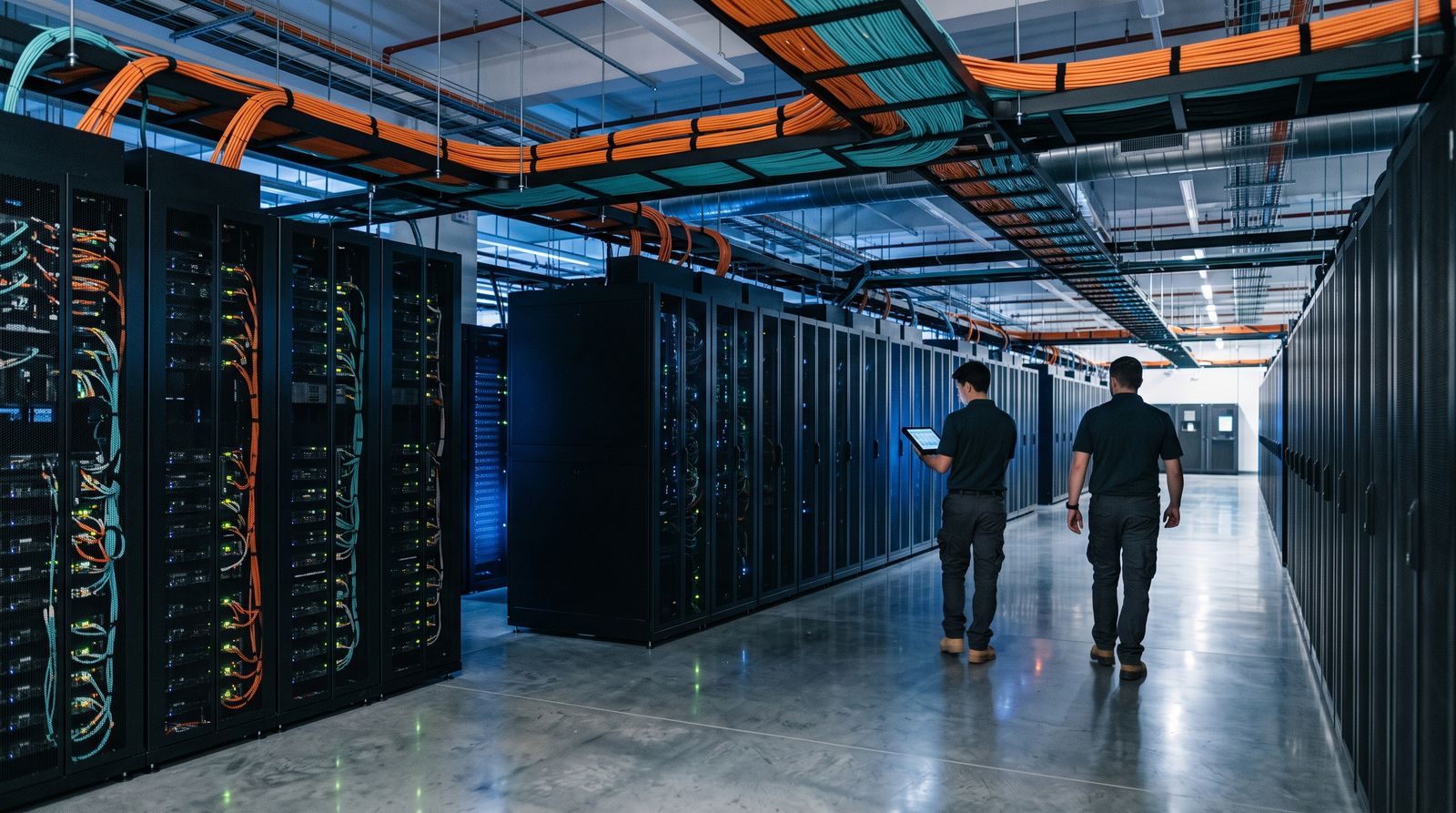
For three years AMD sold chips into a market that had stopped buying chips. Hyperscalers buy racks now — pre-integrated cabinets of GPUs, CPUs, networking and cooling that arrive as one deployable unit — and Nvidia was the only vendor shipping one. That ended this week. At its Advancing AI 2026 event, AMD launched Helios, its first rack-scale system: Instinct MI450-series GPUs, sixth-gen EPYC “Venice” CPUs on Zen 6, Pensando networking silicon and the ROCm software stack, sold as a single rack.
The customer list arrived with it. Anthropic committed to deploy up to 2 gigawatts of MI450-series GPUs in Helios racks, with the first gigawatt beginning in the first half of 2027 — and AMD will make a strategic equity investment of up to $5 billion in the AI lab alongside it. Microsoft expanded its partnership to deploy Helios on Azure for frontier-model inference. Oracle plans 50,000 MI450 GPUs on its cloud starting in the third quarter. Across OpenAI, Meta and Anthropic, AMD’s publicly committed customer compute now runs into the low double-digit gigawatts.
AMD says Helios is in full production, with shipments starting at the end of Q3 and ramping through 2027. Shares still fell 2.29% Thursday to $539.69 — after climbing 11.4% over the prior three sessions, and with the stock up roughly 145% on the year. Jefferies, BofA and Baird all raised price targets anyway; Jefferies went to $640 from $515.
The moat AMD is attacking isn’t the GPU
Nvidia’s durable advantage was never a single die. It was the rack: proprietary interconnect, a software layer nobody wanted to leave, and the fact that buying anything else meant becoming your own systems integrator. Helios is built on open Ethernet networking rather than a closed fabric — a deliberate pitch to buyers who want a second supplier without rewriting their data-center architecture. That is the actual product here. The MI450 is the ticket in; the rack is the business.
Our take: AMD didn’t win a benchmark this week — it won optionality, and it paid for it. A $5 billion equity check into a customer, gigawatt commitments that mostly land in 2027, and first shipments at the tail of Q3 add up to revenue that is real but not yet bankable. That’s why a launch this big produced a down day. The market has already repriced AI from growth story to balance-sheet story, and vendor financing — AMD into Anthropic, Nvidia backstopping customer GPUs — is now standard practice on both sides of the aisle. The bull case is that a credible second rack supplier finally caps Nvidia’s pricing power. The bear case is that everyone in this loop is increasingly funding their own demand.
What to watch
- Shipment timing versus availability. Helios ships to hyperscalers in the second half of 2026, but 2026 HBM4 supply is reported to be fully allocated to the largest buyers. If you are not Microsoft, Oracle, Meta or OpenAI, meaningful volume is a 2027 conversation.
- Nvidia’s pricing response. A credible open-Ethernet rack is the first real test of Nvidia’s ability to hold rack-level margins. Watch Vera Rubin positioning, not press releases.
- ROCm attach rates. Hardware parity is achievable; software switching costs are what kept buyers in place. Whether these gigawatt deals turn into repeat orders depends on the toolchain, not the silicon.
- The equity-stake pattern. Chipmakers taking positions in the labs that buy their chips is now the norm. It flatters demand signals — and it makes the AI capex cycle harder to read from the outside.