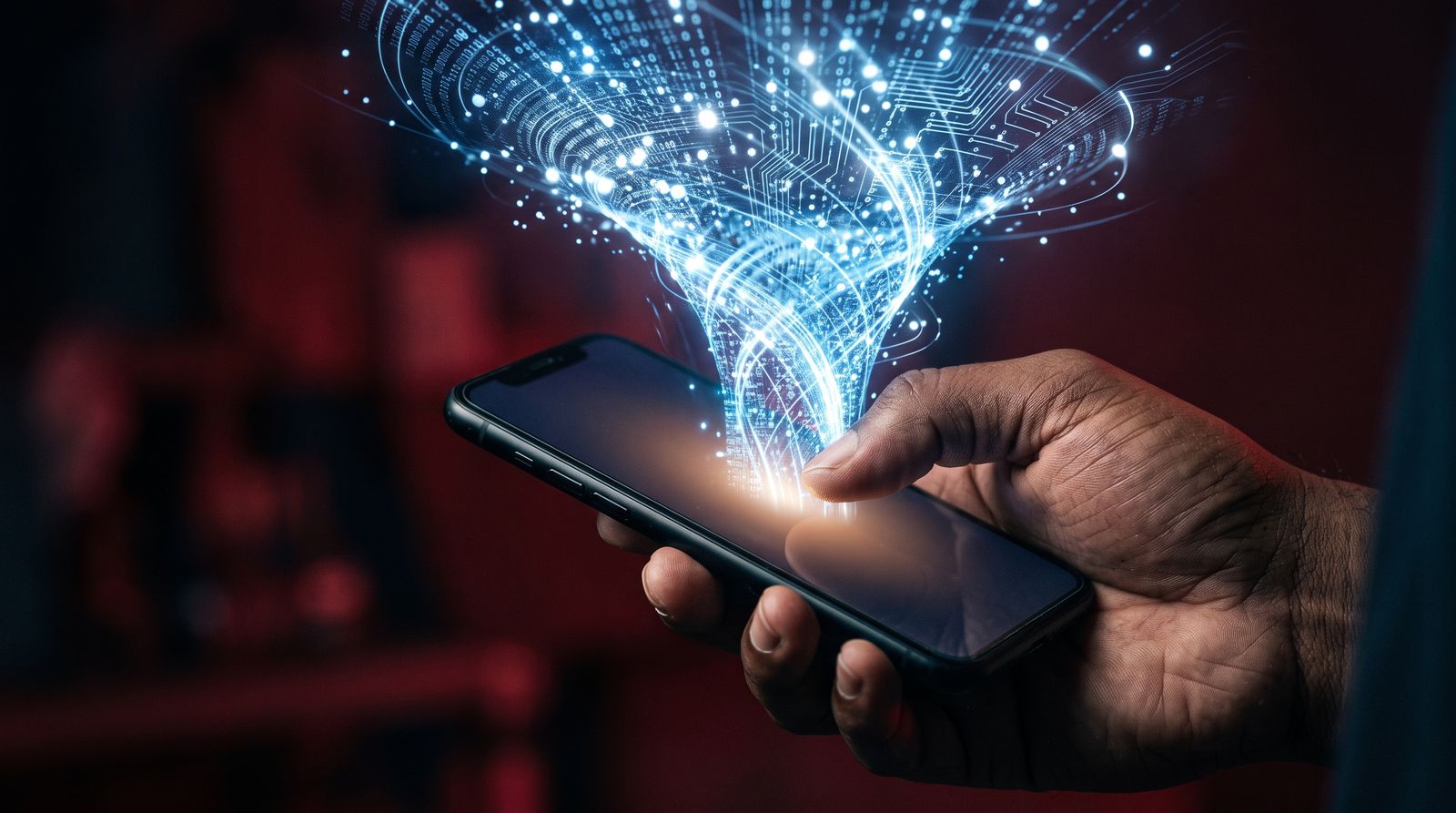
Apple is in early talks with PrismML, a Khosla Ventures–backed spinout from Caltech that compresses large AI models until they run entirely on a phone, CNBC reported. CEO Babak Hassibi said Apple and other companies have been evaluating PrismML’s models — measuring their speed, energy draw, and performance on devices — and called the discussions early but said “things are progressing nicely.”
The pitch is brute-force simplification of how a model stores what it knows. Standard models keep each internal value at 16 bits of precision; PrismML’s method collapses each one down to as few as one to three possible values. The company claims it shrank a 54-gigabyte model to under 4GB — a better-than-90% cut — while using 10–15x less memory and running 6–8x faster. At that size, a model that normally demands a server rack fits inside the storage and RAM budget of a flagship phone.
For Apple, the appeal writes itself. Local models mean features that touch your most sensitive data — health, photos, messages — never leave the device. They mean zero round-trip latency, AI that works in airplane mode, and no per-query cloud bill. And they play to the one AI advantage Apple owns outright: industry-leading silicon already sitting in more than two billion active devices, while the rest of the industry pays escalating billions for data-center capacity.
Our take: Apple doesn’t need to win the frontier race — let Google and OpenAI burn capital on trillion-parameter one-upmanship. It needs near-frontier quality where inference costs nothing, and extreme compression is exactly that kind of asymmetric bet: rivals pay for every token in a data center, while Apple’s marginal cost on-device is zero. The caveat is physics — squeezing 16 bits into 1–3 values is lossy, and independent benchmarks, not press claims, will decide whether this is a breakthrough or a demo. Watch the pattern, too: when an evaluation like this goes well, Apple historically buys the enabler outright rather than renting it — PA Semi in 2008 became Apple Silicon, the most valuable acquisition-per-dollar in tech history.
What to watch
- Whether “early talks” harden into a license, a partnership, or an outright acquisition — and how fast.
- Independent quality benchmarks at 1–3-value precision: how much reasoning survives the squeeze.
- Whether a compressed model ships inside the next iPhone cycle, or stays a lab result.
- Counter-moves: small and open models are already becoming the volume layer — Google and OpenAI won’t cede the on-device tier quietly.