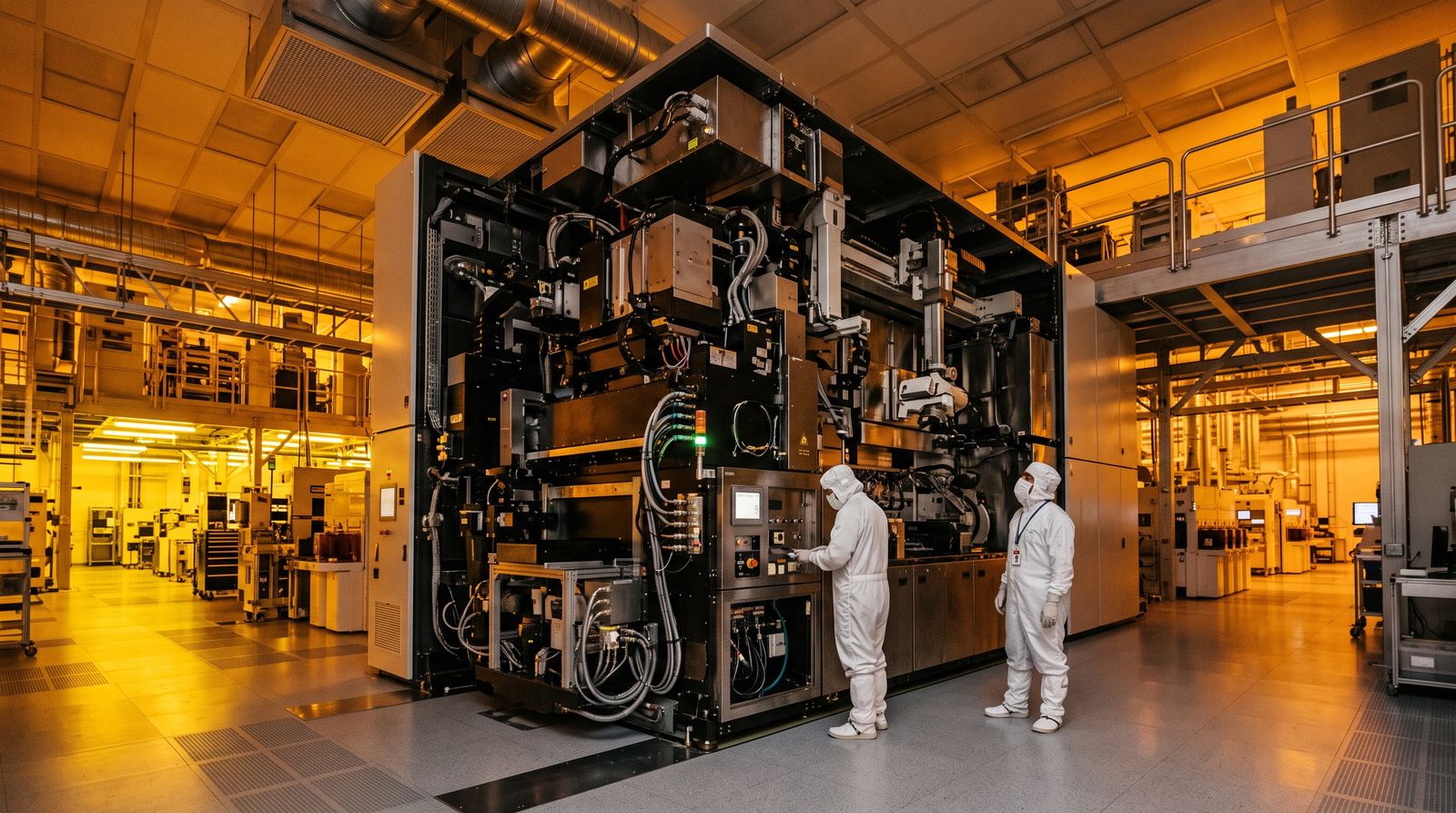
ASML makes the machines that make the chips that make AI possible — and on Wednesday morning it told the market the boom is accelerating, not cooling. Second-quarter revenue came in at €9.33 billion ($10.9 billion) against the €8.80 billion analysts expected, with net income of €2.92 billion versus a €2.62 billion consensus and a 54% gross margin. Beats are routine. What followed wasn’t.
The company raised its full-year 2026 revenue outlook to €43–45 billion, up from €36–40 billion — a 16% lift at the midpoint, and the second guidance hike this year. Gross-margin guidance moved up too, to 54–56%. CEO Christophe Fouquet called order intake “extremely strong” and said customers are accelerating capacity expansion across the portfolio. The company is adding roughly 30% more EUV output for 2027 — and says the orders to fill it are nearly all in hand, with another 30% step-up under study for 2028.
The timing mattered. Markets walked into Wednesday with IBM’s worst day since 1987 still on the tape and a live debate about whether AI capex is a bubble in search of a pin. ASML’s numbers land on the other side of that argument — and they rhyme with the customer one step downstream: TSMC’s June revenue hit a record NT$442.68 billion, up 67.9% from a year earlier, breaking a four-year seasonal slowdown pattern, with its leading-edge N3 capacity reportedly sold out through year-end.
Our take: Lithography is the longest-lead item in the entire AI supply chain. An EUV machine ordered today ships in a year and prints chips the year after — so ASML’s order book isn’t a bet on the AI buildout, it’s a photograph of one already committed through 2027. Hyperscalers can talk their capex up or down on earnings calls; a €250 million tool order is not a vibe. That’s the bull case. The flip side of the same fact: ASML just concentrated its year around AI demand, which means if the buildout flinches — a hyperscaler pause, a hard landing, an export-control shock in China — the most upstream company feels it first and loudest. The canary sings in both directions. For now, every verified data point this week — ASML’s raise, TSMC’s record June — says the same thing: the constraint on AI is still supply, not demand.
What to watch
- TSMC’s full Q2 report this week: the number that matters is capex — if the world’s biggest chipmaker lifts its spending plan, ASML’s raise gets a second confirmation.
- Q3 bookings: ASML’s guidance now leans on orders staying “extremely strong.” The next bookings print is the first place a wobble would show.
- China exposure: export-curb uncertainty is the one caveat ASML kept attached to an otherwise clean quarter. New rules would hit the non-AI half of the book.
- The buildout’s friction points: chips are only one input — power and permits are already becoming the binding constraint in parts of the U.S.