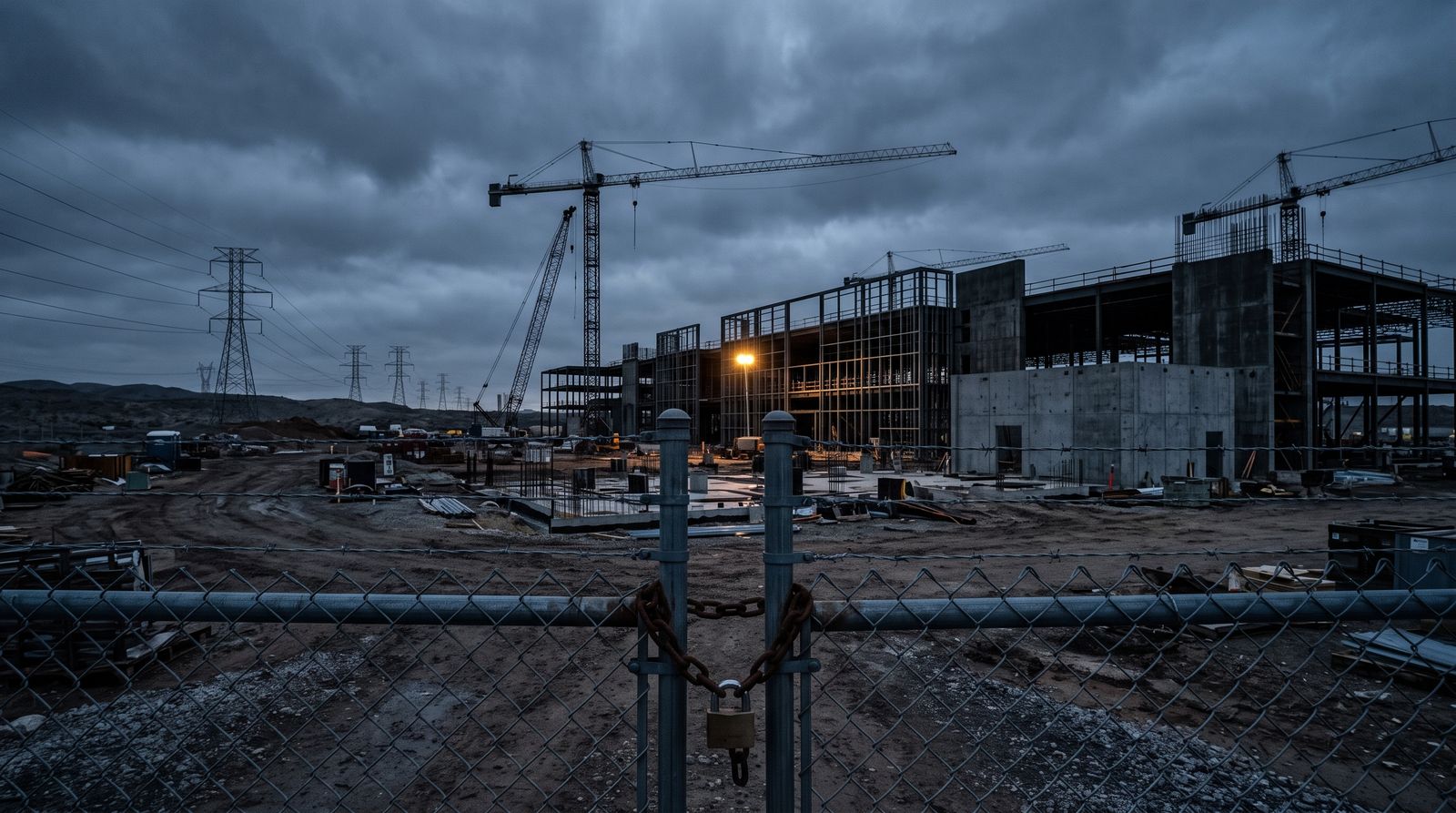
New York became the first U.S. state to freeze new hyperscale data centers on Tuesday. Executive Order 62, signed by Governor Kathy Hochul, directs the state’s environmental regulator to shelve permit applications for any new or expanded data center that can draw 50 megawatts or more — every application not already deemed complete now waits, for up to a year, while the state writes a Generic Environmental Impact Statement covering energy demand, water use, air quality and noise. Once those standards are final, the moratorium lifts and projects proceed under the new rulebook.
The number that explains the order: nearly 12 gigawatts of data center load requests were sitting in the New York ISO’s interconnection queue as of May — more than 8 gigawatts of it filed in 2025 alone. That’s not demand cooling off; it’s demand accelerating into a grid whose upgrade costs land on monthly bills. Hochul’s framing was blunt: “As data center development threatens to hike up utility bills, deplete our natural resources, and create uncertainty for New Yorkers, it’s my responsibility to take action and lead.” The scope is surgical, though. Local permits are untouched. Manufacturing, biomedical and quantum research, hospitals and universities are exempt — and so is Empire AI, the state’s own academic AI computing consortium. This freeze is aimed at one thing: the commercial AI cloud buildout.
The pause is the headline, but the durable part is the money architecture being assembled behind it. The state’s Energize NY proceeding already pushes large loads to pay their fair share or supply their own power. The order adds a proposed Grid Acceleration Fund — upfront capital contributions from data centers, plus an insurance pool against stranded assets if projects shrink or cancel. A Community Investment Framework, due within 60 days, will set the template for host towns to extract local benefits, prevailing wages and project labor agreements. And Hochul says she’ll pursue legislation to repeal sales tax exemptions for massive data centers statewide. The organizing principle running through all of it: beneficiary pays. It lands in a moment when the political backlash to AI’s costs is going mainstream.
Our take: This is the first state-sized template for making AI infrastructure pay its own way — and templates travel. The contrast with yesterday says everything: Meta doubled its Louisiana megasite to 5 gigawatts and $50 billion while New York just froze anything over 0.05 gigawatts. Capex flows where the answer is yes, and the AI map is now being drawn by utility regulators, not chip supply. Two outcomes are possible, and both matter for the trade: either the beneficiary-pays model spreads and the structural cost of compute rises — awkward for valuations already priced for cheap, unlimited scaling — or the buildout concentrates in a handful of yes-states, and grid access becomes the real moat. Either way, the binding constraint on AI has officially moved from chips to power — and the politics of the power bill just entered the room.
What to watch
- Copycat states. New York moved first with a mechanic — moratorium plus environmental review plus grid fund — that any high-cost-grid state can copy. Utility bills are voter-facing in a way AI policy never was; watch statehouses in the Northeast and on the West Coast.
- The clock. The Community Investment Framework is due in roughly 60 days, an interconnection working group forms on the same timeline, a transmission-owner report hits regulators in 90 days, and the full impact statement can take the entire year. Every deadline is a fight between developers and ratepayer advocates.
- The route-around. The order itself points to the exit: supply your own power. Watch whether hyperscalers respond with behind-the-meter gas turbines, batteries and dedicated generation — turning a permitting freeze into an accelerant for private energy buildouts.