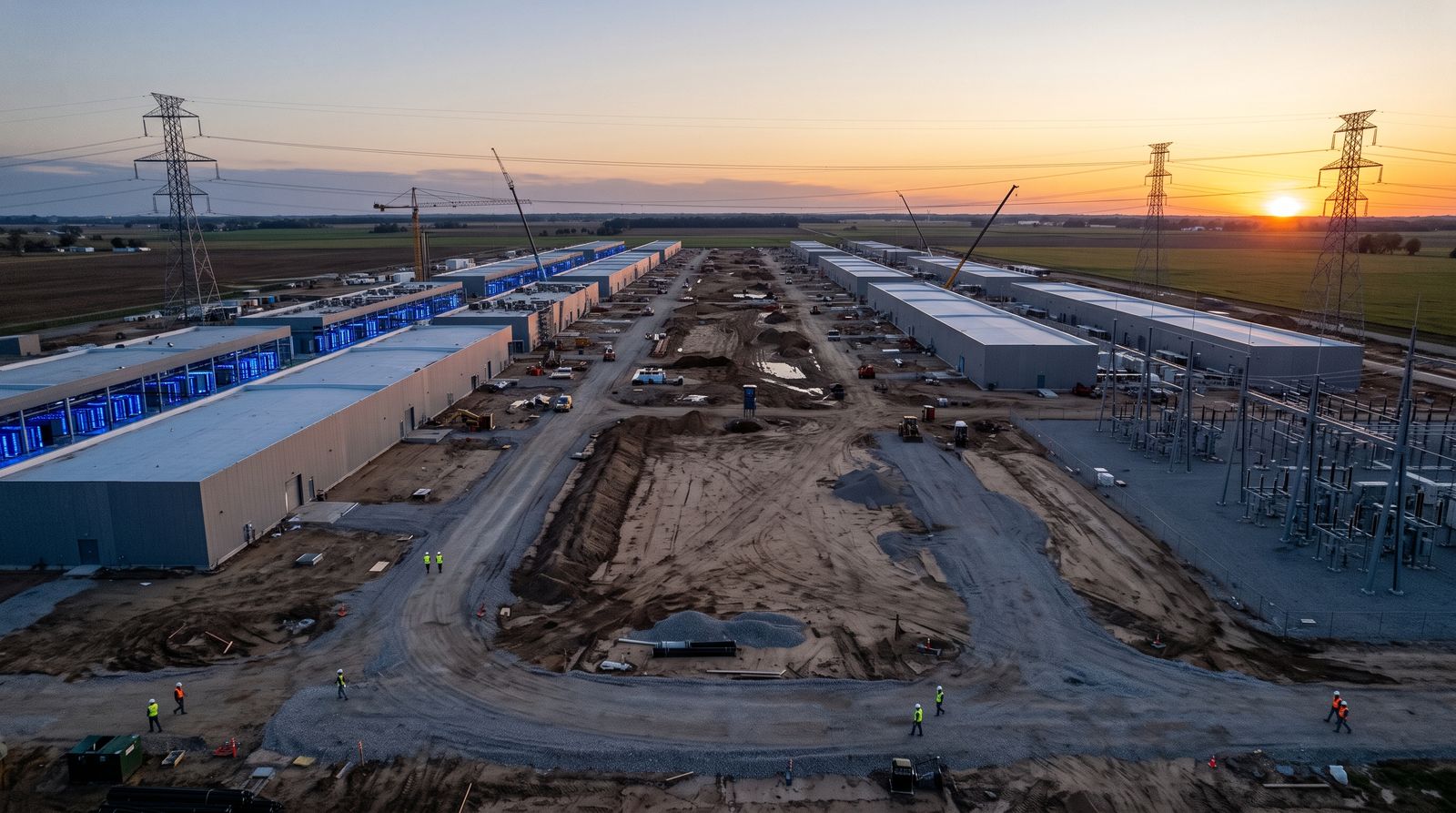
Meta said in a blog post on Monday that Hyperion — the data center it is raising out of farmland in Richland Parish, Louisiana — will be built out to 5 gigawatts of computing capacity at a cost of more than $50 billion. That is two and a half times the 2 gigawatts originally planned, on a price tag that has climbed from a roughly $10 billion project at groundbreaking to about $27 billion after Meta brought in Blue Owl Capital last October — and now north of $50 billion. The full campus should reach 2 gigawatts by 2030 and the complete 5 by around 2032.
The number that matters is the one measured in watts, not dollars. Five gigawatts is roughly the output of five nuclear reactors, or enough electricity to run several million homes — all of it pointed at a single company’s AI. Meta is pairing the build with more than $1 billion for local roads, water and schools, over 1,000 permanent jobs, and a stack of tax incentives tied to that hiring. Strip away the community sweeteners and what is left is a bet that the constraint on frontier AI is no longer the model. It is the power.
That is the through-line across every hyperscaler right now, and it is why the spending keeps outrunning last quarter’s estimate. The industry frames its ambition in benchmarks and parameter counts, but the checks it actually writes are for substations, transmission lines, cooling and concrete. Meta already told investors it would spend into the nine figures on compute even as it builds its own chip; a 5-gigawatt campus is what those dollars turn into on the ground. As one of our earlier reads put it, the truest AI benchmark may be the electricity bill.
Our take: The moat is moving from the model to the megawatt. Frontier models are converging — every few weeks a new one matches the last and someone undercuts the price — so the durable advantage goes to whoever can secure power, land and grid interconnection fastest, because none of that can be spun up on a training run. A 5-gigawatt site is a bet placed years ahead of the models that will fill it: Meta is committing $50 billion in 2026 for capacity that lands in 2032. That is either the most disciplined infrastructure play in tech or the largest speculative power purchase in history, and which one it turns out to be depends entirely on whether AI demand in 2032 is as bottomless as today’s capex assumes. Either way, the race is no longer won in a lab. It is won at the interconnection queue.
The risk sits in that same timeline. Build 5 gigawatts and you have to fill 5 gigawatts; if the demand curve bends even slightly, Meta is left holding a $50 billion power plant with nothing to compute. The picks-and-shovels winners are already visible — the contractors who wire and cool these sites, like the ones behind the scramble for data-center electrical capacity, have a customer for years. The question is whether the hyperscalers writing the checks have one.
What to watch
- Where the power comes from. Five gigawatts does not exist on Louisiana’s grid today. Watch the new gas plants, the utility deals and the interconnection fights — that is the real gating factor on 2032, not the buildings.
- The capex hole. Investors are increasingly nervous that hyperscaler spending is outrunning AI revenue. A $50 billion single-site commitment lands right on that anxiety.
- The 2032 bet. Meta is underwriting demand six years out. If usage compounds, it looks prescient; if it plateaus, this is a very expensive lesson in over-building.
- The copycats. Once one player commits to 5 gigawatts, the others match or look behind. Expect the next round of announcements to be measured in gigawatts, not dollars.