Weightlessness is the most aggressive detraining stimulus available to a human body. Remove the load of standing up and the heart has less blood returning to fill it, less work to do pushing it out, and — given long enough — less muscle with which to do either. Which makes the International Space Station an unusually clean natural experiment in whether structured training can hold a cardiovascular system together against a constant deconditioning pressure.
A study in Circulation from a team led by Northwestern Medicine, with UT Southwestern and UTHealth Houston, followed 13 astronauts through roughly six-month ISS missions, with echocardiograms before launch, during flight and after return. Crew members scanned one another every few weeks; ground teams read the images in near real time. Northwestern detailed the findings this week.
The first two weeks went as the physiology predicts: cardiac filling and stroke volume both fell. What happened next is the finding. Across the rest of the mission, both measures climbed gradually back toward their pre-launch levels — while the astronauts remained weightless the entire time.
The dose that held the line
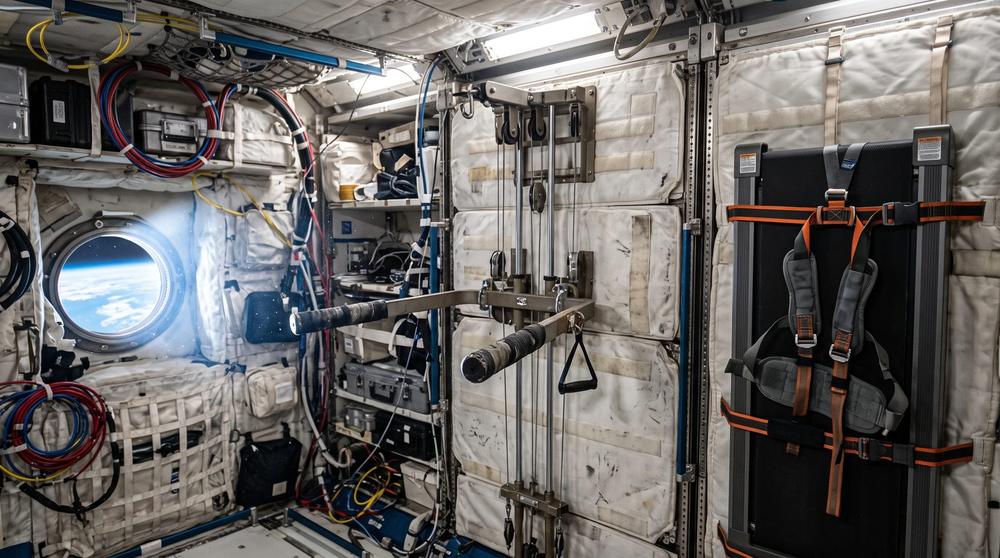
The crews were on NASA’s Exercise Countermeasures programme: up to two hours a day, split into 30 to 45 minutes of endurance work and 60 to 75 minutes of resistance training. Note the ratio. Roughly two-thirds of the daily training budget went to loading, not to cardio, in a setting whose defining problem is an absent load.
“You lose muscle mass and cardiac mass when you’re in a weightless environment,” senior author Dr James Thomas of Northwestern’s Feinberg School said. “To counter that, exercise is crucial when you’re in space.”
The payoff was measured on the ground. After return, astronauts were tilted 22 degrees head-up from lying flat, shifting blood toward the lower body to approximate the gravitational stress of Mars, which pulls at about a third of Earth’s. Their cardiovascular responses were comparable to their own upright standing responses before launch, with no significant signs of strain. Thomas’s read: “there is now reason to think that we would be able to traverse to Mars.”
Our take: ignore Mars for a second and look at what this is evidence for. Thirteen people were held under a relentless, unavoidable detraining stimulus for six months, given a prescribed and heavily supervised two-hour daily dose, and came out with cardiac function that recovered during the exposure rather than after it. That is the strongest available argument that deconditioning is a dose problem, not an inevitability — and the composition of the dose is the interesting part. The programme that protected cardiac structure spent most of its minutes on resistance training. Anyone treating strength work as optional garnish on an endurance base has the ratio backwards.
What to watch
- It is exploratory and observational. Thirteen astronauts, no control group, no randomisation. Nobody flew a crew without exercise to compare against, and nobody should.
- The Mars condition is a simulation. A 22-degree tilt on Earth is not one-third gravity, and the paper does not claim it is. It is a tolerable proxy for an orthostatic challenge, tested in a hospital rather than on a planet.
- Selection effects are enormous. These are professional astronauts: screened, conditioned and supervised to a standard no general population matches. The dose-response may not transfer at all to a sedentary adult.
- Surface work is untested. Tolerating a tilt table weeks after landing is a long way from doing physical labour in a suit after a months-long transit with no resupply.
- The next question is minimum effective dose. Two hours a day is what NASA can mandate. It is not evidence that two hours is what the job required.