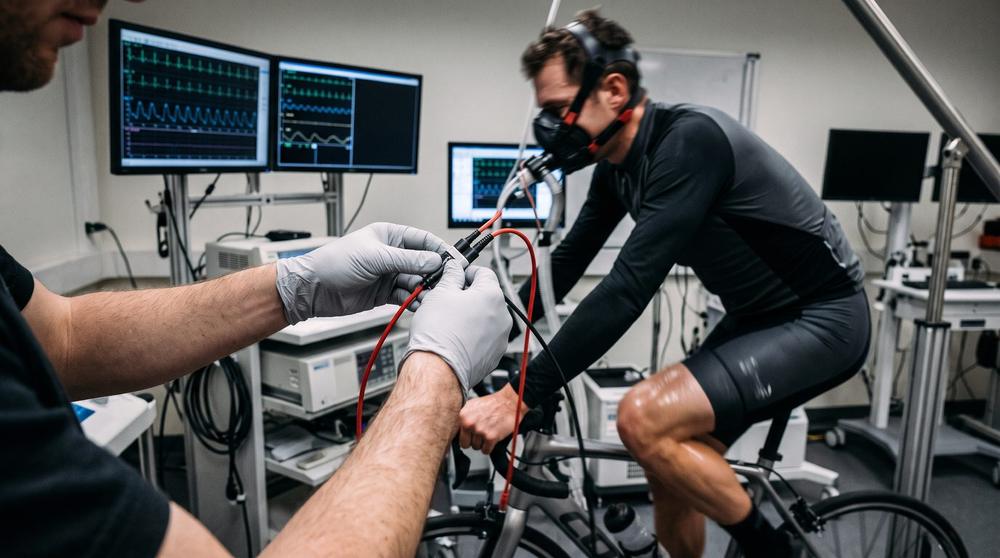
If you already train seriously, the question is not whether exercise raises aerobic capacity. It is which extra block of work, bolted on top of your normal sport-specific training, actually moves VO2max — and how much of it you need. A Bayesian network meta-analysis in Frontiers in Physiology pooled 61 randomised trials to answer exactly that, and then did something unusual: it graded its own evidence as low to very low certainty.
The pooled set covered 1,377 participants at the study-arm level across 60 trials in the main analysis, and 31 trials in the dose-response arm. All were healthy athletes, aged 13.5 to 47.2, with baseline VO2max between 35.3 and 81.0 mL/kg/min. Interventions ran four to 25 weeks. Eleven supplementary training methods were compared against a control group that simply carried on with normal training. The sample was male-dominant.
The five that beat carrying on as normal
Mean difference in VO2max against control, in mL/kg/min, with 95% credible intervals:
- Blood flow restriction training: 3.93 [0.60, 7.27]
- Intermittent hypoxic training: 2.74 [0.60, 4.84]
- High-intensity interval training: 2.71 [1.51, 3.93]
- Small-sided games: 2.56 [0.31, 4.79]
- Sprint interval training: 2.49 [1.25, 3.75]
The other six modalities did not clear the line. Blood flow restriction took the top SUCRA ranking at 0.857 — and look at its interval, which spans from barely-anything to huge. HIIT and sprint intervals had the tightest intervals and were the only two that held up consistently across sensitivity analyses.
Our take: The ranking and the reliability point to different answers, and the reliability is the one worth acting on. Blood flow restriction wins the leaderboard on a credible interval ten times wider than its own lower bound — that is a result built on few trials with scattered findings, not a method with a proven ceiling. HIIT and sprint intervals produce a smaller headline number you can actually plan around. A 2.5 to 2.7 mL/kg/min gain on top of existing training is real and unglamorous: roughly a 3–7% improvement for most trained athletes. Anyone selling you a bigger number is selling you the wide interval.
The dose numbers
This is the part the headlines skip. The dose-response analysis is expressed in METs-minutes per week — intensity multiplied by time — and the curves do not all point the same way.
- Sprint intervals peaked near 500 METs-min/week: 2.99 [1.10, 4.98]. Past that, the estimate did not keep climbing. More sprinting is not more aerobic capacity.
- Small-sided games peaked near 170 METs-min/week: 1.01 [0.01, 2.02]. A modest, low-volume effect, and the lower bound is almost zero.
- HIIT was largest at the highest dose observed — 1,400 METs-min/week, 4.43 [0.31, 8.83]. Note what that means: the curve had not turned over inside the range anyone studied, so the optimum is unknown rather than high. And the interval is enormous.
Network meta-regression found no clear effect modification by age, baseline VO2max or intervention length. Egger’s test found no significant small-study effects (p = 0.132), so this is not obviously a publication-bias artefact. The protocol was pre-registered (PROSPERO CRD420261360986) and the databases were searched on 3 April 2026.
How to use it
- Add intervals, not a new toy. If you are picking one supplementary block, HIIT or sprint intervals are the two with evidence that survived scrutiny. Everything above them on the leaderboard is ranked, not established.
- Cap the sprint volume. The sprint curve flattened around 500 METs-min/week. For most athletes that is two short sessions, not four. The extra two buy fatigue, not capacity.
- Treat the HIIT high-dose result as untested, not as a target. “Biggest at the highest dose studied” is a gap in the literature, not permission to double your weekly intervals.
- If you try blood flow restriction or altitude work, do it as an experiment with your own measurements. Both cleared the line on wide intervals and limited data. Both also carry practical and safety considerations that a pooled mean difference says nothing about.
- Expect single digits. Four to 25 weeks of added work on top of real training produced gains in the low single digits of mL/kg/min. That is what honest progress looks like for someone already fit.
What to watch
- The certainty grade. The authors call the evidence predominantly low to very low certainty. That is their own assessment, and it should discount every number above.
- Who was in the trials. Male-dominant samples, wide age band, baseline VO2max from 35 to 81 mL/kg/min. A pooled estimate across that range is a rough guide, not a prescription for a specific athlete.
- Replication for blood flow restriction. It holds the top ranking. A handful of adequately powered trials would either confirm a genuinely large effect or collapse it. Until those exist, the leaderboard position is the weakest claim in the paper.
The honest headline is not “blood flow restriction wins.” It is that two interval protocols reliably add a couple of points of VO2max to an already-trained athlete, the useful dose is lower than most people assume, and the sport-science literature is still too thin to rank the rest with confidence.