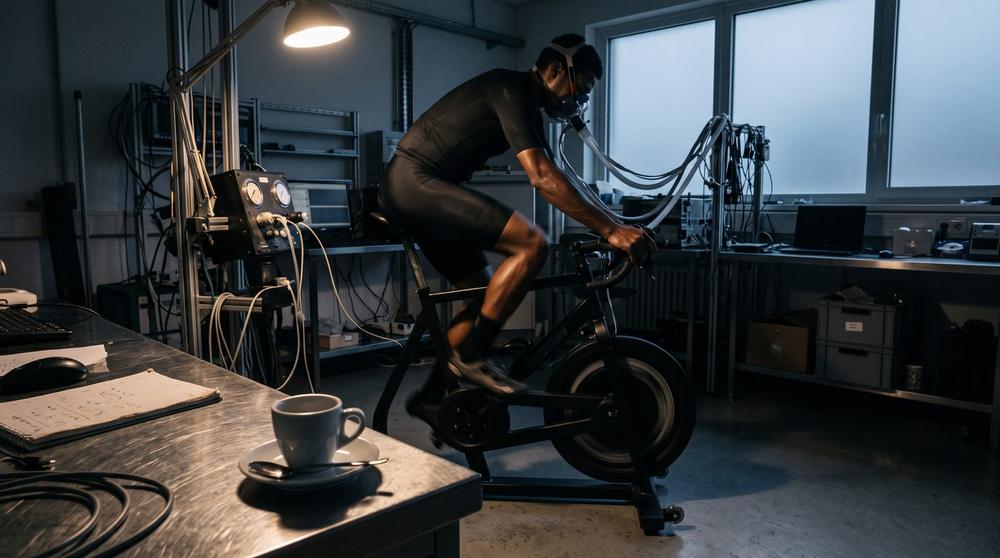
A University of Tsukuba group gave 12 healthy young adults 5.5 mg of caffeine per kilogram of body weight — roughly 374 mg for someone weighing 150lb — an hour before a 3.5-hour block of repeated cycling sprints, and found the performance benefit was still there at the end of it. The paper, Pre-Exercise Caffeine Enhances Repeated Sprint Performance and Alters Physiological and Perceptual Responses with Effects Lasting up to 3.5 h, was published ahead of print in Medicine & Science in Sports & Exercise on 1 September.
The design was two randomised, double-blind trials per participant, caffeine against placebo. Testing started about 60 minutes after the dose. Each set opened with five minutes of moderate cycling and then six five-second all-out sprints, repeated across the 3.5 hours. Mean sprint power came in 0.5% to 2.4% above placebo as reported, with peak power up to 3.7% higher in the second and third sets. Perceived exertion and leg muscle pain were both lower on caffeine. Plasma noradrenaline rose after sprinting, and mean blood velocity in the middle cerebral artery — a standard index of cerebral blood flow — fell.
Two things the study did not establish are worth stating plainly, because the coverage has blurred them. It did not identify when performance peaked, and it did not test whether the effect ends at 3.5 hours. The window was the longest they measured, not the longest that exists.
Our take: The standing advice is to take caffeine 45 to 60 minutes before the event, which quietly implies the benefit is a window you have to hit. This trial says the window is wide enough to cover a whole tournament day, a double session or a long race from a single dose — and that re-dosing at hour two may be buying side effects rather than watts. That is the useful finding, and it comes with two hard limits: twelve people, and a dose at the top of the studied range. 5.5 mg/kg is a lab dose chosen to produce a measurable effect, not a protocol anyone recommends; the authors’ own framing is preliminary. Effects of 0.5% to 2.4% are also the kind of margin that matters to a competitive sprinter and is invisible to everyone else.
What to watch
- Replication at a sane dose. The question that decides whether this changes anything is whether 3 mg/kg — the dose most athletes actually use — holds for the same 3.5 hours.
- The cerebral blood flow signal. Velocity fell in a major artery supplying the brain while performance rose. The study did not determine whether that is benign, and a 12-person trial cannot.
- Whether it survives a larger sample. A within-subject crossover is the right design for this question, which is the study’s real strength. Twelve participants is still twelve participants.
- The sleep trade. A dose that works for 3.5 hours of effort is also a dose still clearing your system late into the evening, and we have covered what short sleep does to the next day.