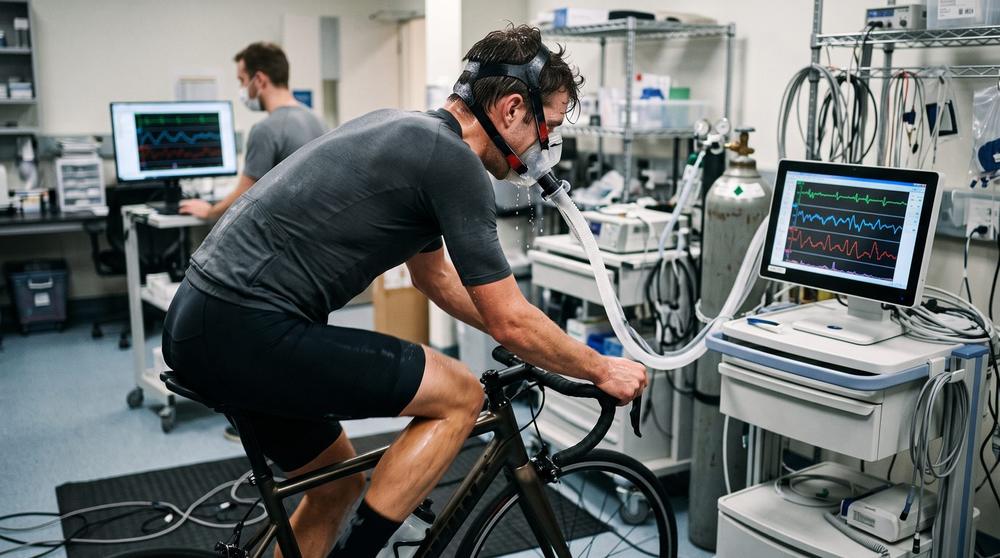
A Bayesian network meta-analysis in Frontiers in Physiology did the thing the training-add-on market never does: it put eleven supplementary methods in one model and ranked them against each other for VO2max in athletes who are already trained. Sixty-one studies screened, sixty randomised trials in the main network, 1,377 participants, thirty-one studies in the dose-response arm. The control condition was not rest — it was carrying on with normal sport-specific training.
Five of the eleven beat that control. Six did not.
Blood flow restriction came out on top at +3.93 mL/kg/min (95% credible interval 0.60 to 7.27). High-intensity interval training was +2.71 (1.51 to 3.93), intermittent hypoxic training +2.74 (0.60 to 4.84), small-sided games +2.56 (0.31 to 4.79) and sprint interval training +2.49 (1.25 to 3.75). Plain aerobic work, moderate-intensity continuous training, resistance training, high-volume training, polarised training and threshold training all failed to separate from control. Control itself ranked last.
The ranking and the certainty point in different directions
Blood flow restriction has the best rank score (SUCRA 0.857) and the widest interval in the table — a credible interval running from 0.60 to 7.27 is a result that could be trivial or transformative, and the authors say so explicitly. HIIT and sprint intervals have the narrowest intervals and the most direct trial evidence behind them, which is why the paper’s own conclusion names those two and not the winner.
That is the pattern worth internalising. In a network meta-analysis, rank order is a summary of probability, not of confidence. The modality you can act on is the one whose interval sits comfortably clear of zero, not the one at the top of the list.
Dose, where it was measurable
Dose was expressed in MET-minutes per week, and only three modalities produced a usable curve:
- Sprint intervals peaked around 500 MET-min/week at +2.99 (1.10 to 4.98) — an actual interior maximum, which means more is not better past that point.
- HIIT kept rising to the edge of the data, largest at 1,400 MET-min/week at +4.43 (0.31 to 8.83). The authors caution that this sits at the boundary of what was studied and is not evidence of a biological optimum.
- Small-sided games peaked near 170 MET-min/week at +1.01 (0.01 to 2.02) — a small effect reached cheaply.
Aerobic work, moderate continuous training and resistance training showed no significant dose-response at all. Network meta-regression found no effect modification by age, baseline VO2max or intervention length.
The exploratory subgroups are thin but coherent. In team ball sports, sprint intervals were +2.70 (1.17 to 4.23). In combat and racket sports, sprint intervals were +2.59 (1.20 to 3.99) and HIIT +2.46 (0.75 to 4.17). In endurance athletes — the group most likely to be reading this — hypoxic training ranked first but nothing reached significance against control.
Our take: The size of these effects is the headline. Two to four mL/kg/min on top of an already-trained athlete is real and it is small, and anyone selling a bolt-on protocol that promises more than that is selling something the evidence does not support. The practical read: if you already train your sport seriously, intervals are the add-on with the best evidence-to-effort ratio, sprint intervals saturate at a modest weekly dose, and the endurance-athlete finding — no modality clearly beating normal training — is the most useful null result in the paper. The authors grade most of the evidence low to very low certainty. Treat the table as a ranking of bets, not a protocol.
What to watch
- Whether blood flow restriction’s interval narrows. It is the only modality where more trials could plausibly move it from interesting to recommended. It also needs qualified supervision, which the rank number does not tell you.
- The MET-minute problem. The authors flag that MET-based dosing poorly captures internal load, especially for sprint work. Future analyses using session RPE or heart-rate load may reorder the dose curves.
- Female athlete data. The samples are male-dominant. Any subgroup conclusion here applies to the population that was actually studied.
- Replication in endurance cohorts. If the null holds, it reframes a large part of the endurance add-on industry.
Eleven methods, one model, and the clearest finding is how little room is left on top of training that is already good.