Most office-design research asks people how a room makes them feel. This one put electrodes on them. Corgan’s research group, working with the University of Arkansas, ran participants through open workstations and private offices while measuring brain activity by EEG, alongside wearable physiological sensors, cognitive testing, direct observation and self-report surveys. The study recruited people with inattentive-type ADHD on the reasoning that a brain which struggles to filter a room will reveal that room’s cost most clearly; the researchers say the findings apply to anyone working in one.
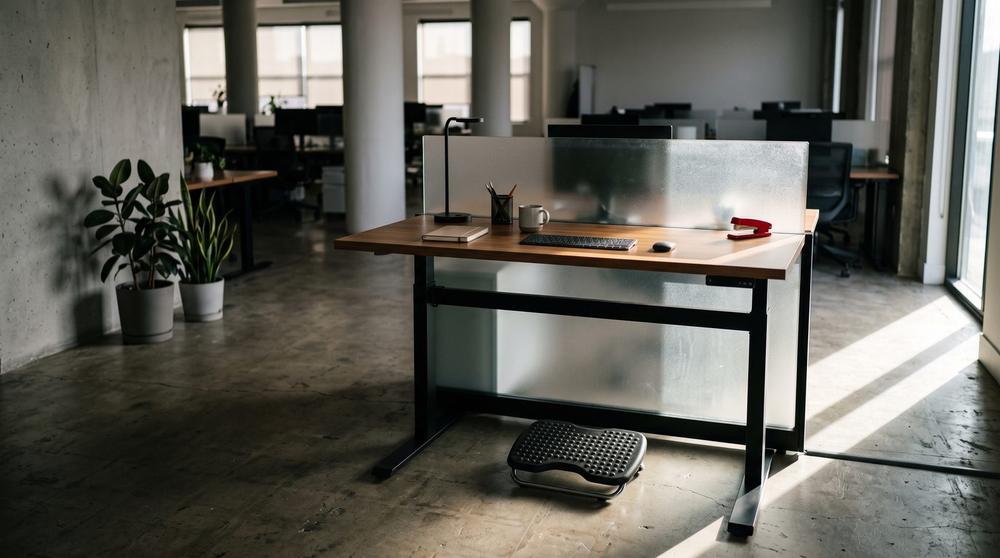
The headline result contradicts how firms actually spend money on focus. The lowest measured cognitive load did not come from the private office. It came from an open layout with visual boundaries — a partial screen, a half-height partition — and no full enclosure.
What moved the needle
- Light. Dim, indirect light produced calmer, less stressed, more focused participants, and EEG showed higher sustained attention under diffused lighting. Bright, direct light increased both distraction and eye strain.
- Orientation. Participants seated with their backs to activity reported 67% greater feelings of insecurity — while also reporting higher concentration. The two results point opposite ways, which is the finding: a layout can buy you focus and charge you for it in vigilance.
- Movement. Brief posture changes — a sit-stand shift, a footrest — supported comfort and attention. Continuous or exaggerated movement reduced both. Participants shifted and fidgeted on their own to regulate attention.
- The whole room. Acoustic hoods, scent and furniture were tested separately, but the researchers’ conclusion is that attention tracks the combined sensory environment rather than any single lever.
Our take: The useful idea here is that “focus space” and “enclosed space” are not the same purchase. A room with a door solves noise and solves nothing about the glare on your desk or the wall you are now facing. The cheap interventions in this study — turn the direct light down, put a low boundary at the edge of a desk instead of a full wall, give people something to change posture with — are the ones the instruments picked up. The expensive one did not win. Worth noting that the published write-ups do not state a sample size, so treat the 67% as a strong signal from a small, well-instrumented study rather than a population statistic.
What to do with it this week
- Audit your own desk for direct light. An overhead downlight and a bright window behind you are the two cheapest things to fix.
- If you sit with your back to a walkway, turn the desk. The study found the vigilance cost is real even when concentration holds up.
- Add a boundary, not a box. A low screen, a shelf or a plant at eye level beats a closed door you will not use.
- Build posture change in on purpose — a footrest, a standing interval — rather than relying on restlessness to supply it.
“Attention is a valuable commodity in today’s workplace,” said Emily Strain, who leads workplace interiors at Corgan. The research, funded through the AIA Upjohn Research Initiative, is the rare version of that sentence with instruments attached.