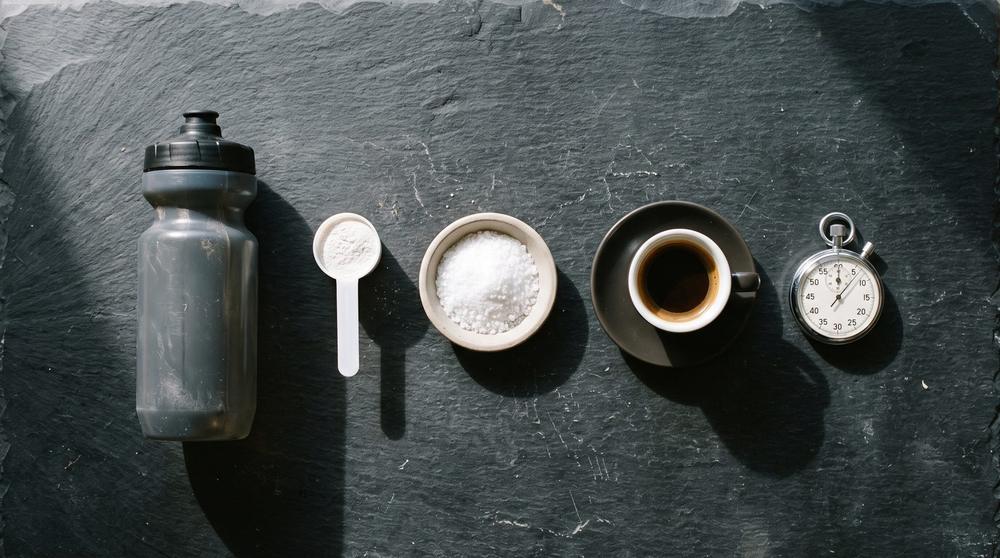
Caffeine works. Sodium bicarbonate works. The obvious move is to take both — one sharpens the central nervous system, the other buffers the acid that ends a hard effort, and the mechanisms barely overlap. Two separate 2026 meta-analyses went looking for the additive effect. Neither found one.
The newer of the two, published in Nutrients on 26 September, pooled 13 randomised crossover trials covering 192 participants. Against placebo, the combination produced a mean power difference of 8.43 watts (95% CI 1.85 to 15.00, p = 0.012) and time-trial completion times about 1.6% faster (ratio of means 0.984, 95% CI 0.970 to 0.998, p = 0.022). Both are real numbers. Both are also fragile: drop a single study from the power analysis and the effect loses significance (p = 0.160); drop one from the time-trial analysis and the same thing happens (p = 0.067).
Then the comparison that actually matters. Against caffeine alone, the stack was worth −2.91 watts (p = 0.738). Against sodium bicarbonate alone, 6.49 watts (p = 0.379). Neither is distinguishable from zero. The authors’ conclusion: “Current evidence does not establish an additional performance benefit over caffeine or sodium bicarbonate alone.”
Our take: The replication is what makes this worth acting on. Three weeks earlier, a Bayesian network meta-analysis in Metabolites — 13 studies, 181 participants, pre-registered on OSF — ran the same question with completely different statistical machinery and landed in the same place: caffeine alone 0.21, bicarbonate alone 0.21, the combination 0.28, all in Hedges’ g against placebo, with no credible difference between the three active conditions. Two independent teams, two methods, one answer. Where the combination did dominate was metabolism: it produced the largest blood lactate rise of any condition (g = 1.75) with no proportional performance gain. More measurable physiology, same stopwatch. That is the single most useful pattern in sports nutrition and almost nobody applies it — a bigger biomarker response is not evidence of a bigger result, and stacking supplements is the fastest way to generate the first while paying for the second.
The cost side is not zero
Gut tolerance is where the stack actually shows up. The Nutrients review could not pool the gastrointestinal data because the measures varied too much, so it synthesised narratively: against placebo, four studies reported more symptoms on the combination, five found no significant difference, three were descriptive only. Against caffeine alone, two studies reported more GI discomfort on the stack, at p = 0.011 and p = 0.005. GRADE certainty for the GI and perceived-exertion outcomes was rated very low.
There is a mechanistic hint in the Metabolites data too: caffeine on its own lowered blood bicarbonate (g = −0.89), which is the opposite of what you are buying bicarbonate for. Interesting, not conclusive, and not enough on its own to explain the missing additivity.
What this changes in practice
- Pick one and dose it properly. Both meta-analyses put caffeine and bicarbonate at essentially the same effect size. Choose on tolerance and logistics, not on expected gain.
- Stop treating a stack as free upside. The measured downside here is gut distress on exactly the days it costs most. An effect that disappears on single-study exclusion is not worth that trade.
- Test the combination on yourself before you trust it. These are group averages across 6-to-28-person trials. If you respond well to both, run it in training and keep the data; just do not assume the group result is hiding your personal one.
What to watch
- Bigger single trials. Both reviews are limited by having only a handful of studies per outcome, with prediction intervals crossing the null. One adequately powered trial would settle more than another meta-analysis.
- Women in the samples. The Nutrients pool was 152 men and 40 women. Nothing here supports a sex-specific claim either way, which is itself the finding.
- Delivery format. Most of the GI signal is likely a dosing-vehicle problem rather than a bicarbonate problem. If the enteric-coated and gel formats reproduce the buffering without the symptoms, the whole cost side of this calculation changes.