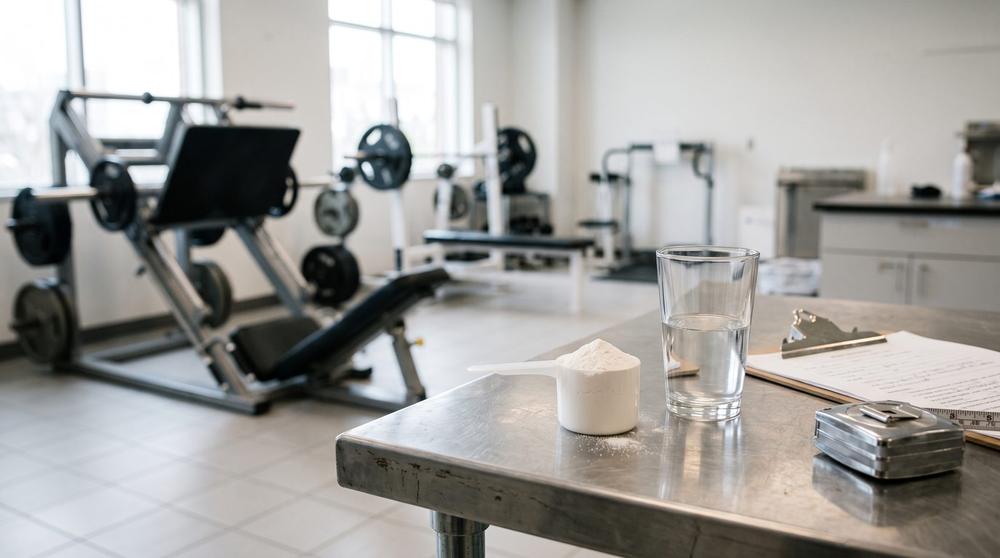
A 12‑week trial out of Texas A&M gave 64 healthy adults aged 45 to 65 ten grams of creatine monohydrate a day, split across four conditions: exercise or no exercise, creatine or placebo. The group that took creatine and did no structured training at all gained roughly 2.4 pounds of lean tissue and improved on both leg press and bench press.
No programme. No gym. Strength went up anyway.
The exercising arms did better, as you would expect. Creatine plus a training and weight‑loss programme added close to three pounds of lean tissue while cutting fat mass, with a larger drop in body‑fat percentage than placebo. Creatine plus training beat training alone on leg press, bench press and time to exhaustion. The findings were published in the Journal of the International Society of Sports Nutrition, with Texas A&M professor Richard Kreider as principal investigator.
What did not move
Aerobic capacity. Creatine added nothing to the improvement in aerobic fitness — the training did that on its own. This is consistent with what creatine is understood to do, which is buffer short, high‑output efforts rather than change how efficiently you use oxygen over time. If your target is a faster 10K, this trial is not about you.
And the design has a seam worth naming. Participants self‑selected into the exercise programme or the control condition, then were randomised to creatine or placebo within their group. So the creatine‑versus‑placebo comparison inside each arm is randomised and clean. The comparison between the exercising and non‑exercising arms is not — the people who chose to train were, by definition, people who chose to train. Sixty‑four completers is also a modest number once it is divided four ways.
Our take: The headline result is real and the caveat matters more than the headline. What this trial supports is narrow and specific: in middle‑aged adults, creatine appears to contribute to lean tissue and maximal‑strength measures even without programmed training, and to add to those measures on top of training. What it does not support is a shortcut. The no‑exercise arm gained 2.4 pounds of lean tissue; the exercise‑plus‑diet arm gained nearly three and lost fat. The supplement narrowed a gap it did not close. Anyone reading “muscle without the gym” is reading a press release, not a result.
The dose is the other story
Ten grams a day is roughly double the five‑gram maintenance dose most protocols use. Kreider’s own framing of why that matters is the most useful line in the coverage: getting ten grams from food “would require eating about five to 10 pounds of meat or fish each day.” That is the honest case for supplementation — not that the powder is magic, but that the dose the study tested is not reachable at dinner.
It also means this trial does not tell you what five grams does in the same population. The result belongs to the dose that was tested.
What to watch
- Replication with random assignment to exercise. The self‑selection seam is fixable, and until it is fixed the between‑arm numbers are directional.
- Whether the lean‑tissue gain holds past 12 weeks. Short trials catch the early slope, which is usually the steepest.
- Dose‑response work at five versus ten grams. This is the question most people actually have, and this trial does not answer it.
- Function, not just mass. Leg press and bench press are strength measures. Whether the same protocol changes stairs, chairs and carrying things is a different endpoint.
This is a research finding, not a recommendation — a supplement decision in your forties is a conversation to have with a clinician who knows your kidney function and your medication list, not with a study summary. But as evidence goes, a randomised placebo comparison inside each arm is a step up from the observational noise this category usually generates.