Brandon McNulty attacked with about 32 kilometres left of a 273.4-kilometre world championship and finished it alone, 13 seconds clear. It is the first time an American man has won the elite road race rainbow jersey in 33 years — Lance Armstrong in 1993 was the last. Michael Matthews took second, Mathieu van der Poel third. The winning time was 6:17:04.
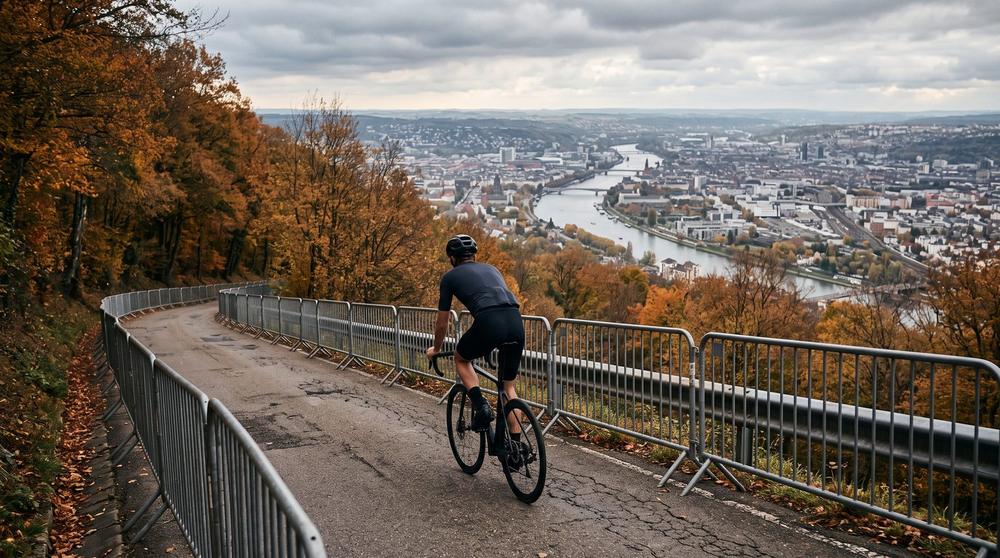
The course did what the course was built to do. Montreal had no mountain to offer, so it offered the same hill twelve times: a roughly 100-kilometre opening loop, then twelve laps of a 13.4-kilometre Mont-Royal circuit, with the Voie Camillien-Houde climb — 1.67km at 7.4%, pitching to 10% — coming round again and again. Total elevation gain: 3,803 metres. No single ascent on that parcours would decide anything. Forty of them, stacked, decided everything.
Thirteen seconds is the whole race
The margin is the interesting number. After six hours and seventeen minutes, McNulty finished with less than a quarter of a minute in hand. He built a lead of over a minute after the four-man break ahead of him was swept up, then watched most of it disappear over the closing laps. “Even in the last 300 metres, I really didn’t believe it. I was so tired,” he said afterwards. “But miracles happened.”
What kept him upright was not extra strength. It was the chase behind him, which contained several riders capable of closing 60 seconds and no agreement about who should spend the effort doing it. A world championship is raced by national teams, not trade teams, which is exactly why co-operation behind a solo leader tends to collapse: everyone in the group is a rival in eleven months of the year, and every turn on the front is a turn spent for somebody else’s sprint. Matthews was the fastest finisher left. That is precisely the reason nobody wanted to tow him.
Our take: The lesson here is not about legs, it is about incentives. McNulty won because he removed himself from a bargaining problem he could not win — he was never going to beat Matthews or van der Poel in a sprint, so he changed the question from “who is fastest” to “who will pay to catch me.” Once that is the question, a group of well-matched rivals reliably underpays. It is the same structure that makes committees miss deadlines everyone can see coming: the cost of acting is individual, the benefit is shared, and so the action arrives 13 seconds too late. Attrition courses like Montreal do not just tire people out. They shrink the front group until the collective-action problem is small enough to be fatal.
What to watch
- Whether the format sticks. A circuit-heavy world championship produced a solo winner from outside the sprint favourites. Expect organisers to notice what twelve laps of the same hill selected for.
- American depth. Ashlin Barry took the men’s under-23 title at the same championships. Two rainbow jerseys in one week is a signal about a pipeline, not a fluke week for one rider.
- Van der Poel’s read. Third after a race he could not control is a different result from third after a sprint. How he rides the next hard-attrition championship is the tell.
- The chase maths. A solo move from 32km out succeeding at world-tour level is unusual enough that riders will recalibrate how early is too early. That recalibration is what makes next year’s race.