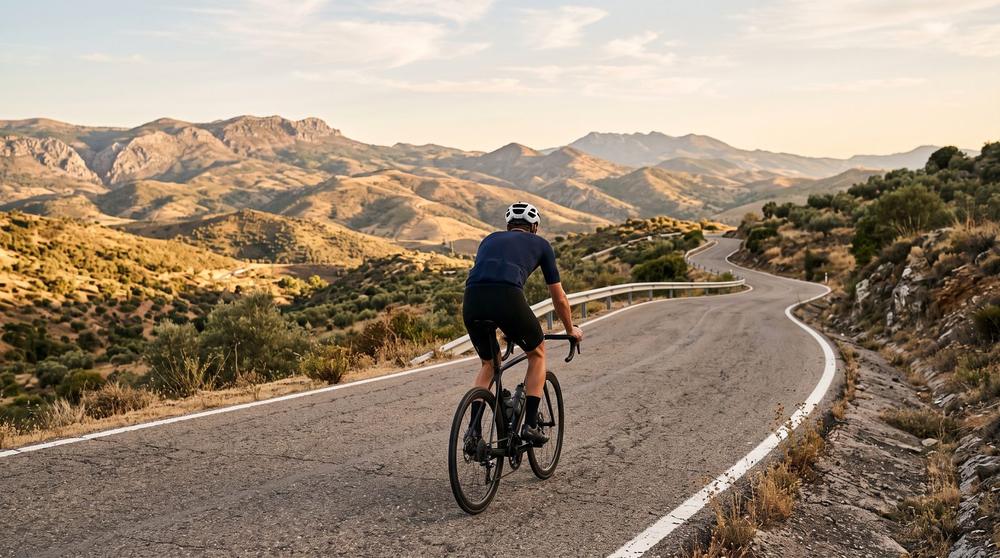
Enric Mas has finished second at the Vuelta a España three times. He first stood on that podium in 2018, aged 23, behind Simon Yates, and was immediately labelled the next Spanish Grand Tour winner. He was third in 2024. The label sat on him for eight years without converting.
It converted this week. Mas took the race lead and defended it through the decisive mountain stage 20, finishing 2:15 clear of Primž Roglič, with Felix Gall third at 2:44. The general classification was mathematically settled before the final stage rolled out of Armilla toward Granada — this year’s Vuelta ends beneath the Alhambra rather than in Madrid, on a short circuit that was always going to be a sprinters’ and stage-hunters’ affair rather than a GC one.
The tempting narrative is that something clicked. It is worth resisting. Mas is 31. The power numbers that produce a 2:15 Grand Tour margin are not meaningfully different from the ones that produced a two-minute deficit in 2021. The physiological ceiling of an elite Grand Tour climber moves very little between 26 and 31; what moves is everything around it.
Our take: This is a field-composition story dressed up as a breakthrough story. For most of Mas’s career he was the second-best climber in races that contained a generational one. Being reliably excellent in a field with an outlier gets you podiums and nothing else — and the honest lesson is uncomfortable: sustained near-misses are often evidence that your performance is fine and your timing is not. The practical response is not to train harder. It is to stay in the game long enough for the field to change, which is exactly what Mas did.
There is a version of this in most careers. The person who was almost promoted four times, the product that was second in every bake-off, the founder whose category was owned by one dominant player. The instinct is to read repeated second place as a character flaw and respond with more effort. Sometimes that is right. Often the more accurate read is that the distribution of competitors is doing most of the work, and the only durable strategy is to remain credible and present until it shifts.
What Mas actually did well over eight years was avoid the two exits that remove people from contention: he did not blow up chasing a win he could not get, and he did not drift out of the top tier. Sepp Kuss moving six places into the top five on stage 20 is a smaller version of the same principle — position held, opportunity taken.
What to watch
- Whether Movistar builds around him for the Tour. A first Grand Tour at 31 usually buys a team leadership mandate; the question is which race it is spent on.
- Roglič’s 2027 programme. Second at 2:15 is still a competitive ride, and his scheduling choices shape next year’s Vuelta field.
- The Granada finish. Replacing Madrid changes the race’s final-week calculus; whether it stays is an organiser decision with real GC consequences.
Eight years of nearly. Then one September where the maths finally fell his way — and he was still there to collect it.