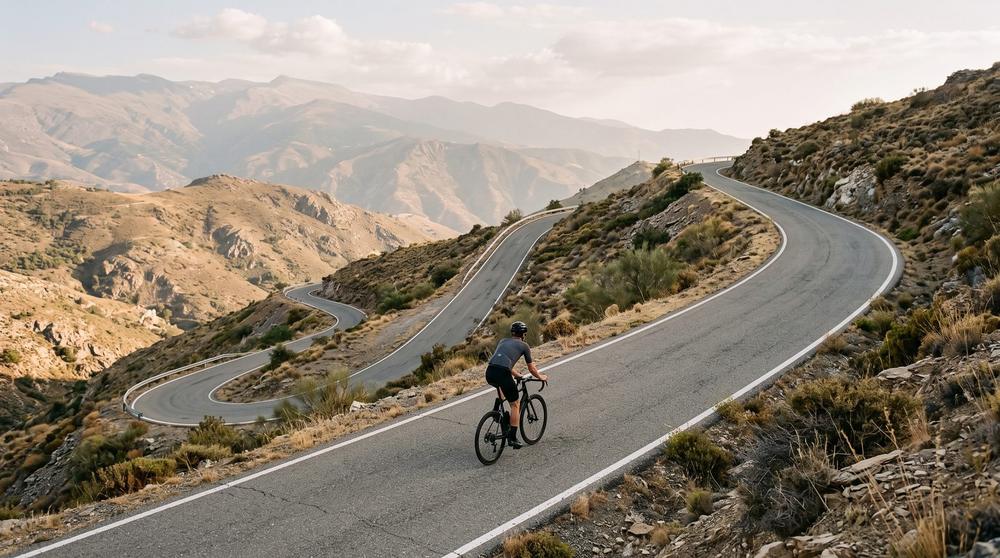
Mikel Landa rode away from the breakaway on the Collado del Alguacil on Saturday and soloed to his first victory in five years, closing out the 186.8-kilometre stage from La Calahorra with Tobias Halland Johannessen and Ramses Debruyne dropped somewhere on the slope behind him.
That was the emotional story. The arithmetic story happened six and a half minutes later, and it went the way almost nobody predicted on Friday.
Felix Gall attacked on the final climb, aiming at Roglič’s second place rather than the red jersey. Enric Mas went with him immediately. Primož Roglič — the rider everyone had spent a week expecting to detonate the race on this exact mountain — watched them go and rode his own tempo to protect the podium step he already had. Gall crossed 6:37 behind Landa, Mas at 6:54, Roglič 55 seconds behind Gall.
1:37 became 2:15
Mas lost 17 seconds to Gall and gained 38 on Roglič. He goes into Sunday’s ceremonial run into Granada leading by 2:15, with Gall third roughly another half-minute back. Barring a crash on a processional stage, Movistar’s Mas wins his first Grand Tour at home.
The interesting part is not that the leader held. It is how. Mas did not defend by riding defensively. He defended by following the fastest wheel on the mountain the instant it moved, which is the harder version and the one that produces a bigger margin at the top.
Our take: Roglič lost this Vuelta on the day he had every reason to win it. Nine kilometres at 9.8% is exactly the terrain that has decided Grand Tours in his favour for a decade — and when the decisive move went, he had nothing to answer with and made the correct, unglamorous call to bank second place instead. Three weeks of accumulated fatigue does not announce itself in advance. It just removes the option on the one day you needed it. Mas, meanwhile, gained time by responding to an attack that was not aimed at him: the whole race turned on 200 metres of reaction speed.
What the last mountain stage actually tested
Landa’s win is worth its own paragraph, because it is a different kind of result. A rider who had spent the season invisible got into the right move on the last day it was possible to get into one, and had the legs left to go alone on a climb averaging close to 10%. Breakaway wins on queen stages are not consolation prizes — they require reading three weeks of race dynamics correctly and picking the one day the GC teams will let a group go.
The GC group, by contrast, tested something narrower: who had rationed correctly. Gall had. Mas had. Roglič, on the evidence of Saturday, had not — or had spent it in the Jerez time trial and the stages before it.
What to watch
- Sunday into Granada is ceremonial for the general classification but not for the sprinters. The jersey is decided; the stage is not.
- Gall’s 17 seconds on Mas are the only marker of who was strongest on the last climb, and worth remembering when the 2027 Grand Tour favourites get listed.
- Whether Roglič’s ride reads as fatigue or as a deliberate trade of a long-shot win for a certain podium. The two look identical from the roadside.
Mas has led this race since before the time trial and never looked comfortable doing it. On the one stage designed to take it off him, he finished with more of a lead than he started.