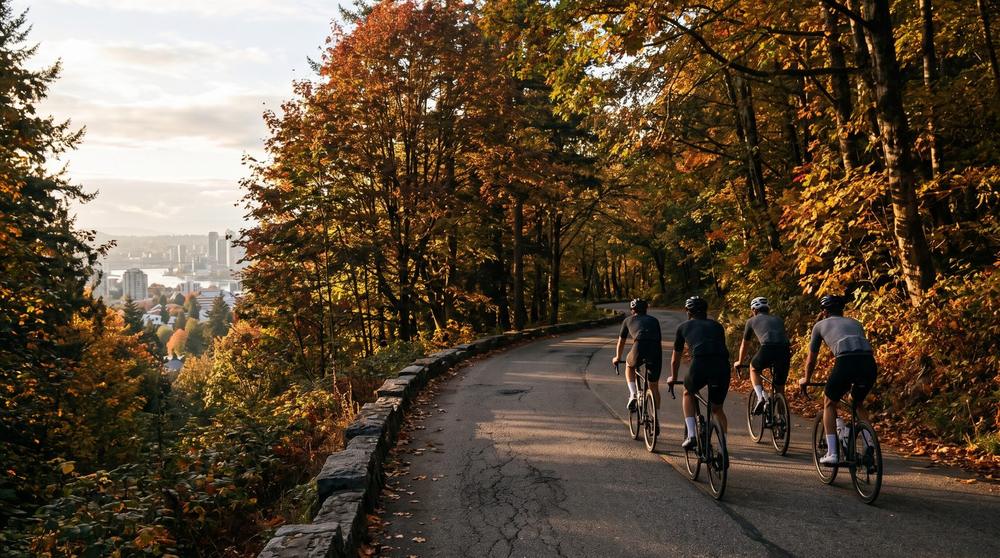
The elite men's road race at the UCI Road World Championships, which start in Montreal on Sunday, covers 273.7km with 3,803m of climbing. Neither number is the interesting one.
The interesting number is 269 — the metres of vertical gain in a single 13.4km lap of the Mount Royal finishing circuit. The race does that lap twelve times.
There is no mountain on this course. Camillien-Houde, the main sustained climb, is about 2.3km at 6.2%, with the hard section closer to 1.8km at 8%. Côte de la Polytechnique is shorter still, though it kicks above 11%. Any rider on the start list can ride either of those climbs comfortably on a Tuesday. The course is not asking whether they can. It is asking what happens on the eleventh repetition, after 220km, with the race already broken.
Our take: Circuit worlds and mountain worlds select different athletes, and the difference is not fitness — it is variance tolerance. A single 20-minute climb ranks riders cleanly by power-to-weight; twelve six-minute efforts rank them by how little they degrade between efforts. The winner in Montreal will almost certainly not be the strongest rider on lap one. Repetition is a fatigue test wearing a climbing test's clothes, and it rewards the rider who spent the season learning to produce the same number on the twelfth rep as the first.
The defending champion is not coming
Tadej Pogačar has confirmed his 2026 season is over after a crash at the Vuelta a España. He will not travel to Canada. A Worlds without the defending champion is a different race, and not only because the favourite is missing: his absence removes the rider whose presence normally dictates how everyone else structures their day.
The names now leading the conversation — Evenepoel, Del Toro, Seixas, Van Aert, Pidcock — represent genuinely different theories of how to win on this parcours. That is rarer than it sounds. Most one-day championships have a consensus tactic and an argument about who executes it best.
It is also a course that suits riders coming out of a hard grand tour rather than a fresh taper, which is why the Vuelta's final week and the repeated-effort racing in its closing stages are worth rereading as form guides.
Why cumulative beats magnitude
The training principle underneath this is not specific to cycling, and it is the reason the course design matters beyond the result.
- A single maximal effort tests ceiling. One long climb measures the highest sustainable output a rider can hold for that duration. It is close to a lab test performed outdoors.
- Repeated submaximal efforts test the floor. Twelve efforts at 90% measure how much the twelfth costs relative to the first — substrate depletion, thermoregulation, neuromuscular fatigue, and the accumulated cost of every acceleration out of every corner between climbs.
- The gap between those two is trainable, and separately. Riders who build only the ceiling arrive with a bigger number and lose it faster. This is why the winner of a circuit championship frequently is not the winner of that year's hardest mountain stage.
Montreal last hosted the Worlds in 1974. The organisers did not go looking for an alp, and the decision not to is what makes the week worth watching: a hard race built entirely out of easy climbs.
What to watch
- Lap times through Camillien-Houde. The degradation curve across the twelve ascents will describe the race better than the finishing gaps do.
- Whether the decisive move comes early — the usual response to a course with no single launchpad is to make the race long rather than sharp.
- Team sizes and how nations use them without a Pogačar to mark, which historically produces more chaotic, less controlled racing.
- Conditions. Late September in Quebec can deliver anything, and 273.7km in the rain on a twelve-lap circuit is a different event entirely.