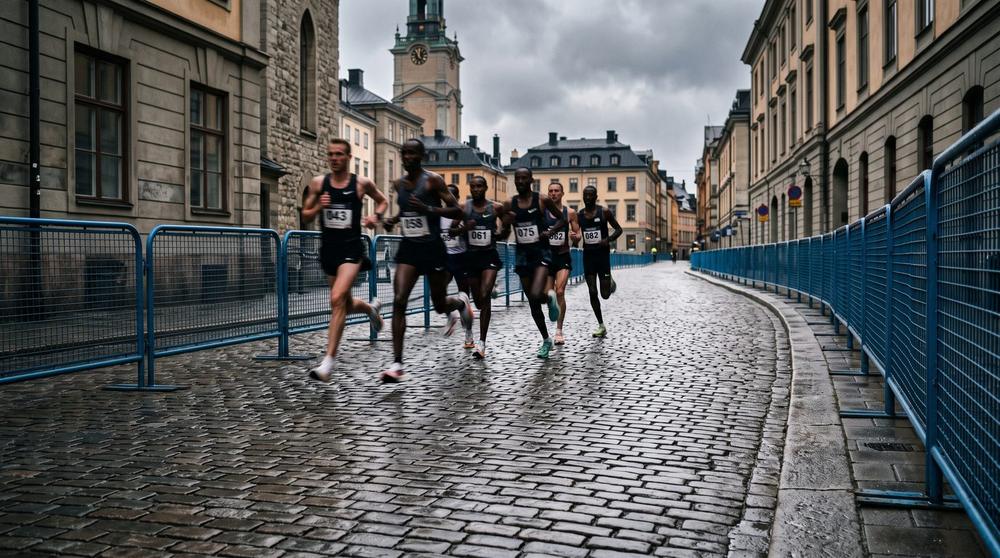
The World Athletics Road Running Championships open in Copenhagen on Saturday: 496 athletes, 270 men and 226 women, from 85 federations plus the Athlete Refugee Team, contesting three titles over two days. Half marathon, 5km, and — the reason to pay attention — a road mile.
The entry lists are serious. Yared Nuguse heads the road mile field with a career best of 3:51.90. France’s Jimmy Gressier, the world 10,000m champion, leads the 5km entries off 12:51 run in Lille in April. Kenya’s Nicholas Kipkorir tops the men’s half marathon with 58:08 from Lisbon earlier this year. Jakob Ingebrigtsen and Agnes Ngetich are both entered. Behind them, 65,000 amateurs will run the same three distances on the same closed streets.
That last number is the part most coverage will skip, and it is the structural idea the whole championship is built on.
Our take: Distance running’s problem is not talent, it is legibility. A marathon asks a casual viewer for two hours and gives them forty minutes of nothing. A championship road mile asks for four. No heats, no lanes, no split times to decode, one lap of a city, a winner. Pair that with a mass race on the same tarmac and you have built the only version of elite sport where the spectator can credibly say they did the same thing — which is exactly the loop that made parkrun and the big-city marathons enormous. The experiment worth measuring here is not who wins. It is whether a four-minute world title can hold an audience that will not sit through a half marathon.
The mile is a different event on the road
Track milers race a known geometry: same distance, same bends, same surface, a rhythm every athlete in the field has rehearsed since they were fifteen. A road mile has none of that. Courses vary by city, by camber, by corner count and by whether the finish runs uphill. Pacing judgement built over years on a 400m oval transfers imperfectly, which is why road-mile results reward athletes who race the field rather than the clock.
It also compresses the tactical error budget to almost nothing. In a 1500m final a bad first 200 can be repaired. Over a mile on closed roads, against a field this deep, it cannot. The interesting question in Copenhagen is whether the track specialists or the road racers have read that better — and Ingebrigtsen’s presence in a field led by Nuguse is the cleanest test available of how much a track rhythm is worth off the track.
What to watch
- Whether the mile goes out slow. A tactical, sub-56-second last lap does far more for the format than a time trial would.
- Gressier’s double intentions. The 5km and the mile reward opposite things.
- The Copenhagen course. The half marathon here is historically fast; flat and sea-level cuts both ways in September.
- Broadcast numbers for the mile versus the half. That comparison is the whole argument.