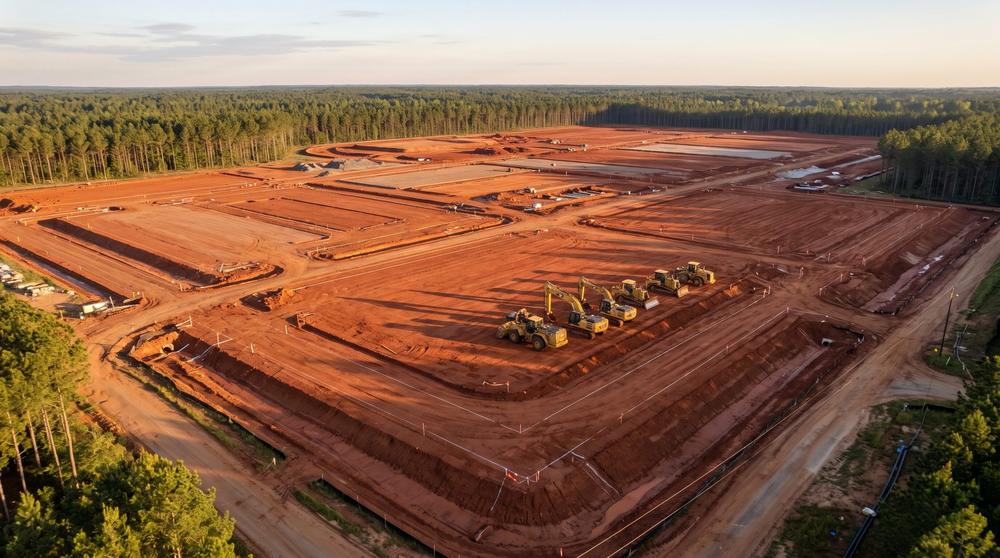
President Trump told a campaign rally in Perry, Georgia on Saturday that Audi will build its first American vehicle assembly plant near Macon, calling it “the single largest investment in U.S. auto industry history, modern history.” The figure he used was $4.2 billion. Audi’s own news release puts it at $4 billion.
Everything else lines up across both accounts. The site is expected to employ about 4,500 people and handle up to 200,000 vehicles a year. Construction begins in 2027. Production is targeted for the early 2030s. A US official who took part in the negotiations told Bloomberg that Volkswagen intends to assemble the Audi Q7, Q8 and Q9 there, and Audi chairman Gernot Döllner said the company will “bring our biggest and most premium SUVs and produce them here in Macon, Georgia.”
Volkswagen is separately adding roughly 25,000 units of annual capacity at its Scout Motors plant in Blythewood, South Carolina, for a model it has not yet named.
The payback case stands on its own
Audi has no US assembly today. It imports every car it sells here from Europe and Mexico, which made it one of the most tariff-exposed premium brands in the market. Reuters puts the cost of US tariffs to Audi at about €1.2 billion ($1.4 billion) last year. Global sales fell 7% in the first half of 2026; US sales fell 16%.
That is the arithmetic that matters. A €1.2bn annual tariff bill against a one-time $4bn build is a case that closes without anyone needing to agree about politics. Trump’s version — “Without tariffs, they wouldn’t be coming in” — is defensible as far as it goes. What it skips is the calendar.
The calendar is the story
No vehicle leaves Macon before the early 2030s, and no concrete is poured before 2027. For the payback case to hold, the tariff schedule that justifies the plant has to survive two more election cycles. The announcement itself landed ten days before the 3 November midterm, in a state where the Senate race is rated likely Democrat and Jon Ossoff leads Mike Collins by more than eight points in the RealClearPolitics average.
Toyota’s $3.6bn San Antonio truck plant, announced in July, has the same shape: roughly 2,000 jobs, completion targeted for 2030. These are real projects with real steel attached. They are also announcements whose political value is banked this week and whose jobs arrive next decade.
Our take: The $200m gap between Trump’s number and Audi’s is the smallest problem here. The real one is that a plant starting in 2027 and producing in the early 2030s is being underwritten by a tariff regime nobody can guarantee past 2028. Audi is hedging a trade policy, not a car market — and a hedge that takes six years to install has to be right about politics, not products. Treat the jobs number the way you would treat any capacity announcement: as an intention with a decade of optionality attached.
What to watch
- Volkswagen Group’s capex plan. Whether the $4bn appears as incremental spend or as capacity reallocated out of Europe and Mexico. Those are very different stories for the plants losing the volume.
- The Georgia incentive package. State and local terms have not been published. That number usually lands weeks after the photo opportunity.
- The Q9. It is not on sale. A plant built around three SUVs, one of which does not yet exist in the market, is a bet on the large-premium segment holding through 2032.
- USMCA. Hyundai has tied future investment to clarity on it and Honda has raised trade-policy concerns. The review is the shared variable under every one of these announcements.