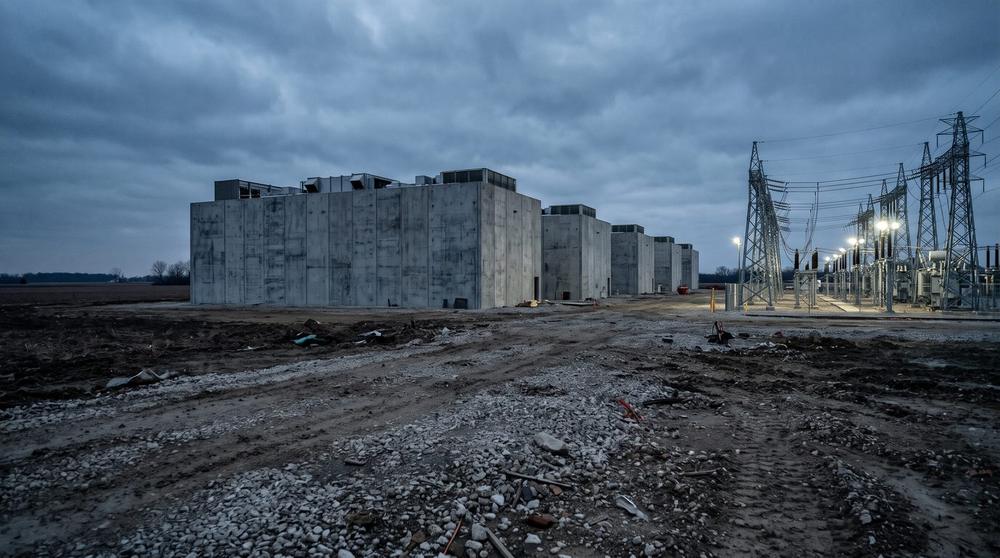
Blackstone Digital Infrastructure Trust said Monday it will buy a majority stake in a portfolio of Amazon Web Services data centers valued at about $5 billion. The $5 billion figure and the 75% stake appear in four separate accounts — Reuters, a CRE Daily report carried by Yahoo Finance, a Seeking Alpha summary and a write-up of the company’s Q3 earnings call. Reuters puts the stake at 75.1%; the other three round it. Amazon keeps the remainder and leases back every building.
The shape of it: two joint ventures with AWS, structured as a sale-leaseback, with Amazon as both partner and sole tenant. Thirteen newly built powered shells, more than two-thirds of them in Northern Indiana and the rest in Mississippi. A going-in cap rate of 7%, a GAAP yield of 8.1%, rent escalators of 2.75% a year, and an initial lease term of 12 years extendable to 32. Each of those figures clears two independent sources. Closing is expected by year-end, subject to customary conditions.
BXDC’s own share is $3.7 billion: roughly $1.9 billion of cash — described on the call as effectively all of the proceeds from its May 2026 listing — plus $1.9 billion of asset-level debt. That lifts implied leverage to about 49%, against a stated long-term target of 40%. This is the REIT’s first investment.
Our take: A 7% going-in cap rate on a $5 billion portfolio implies something close to $350 million of first-year rent. That is our arithmetic, not a disclosed figure, and the only reason it has to be arithmetic is that nobody has published the rent. Meanwhile the deal is the fund. A REIT that lists in May, holds cash for six months, then puts all of it into one tenant, on one transaction that management confirmed was negotiated directly with Amazon rather than competitively bid, has not assembled a portfolio. It has assembled a single credit exposure wearing a real-estate costume. What makes that defensible is the full Amazon parent guarantee running the length of the lease — and that detail is sourced to the earnings call and nowhere else.
The megawatt number does not survive contact with a calculator
One figure from the call puts the portfolio at about 50 megawatts. Divide $5 billion by 50 MW and you get $100 million per megawatt, which is an order of magnitude above what powered shell space has traded for in any disclosed comparable. One of three things is true: the 50 MW refers to something narrower than the portfolio’s capacity, the figure is wrong, or the $5 billion is buying something other than shells. The company said the purchase basis sits more than 50% below estimated turnkey replacement cost and that rents are more than 70% below comparable turnkey assets — both single-sourced, both pointing the opposite way. None of this is reconciled anywhere in the coverage, and the megawatt figure has exactly one source.
What was not disclosed
- Annual rent, in dollars. Not in any account.
- Price per megawatt, and how $5 billion divides across thirteen buildings.
- Gross IPO proceeds. The only reference is that about $1.9 billion of cash is “effectively all” of them.
- An exact closing date — “by year-end,” “late in the fourth quarter.”
- Lender identities and final debt terms. The mortgage assumption given was SOFR plus mid-to-upper 100 basis points, single-sourced.
- The campus count. One account describes thirteen shells across two AWS campuses; the call summary calls all thirteen campuses. Thirteen is consistent. What a campus is, is not.
What to watch
- Whether rent in dollars appears when the first filing covering this deal lands.
- Whether the 50 MW figure is restated, clarified, or quietly dropped.
- The path from 49% leverage back toward the 40% target, and what gets sold or issued to get there.
- Q1 2027, which management named as the first clean read on earnings. No 2027 guidance was given.
- A possible fourth-quarter special dividend to satisfy REIT distribution rules, which the CFO said is not a run-rate proxy.
For the wider pattern of capacity commitments being announced faster than their economics are disclosed, see our notes on AirTrunk’s $11 billion and the gigawatts “signed or under review” and the guarantee buried in Nvidia’s footnote.