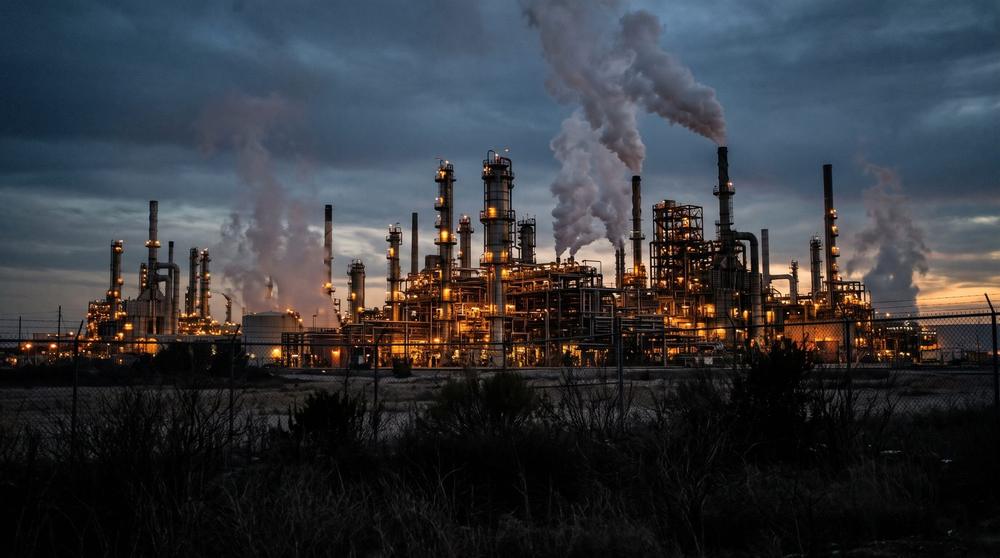
Chevron’s downstream division — refining and marketing — earned $4.93 billion in the third quarter. A year earlier it earned $1.14 billion. That is 4.3 times the profit from turning crude into fuel, and it happened in a quarter when Chevron pumped less oil than the year before.
Production fell to 3.98 million barrels of oil equivalent per day, from 4.09 million a year ago and 4.07 million in the second quarter. The company attributes the drop to “lower entitlements from higher prices and impacts from the Middle East conflict.” Average Brent in the quarter was $97 a barrel — down from $104 in Q2, though well up on $69 a year ago.
So: fewer barrels, a lower average crude price than last quarter, and net income of $9.92 billion against $3.54 billion a year ago. The barrels are not doing this. The refineries are.
Where the money actually came from
Chevron’s US downstream earned $3.59 billion, up from $638 million a year earlier. International downstream earned $1.35 billion against $499 million. Year to date, downstream has made $8.98 billion versus $2.20 billion over the same period in 2025 — a four-fold swing in nine months.
The plants ran flat out to get it. US refinery crude unit inputs hit 1,093 thousand barrels per day, which Chevron calls a record, at “nearly 98 percent” crude unit utilisation. Meanwhile upstream earnings fell sequentially to $5.70 billion from $8.18 billion in Q2.
Exxon reported the same morning with adjusted earnings of $4.23 a share, ahead of estimates. Reuters reports that Exxon is now generating more income from refining than from upstream for the first time in at least six years — a reversal that would have been unthinkable for an integrated major two years ago. Exxon ran its US refineries near maximum utilisation too; AP reports its Gulf Coast plants at 100% utilisation and second-highest-ever Gulf Coast diesel output.
Our take: this is a scarcity margin, not an operating achievement. Refining is printing money because fuel-making capacity has been knocked out — Reuters cites attacks on refineries in Saudi Arabia and Russia and the effective closure of the Strait of Hormuz — while demand did not move. Both companies are behaving as though they agree: Chevron cut net debt by $7.8 billion in the quarter and Exxon by $8 billion, rather than converting the windfall into bigger buybacks. Balance sheets, not promises. That is what a company does when it thinks the margin is temporary.
The tell is in the capital allocation
Chevron spent $4.0 billion of capex in the quarter, down from $4.4 billion a year ago, which it attributes largely to lower Permian spending. It generated $16.0 billion of operating cash flow and $12.0 billion of free cash flow, declared a $1.78 quarterly dividend payable 10 December, and cut total debt by $3.5 billion. Exxon said it will repurchase $20 billion of stock in 2027 — matching, not exceeding, the pace of the prior two years.
Read that again. Record refining margins, and capital spending goes down while debt is repaid at the fastest clip in years. CFO Eimear Bonner’s framing, per Reuters: “We think in decades, not quarters.” She also told Reuters that Brent swung from as low as $68 to as high as $132 inside the quarter — which explains the reluctance to extrapolate.
The companies are visibly aware of the politics. US diesel is around $6.32 a gallon, up roughly 71% year over year on AAA figures cited by AP, four days before the midterms. Exxon CFO Neil Hansen: “It’s important to acknowledge that these higher fuel prices put real pressure on families and businesses.”
What to watch
- Capacity coming back. Refining margins mean-revert violently once damaged plants restart. Nobody has published a restart timetable.
- Whether capex stays down. If majors won’t build refining capacity into record margins, the shortage is structural.
- Policy risk. A diesel export ban was reportedly considered in September and declined in October. Fuel at $6.32 keeps it on the table.
- Chevron’s international downstream. Refined product sales there fell 9% on Middle East supply disruption — margin covered it this quarter.
Shares rose modestly premarket — Exxon about 1.9%, Chevron 1.1%, on AP’s figures. A restrained reaction to a quarter like this is the market agreeing with management: the earnings are real, and the reason for them is not.