Shell reported third-quarter adjusted profit of $10.81 billion on Thursday morning, against a $10.33 billion analyst consensus and $5.43 billion in the same quarter last year. It is the company’s best quarter since 2022. The buyback goes to $5 billion for the next three months, up from $3 billion — the second largest Shell has announced. Shares rose about 3.2% in early London trade.
The quarter was not won in the oil field. Shell’s oil and gas production is down 17% over the first nine months of the year, mainly because of disruption in Qatar. Pearl GTL, its gas-to-liquids plant there, has been running at reduced output since being halted by an attack in March, and Shell says repairs could take about a year.
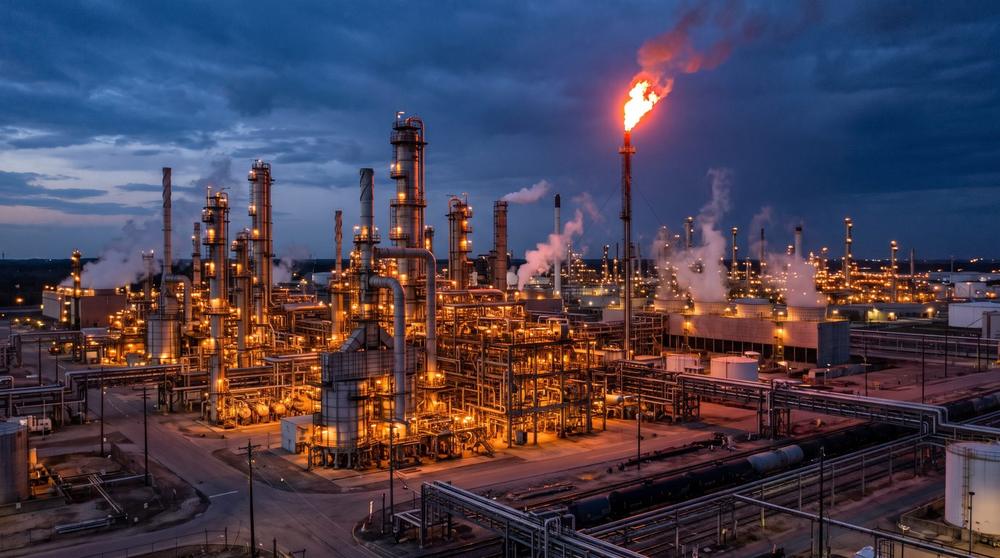
It was won in the refinery. Shell’s indicative refining margin was $42 a barrel in the quarter, against $11.60 a year ago and $24 in the second quarter. The previous peak, in the 2022 energy crisis, was around $28.
The downstream broke its own record
- Chemicals and Products: segment profit of $3.855 billion — a record for the downstream business. Refinery utilisation ran at 96%.
- Integrated Gas: $3.037 billion, up from $2.7 billion in the second quarter, on realised gas prices of $8.30 per thousand cubic feet against $7.20.
- Cash: $21.0 billion of operating cash flow and $16.3 billion of free cash flow. Excluding working capital, operating cash flow was $21.7 billion against $12.24 billion a year ago, and against roughly $18.2 billion expected.
- Balance sheet: net debt down to $39.7 billion from $41.8 billion; gearing 16.6% from 18.7%. The dividend is unchanged at $0.3906 a share.
Shell also took roughly $2 billion of impairments on European biogas assets, including assets acquired in the 2023 Nature Energy deal, and absorbed $5.4 billion of non-cash increases to shipping leases, which count toward net debt. And it cut capital expenditure guidance for the year, to $23–25 billion from $24–26 billion.
Our take: Read the capex cut and the buyback raise together, because they are the same decision. A refining margin of $42 against a prior all-time peak of $28 is not a demand story — it is a missing-capacity story, the consequence of refining and specific crude grades being taken offline rather than of the world consuming more fuel. Shell knows a margin set by absent capacity reverses when the capacity returns, so it is not reinvesting the windfall at the top of the cycle. It is handing the cash back. That is the right call and also an admission: management does not believe these margins last. Note the shape of it — profit nearly doubled while production fell 17%. Companies are not usually paid more for producing less.
It is the whole sector, not one company
TotalEnergies reported the same morning with adjusted net income of $9.1 billion against $4.0 billion a year earlier and roughly $8.3 billion expected. Its refining margin was $33.20 a barrel, also close to a quadrupling, and its refining and chemicals arm posted a record $3.6 billion — more than five times last year and double the prior quarter, on refining throughput up nearly 10%. Gearing fell to 9.1% from 13.1%. It reiterated $2.5 billion of buybacks for the fourth quarter and added $2.5 billion for the first quarter of 2027.
Austria’s OMV also posted its strongest operating profit since 2022. European energy shares rose about 1.9% on the prints. BP, Chevron and ExxonMobil report Friday, and the read-across is now obvious: whoever has the most refining capacity running has the best quarter.
That is a different market from the one the crude headlines describe. Brent at $116.72 was a shipping-risk story, and the divergence between Murban and Brent showed the market pricing specific grades, not barrels in aggregate. Refining margins are the same phenomenon one step downstream: the constraint is not supply of oil, it is the ability to turn particular oil into particular products in particular places.
What to watch
- Friday’s US majors. Exxon and Chevron have more refining exposure than BP; if the $42 margin shows up in their numbers too, this is a structural capacity shortfall rather than a European quirk.
- Whether $42 holds into the fourth quarter. Shell guided refinery utilisation to 92–100%. The margin, not the utilisation, is the swing factor.
- Pearl GTL. A roughly year-long repair means the production drag persists through most of 2027.
- Integrated Gas volumes. Fourth-quarter guidance of 1,080–1,180 thousand barrels of oil equivalent per day against 772 thousand in the third quarter, boosted by the ARC Resources acquisition. That is where the production line starts to recover.
- The payout ratio. RBC expects Shell to miss its 40–50% guidance for the year given abnormal macro conditions — worth watching if margins normalise while the buyback is already committed.
The energy majors are having their best year since the 2022 crisis, and they are spending less, not more, while it happens. Compare that with EQT paying a 20.6% premium for Range Resources: in gas, the bet is on structural demand growth. In refining, nobody is building for it.
This is reporting on company results and commodity markets. It is not investment advice.