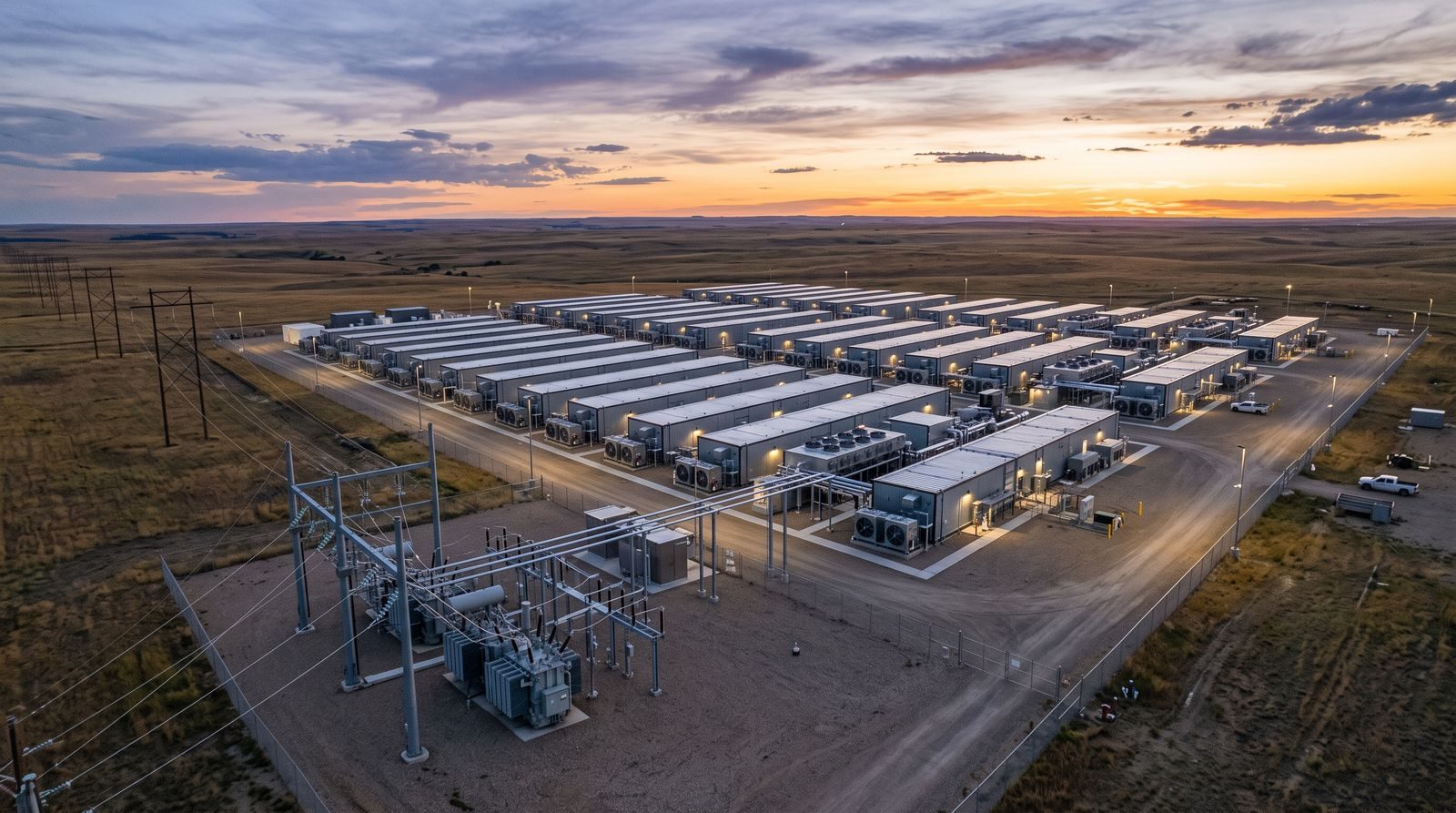
Crusoe has closed a Series F of more than $3 billion at a post-money valuation of roughly $30 billion, co-led by Atreides Management and Valor Equity Partners with Mubadala Capital participating. That is three times the $10 billion mark the AI data-center developer carried in October, when it raised $1.38 billion. Ten months, 3x.
The number that explains the number is a different one. Bloomberg reported on 3 September that Crusoe had signed a five-year cloud contract worth approximately $13 billion to supply GPUs and adjacent AI infrastructure to Jane Street. The contract is commercial, not financing — but it landed in the middle of the raise, and it is the reason the round priced where it did.
Crusoe already counts Meta, Microsoft and OpenAI among its customers. Those are the names you expect on an AI infrastructure logo slide. Jane Street is not.
The buyer is the signal
Every large compute contract disclosed in the past eighteen months has been a lab renting capacity to train and serve models, or a hyperscaler renting capacity to resell. Both are bets on the AI market growing. A proprietary trading firm buying $13 billion of GPU capacity over five years is a different bet: that the compute pays for itself inside Jane Street's own P&L, in a business where the returns are measured daily and the CFO is not writing a strategy memo.
That is the first genuinely large non-lab, non-hyperscaler anchor tenant we have seen at this scale. It says the demand curve for frontier-grade compute has widened past the people building models to the people using them on their own book.
Our take: The valuation is the least interesting fact here. A $30 billion mark on a private data-center developer is a story about capital availability. A quant fund committing $13 billion over five years is a story about unit economics — someone with an unusually short feedback loop between spend and return decided the maths works. Watch which category of buyer signs the next one. If it is another firm that marks its own book to market, the AI infrastructure trade has a second leg that does not depend on model-lab funding rounds continuing.
What this costs to build
Crusoe's model is vertical: it develops the sites, brings the power, and operates the cloud on top. That is capital-hungry in a way pure GPU resellers are not, which is why the equity raise and the contract are joined at the hip. $3 billion of fresh equity against a $13 billion revenue commitment is roughly the ratio you would expect for a build-to-suit developer levering up against contracted cash flows.
The risk is the same one every AI data-center balance sheet carries: the contracts are five years, the assets are longer, and the GPUs inside them are shorter. Depreciation schedules on accelerators are the live argument in this sector, and a $13 billion contract does not settle it.
What to watch
- Contract disclosure. The $13 billion figure is reported, not filed. Terms — take-or-pay versus consumption, ramp schedule, hardware refresh obligations — decide whether it is $13 billion of revenue or $13 billion of intent.
- The next non-lab buyer. One quant fund is an anecdote. Two is a category, and it re-rates every private compute provider in the market.
- Power, not chips. Crusoe's edge has always been siting and energy. The constraint on the next $30 billion of valuation is interconnect queues, not GPU allocation.
- The October comparison. A 3x in ten months on the back of one contract is how private marks get fragile. If the Jane Street ramp slips, the $30 billion is the number that moves.
The AI infrastructure market spent two years being priced off what the labs would pay. It is now being priced, at least partly, off what a trading desk will pay. That is a healthier demand base — and a much harder one to forecast.