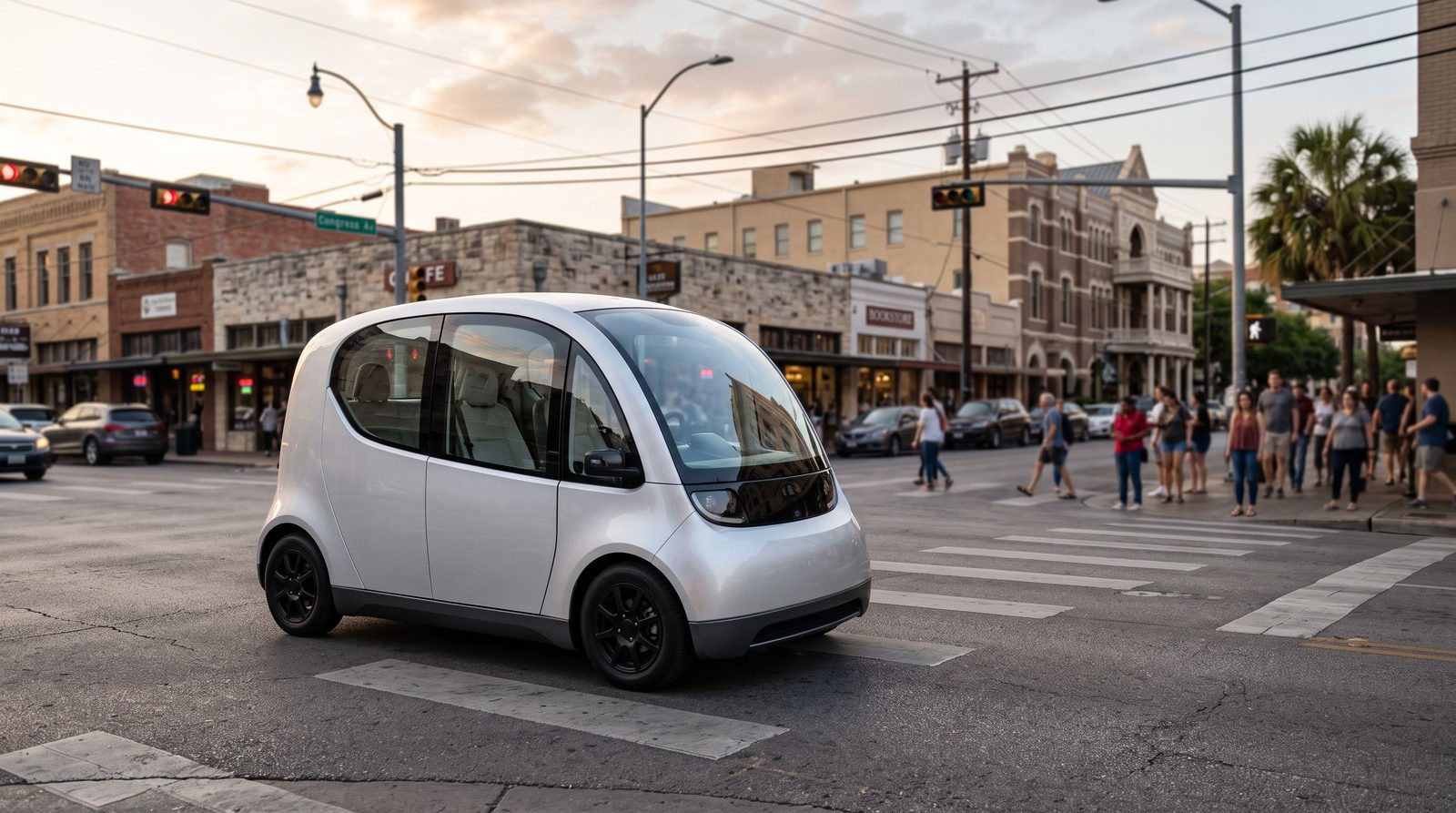
Tesla put its first Cybercabs on public streets in Austin this week — two-seat vehicles with no steering wheel, no pedals and no mirrors permanently fitted. Within hours, the National Highway Traffic Safety Administration opened an investigation into whether roughly 1,000 of them were properly certified.
The probe is not about a crash. There is no incident to point at. NHTSA says it will examine the process and technical data Tesla used to certify the vehicles — specifically, whether Tesla was correct in deciding that certain Federal Motor Vehicle Safety Standards simply do not apply to a car with no driver controls.
Tesla notified the agency that it had certified the Cybercab as compliant with all applicable standards. The entire dispute lives inside that one word: applicable.
How US vehicle safety actually works
Unlike the European type-approval model, where a regulator inspects and blesses a vehicle before it can be sold, the United States runs on self-certification. The manufacturer attests that its vehicle meets the federal standards. NHTSA audits afterwards and can force a recall if the attestation was wrong.
That system is efficient and it works fine when the standards clearly apply. The problem is that most of the FMVSS catalogue was written on the assumption that a human sits in the front-left seat holding a wheel. Requirements for steering column displacement, mirror placement, brake pedal force, occupant protection in a driver position — the text presumes controls that a Cybercab does not have.
So a manufacturer building a vehicle with no driver controls faces a genuine interpretive question, and under self-certification it gets to answer that question itself, then start selling rides. NHTSA’s move is the audit arriving on day one rather than year three.
Our take: this is a governance story dressed as a car story. Tesla has not been accused of building an unsafe vehicle — it has been asked to show its working on a legal interpretation it made unilaterally. The precedent matters far more than the outcome: if a company can self-certify its way past standards it judges inapplicable, the American regulatory model is faster than anyone’s. If NHTSA disagrees, the remedy is a recall of a fleet that is already carrying passengers.
Why the timing is the aggressive part
Companies building purpose-built robotaxis have generally had two options: petition for an exemption and wait, or design the vehicle so the question never arises — keep the wheel, keep the pedals, remove the driver. Waymo took the second road. Tesla has taken neither.
Deploying first and answering questions afterwards compresses the timeline enormously if it works. It also concentrates the downside: a fleet on the road is a recall liability, an insurance question and a headline risk in a way that a fleet in a depot is not. Tesla has effectively converted a regulatory delay into a regulatory bet.
For everyone else in the sector, the read-through is uncomfortable in both directions. If Tesla’s interpretation survives, competitors who waited for exemptions have handed over a year or more of market position for nothing. If it does not, the regulatory reaction is likely to be a tightening that applies to all of them.
What to watch
- Whether the probe escalates. An audit query is routine. An upgrade to an engineering analysis, or a demand that operations pause, is not.
- Which specific standards Tesla deemed inapplicable. That list, once it becomes public, is the whole argument.
- Texas and Austin-level response. State and municipal permission is separate from federal certification, and it can be withdrawn much faster.
- Fleet expansion. Tesla has said it will scale gradually to more vehicles and more cities. Whether it keeps scaling while the file is open tells you how confident the legal read is.
The Cybercab is a bet that the rules written for cars with drivers do not bind a car without one. That may well be right. It is now going to be settled in a docket rather than a press release.