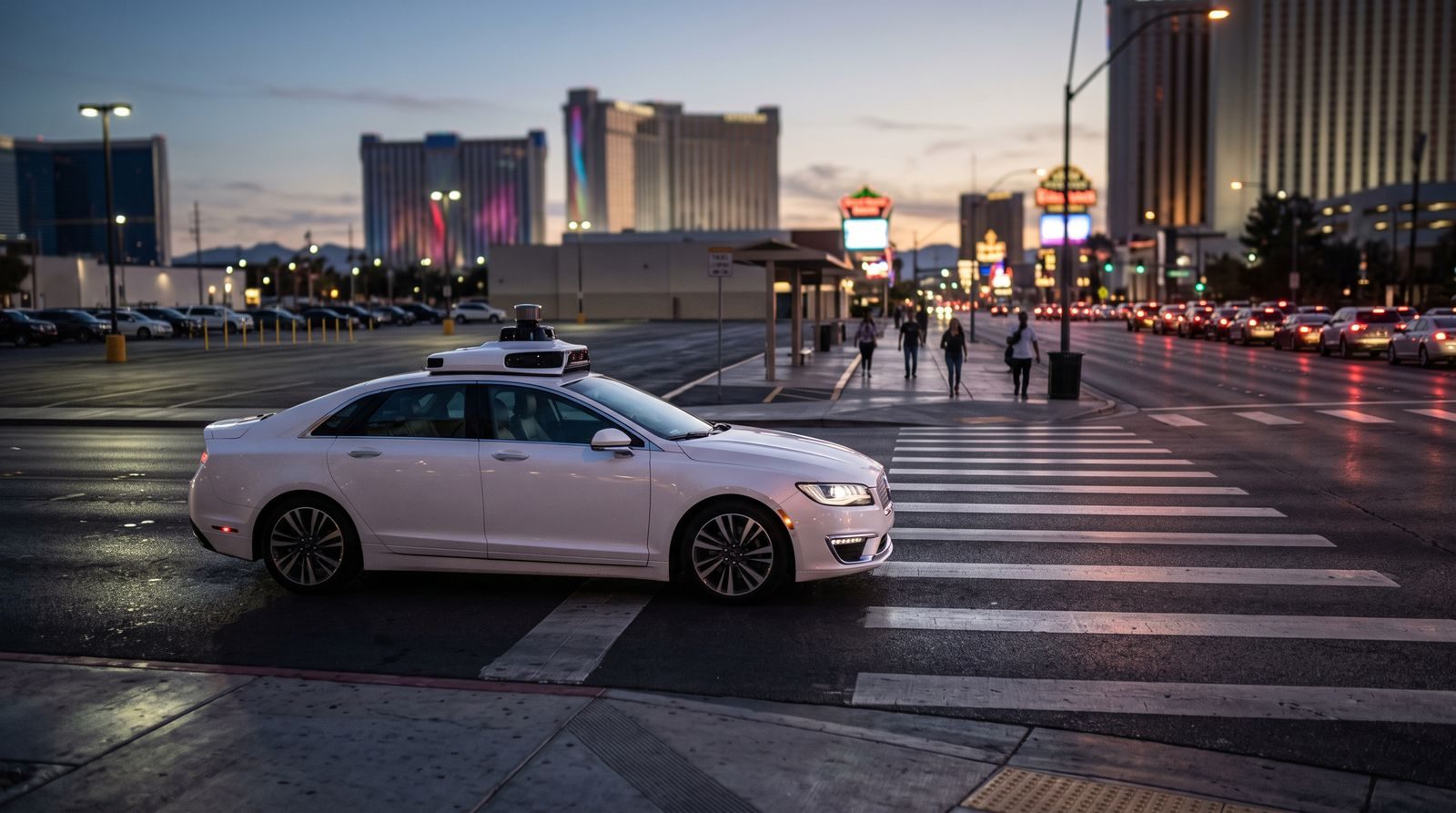
The Nevada Transportation Authority unanimously approved three commercial robotaxi permits on Thursday, clearing Tesla, Uber and Waymo to run paid driverless services across Clark County — Las Vegas and everything around it. Tesla’s permit allows up to 5,000 vehicles over the next 12 months. Waymo got 1,000. Uber got 1,000, which it will run through its partners Motional and Zoox. Zoox already holds a separate permit good for 100.
Add the named allocations and you get 7,000 vehicles, plus Zoox’s hundred. Most coverage rounded the headline to “up to 8,000.” Either number is the largest single robotaxi authorisation any US metro has handed out.
And the man responsible for building Tesla’s share of it spent the hearing talking the number down.
The ceiling is not the fleet
“The 5,000 has always been a ceiling for us,” Eric Early, Tesla’s Cybercab chief engineer, told the meeting. “I don’t think we’ll be in a position by this time next year to deploy 5,000 vehicles, and it’s not [because of] the technology. … I think we would be extremely happy and satisfied if we could get ourselves up to 2,500, maybe a bit higher than that in the next year.”
That is the company’s own engineer cutting the permitted number in half before a single car is delivered, and explicitly saying software is not the binding constraint. Manufacturing, depots, charging, cleaning and remote-support staffing are.
The gap gets wider when you look back three weeks. Nevada regulators signed off on Tesla’s earlier autonomous-vehicle permit on 27 July with a fleet cap of ten cars — against an application that asked for 5,000 across all of Clark County. That permit also geofenced Tesla to a regulator-approved slice of the Strip, capped top speed at 45 mph, banned pickups at Harry Reid International, required a visible “robotaxi” label and required passengers to be told they were riding without a driver.
So inside four weeks the same regulator went from ten vehicles to a five-thousand ceiling. Neither number describes how many driverless cars will actually be circling the Strip next August.
Our take: Regulatory approval has quietly stopped being the bottleneck in autonomy, and almost nobody has updated their mental model. For a decade the story was “the tech works, the rules don’t allow it.” Nevada just allowed it — and the operator immediately said it cannot build that fast. Permits are free to issue. Vehicles, depots and technicians are not. Watch the delivered fleet count, not the permit ceiling. The two will diverge for years, and the ceiling is the number that gets into headlines.
Who is actually fighting this
Opposition at the hearing came from the incumbents, not from safety groups. Kimberly Maxson-Rushton, a lawyer representing the Livery Operators Association, said the applications raised “two grave concerns”: “One deals with the oversaturation of the commercial transportation industry as a whole in Nevada. And the second one deals with the overcrowding of the roadways, and specifically the Golden Triangle.”
The Golden Triangle — the wedge between the airport and Las Vegas Boulevard — is where nearly all of the AV testing has happened so far, and it is also where the highest-value fares are. Motional has been testing downtown and at Town Square as well. Vegas is now the first city where Tesla, Waymo and Uber’s partners are all licensed to chase the same rider on the same streets in the same year.
Uber is playing a different hand. It has spent months lobbying for hybrid networks that mix human drivers with robotaxis, and repeated the pitch at the hearing: phase vehicles in to cover peak demand rather than flooding the market. That is a hedge. If Uber’s autonomous partners lag Tesla and Waymo, the rule it wants keeps human drivers — and therefore Uber — in the middle of every ride.
What to watch
- Delivered vehicles, quarterly. Tesla’s own guidance is 2,500 “maybe a bit higher” in twelve months. Anything under 1,000 by mid-2027 means the manufacturing constraint is worse than stated.
- Whether the Strip geofence and the 45 mph cap survive. The earlier permit’s restrictions are what make airport runs — the most lucrative trip in the city — impossible. Airport access is the real prize.
- Clark County driver employment. Taxi and rideshare headcount is the cleanest available measure of whether robotaxis add jobs or subtract them, and Vegas will produce the first honest data set.
- Whether other states copy the ceiling-with-no-floor structure. It is politically cheap: regulators look permissive, and the operators self-limit anyway.