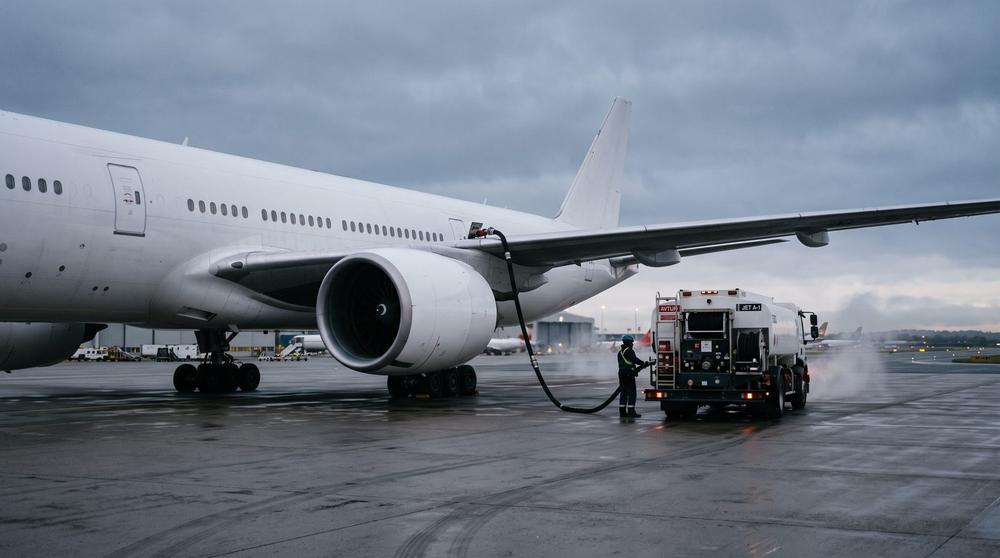
Delta reported September-quarter results on Friday that split cleanly in two. The demand half was strong: GAAP operating revenue of $20.2bn, up 21%; adjusted revenue of $17.6bn, up 16%; premium revenue up 18% on a 6% increase in premium seats; loyalty revenue up 18%. Capacity was flat year over year. Chief executive Ed Bastian said demand “remains strong, supported by consumers’ growing preference for experiences and travel.”
The cost half ate it. GAAP fuel expense rose 69% to $4.35bn, with the average price per gallon up 68% to $3.80. GAAP diluted EPS fell 47% to $1.15 from $2.17. Adjusted EPS of $1.72 was up 1% on last year’s $1.70 and short of analyst estimates. Adjusted operating margin compressed to 9.4% from 11.1%. Free cash flow fell 44% to $463m.
Then the guidance. Full-year adjusted EPS is now $5.10 to $5.60, down from $6.50 to $7.50 — about 23% off at the midpoint. The December quarter is guided to adjusted EPS of $1.15 to $1.65 on roughly 20% revenue growth and a 7% to 9% operating margin, assuming all-in fuel of about $4.25 a gallon. Delta expects full-year fuel costs to rise roughly $6bn. The stock fell about 4%.
Revenue guidance went up. Earnings guidance went down 23%.
That is the cleanest statement yet of what $90 crude does to a corporate P&L, and it is worth sitting with. Delta did not report a demand problem, a pricing problem, a cost-discipline problem or a balance-sheet problem. It reported one input price, and that input price took roughly a quarter of the year’s earnings.
The December assumption is itself a forecast. Delta is modelling $4.25 a gallon all-in while the Hormuz disruption that pushed crude to these levels remains unresolved, which means the guidance it just cut is marked to a curve that can move again. Every airline reporting over the next three weeks is marked to the same one.
Our take: Flat capacity is the number to respect here. An airline with strong demand and a broken cost line has one obvious temptation — fly more seats to spread the fixed cost — and Delta did not take it. That restraint is most of why adjusted EPS still rose 1% in the quarter instead of going negative. The risk from here is not Delta’s cost control; it is a competitor with weaker pricing power breaking ranks and adding seats into a $4-a-gallon winter. Industry capacity, not any single carrier’s hedging, decides whether fares keep pace with fuel.
What to watch
- United, American and Southwest. All report within three weeks. The question is not whether they cut guidance — it is which of them holds capacity flat.
- The realised December fuel price against Delta’s $4.25-a-gallon assumption. Every 25 cents is real money on a $6bn annual increase.
- Premium and loyalty. Both grew 18% and are carrying the revenue line. If consumer spending on experiences cools, the demand half of this report stops offsetting the cost half.
- The $2.5bn free-cash-flow target and about 2.2x gross leverage. Free cash flow already fell 44% in the quarter.