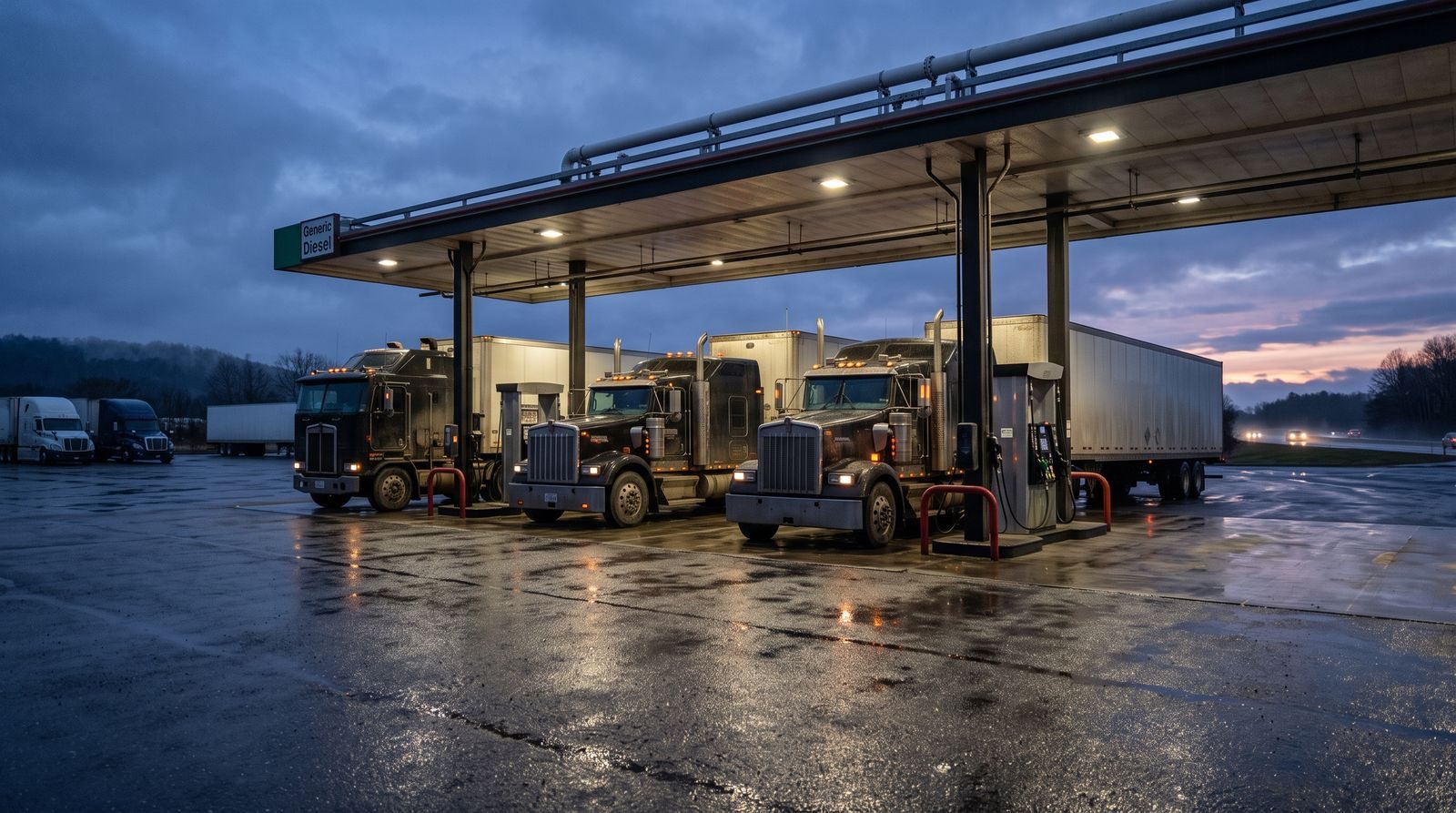
The average US retail price of diesel reached $5.85 a gallon on Friday, an all-time high. It passes the June 2022 peak of $5.81, set a few months after Russia's invasion of Ukraine, and sits nearly 60% above where truckers were paying a year ago.
Oil, meanwhile, retreated at the end of a volatile week. That divergence is the entire point. This is not a crude story that has trickled down to the pump. It is a refining story — the capacity to turn barrels into distillate has been damaged faster than the barrels themselves have gone missing.
Three things did the damage, and they compounded. Iran's effective closure of the Strait of Hormuz — the route for roughly 20% of globally exported crude — started as a supply shock in February and has since become a refining shock, because Gulf refining capacity has been struck directly. Ukrainian long-range drone strikes have cut into Russian refinery output. And Russia extended its diesel export ban through the end of September, withdrawing supply from a market whose reserves were already critically thin. Seasonal demand did the rest.
Why distillate is the one that hurts
Gasoline is a consumer expense. Diesel is an input cost. It moves freight, runs agricultural equipment, powers construction, and increasingly backs up data centers. A 60% year-on-year move in diesel does not stay in the transport line of anyone's P&L — it propagates into the cost of every physical good, on a lag of roughly one to two quarters, and it does so regardless of what the consumer is doing.
That lag is what makes today's print awkward. It arrives on the same day payrolls came in at 162,000 against a 53,000 estimate, the two-year yield hit its highest since January 2025, and money markets moved past a 50% probability of a September hike. A labour market that will not cool, plus a supply-driven cost shock working its way through goods prices, is the specific combination that central banks have the fewest good options against.
Our take: Refining capacity is the constraint nobody hedges. Firms hedge crude because crude is liquid and the instruments are obvious; the crack spread — the margin between crude and refined product — is where the damage actually shows up, and it is far less commonly covered. A business that hedged oil this year and thought it was protected is discovering it hedged the wrong leg. Check what your freight contracts index to. If they float on diesel rather than crude, you have already taken this hit and it is not in your forecast yet.
What this is not
It is not a demand story. Nothing in the data suggests freight volumes surged; the move is supply destruction plus normal seasonality. And it is not obviously self-correcting, because the fix is physical repair of struck refining assets in active conflict zones, on timelines set by the conflicts rather than by price signals. High margins normally pull refining capacity back online. They cannot pull back capacity that has been hit.
What to watch
- The Russian export ban's end-September expiry. Extension is the base case to plan against; lapse would be the first genuine relief valve.
- Crack spreads, not crude. If crude falls and diesel does not follow, the refining bottleneck is still binding and the pass-through continues.
- Goods CPI on a one-to-two-quarter lag. This is where a freight-cost shock shows up, and it lands into a Fed already leaning hawkish.
- Contract renewals. Freight and logistics contracts repricing this quarter will bake $5.85 into the next twelve months of somebody's cost base.
The headline number is a record. The useful number is the gap between it and crude.