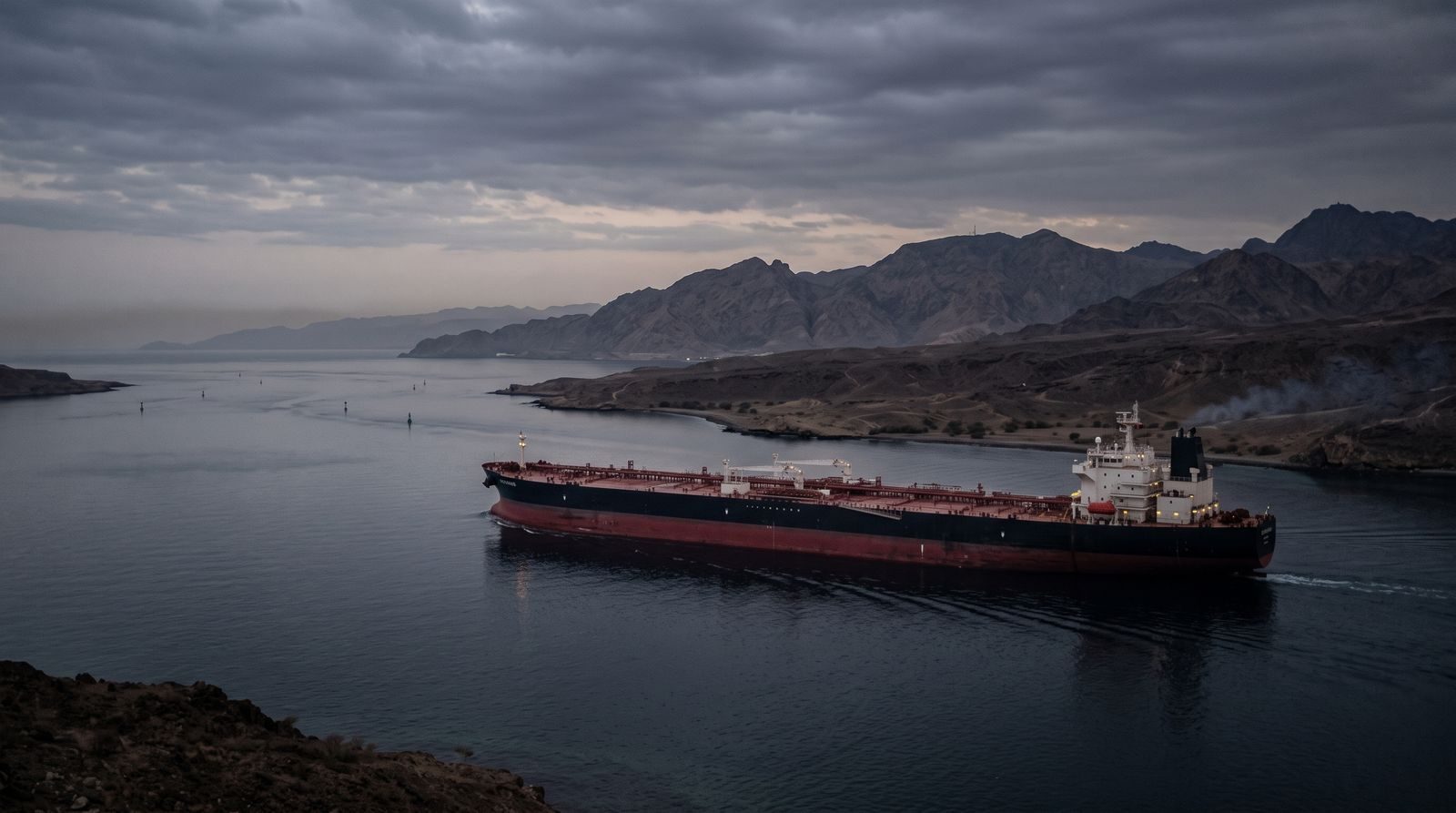
Two very large crude carriers were struck by unknown projectiles in quick succession late Monday while transiting out of the Strait of Hormuz, according to maritime security consultant Marisks, whose account was carried by Bloomberg and the trade press on Tuesday.
The vessels named were the Sidr, run by Saudi Arabia’s Bahri, hit northeast of Khasab, Oman, and the Senegal Prosperity, operated by South Korea’s Sinokor, reported struck by three projectiles east of the same coast. Both were outbound from the Gulf. Crews were reported safe and no casualties or spill have been reported. The projectiles have not been attributed.
Equities were lower and crude higher on Tuesday as the strikes fed into an already tense session, with bond yields rising in the US and abroad on inflation worries. That is the visible layer. Underneath it sits a market that moves first and matters more.
Our take: Watching the oil price for a chokepoint story tells you about sentiment. Watching war-risk insurance tells you about physical supply. A barrel does not stop moving because Brent is up three dollars — it stops moving when an owner cannot buy cover at a price the charter will bear, or when the underwriter simply declines the transit. Two hulls hit in the same night, in the same corridor, is exactly the pattern that pushes underwriters from pricing a risk to refusing it. The oil price is the thermometer. Cover is the disease.
The number that has already moved this year
War-risk cover is quoted as a percentage of hull value per transit. In peacetime that number is a rounding error — roughly a quarter of one percent. Reporting through the summer put Hormuz war-risk premiums in a range of about 3% to 10% of hull value as attacks intensified, which on a $100 million tanker is the difference between roughly $250,000 and something in the millions, per voyage.
Those figures move week to week and are negotiated hull by hull, so treat any single quote as a snapshot rather than a rate card. The direction is the point. When cover costs several percent of the asset, the economics of a transit stop being about the freight rate and start being about whether anyone will write the policy at all — which is why governments in several jurisdictions have already been pulled into acting as insurers of last resort for these routes.
What to watch
- Whether underwriters withdraw rather than reprice. A higher quote is a market. No quote is a closure, and it shows up in loadings before it shows up in Brent.
- Attribution. The projectiles are unattributed so far. Who gets blamed determines whether this is treated as an escalation or an incident, and insurers price those very differently.
- Charterer behaviour, not owner statements. Watch for outbound transits being re-routed, delayed or held at anchorage. That is the real-time indicator.
- The rate/yield interaction. An oil shock that arrives with September hike odds already elevated does not give the usual duration hedge much to work with — something we flagged after Sunday’s Larak Island strike.
Two hulls, one night, no attribution. The market that answers first is not the one on the screen.