Eaton's second quarter: record sales of $8.5 billion, up 21% year over year. Fourteen points of that were organic; seven came from acquisitions. Segment margins landed at 23.1%, above the high end of the company's own guidance. Adjusted earnings were $3.15 a share, a second-quarter record. Reported diluted EPS was $2.11.
Then management raised the year. Organic growth guidance moved to 11–13%, segment margins to 24.1–24.5%, and adjusted EPS to $13.40–$13.60 from $13.05–$13.50. The third-quarter organic revenue guide — up 13.5% to 15.5% — landed against a Street estimate of roughly 10.6%. That is a five-point gap on a company this size. The stock rose about 3%.
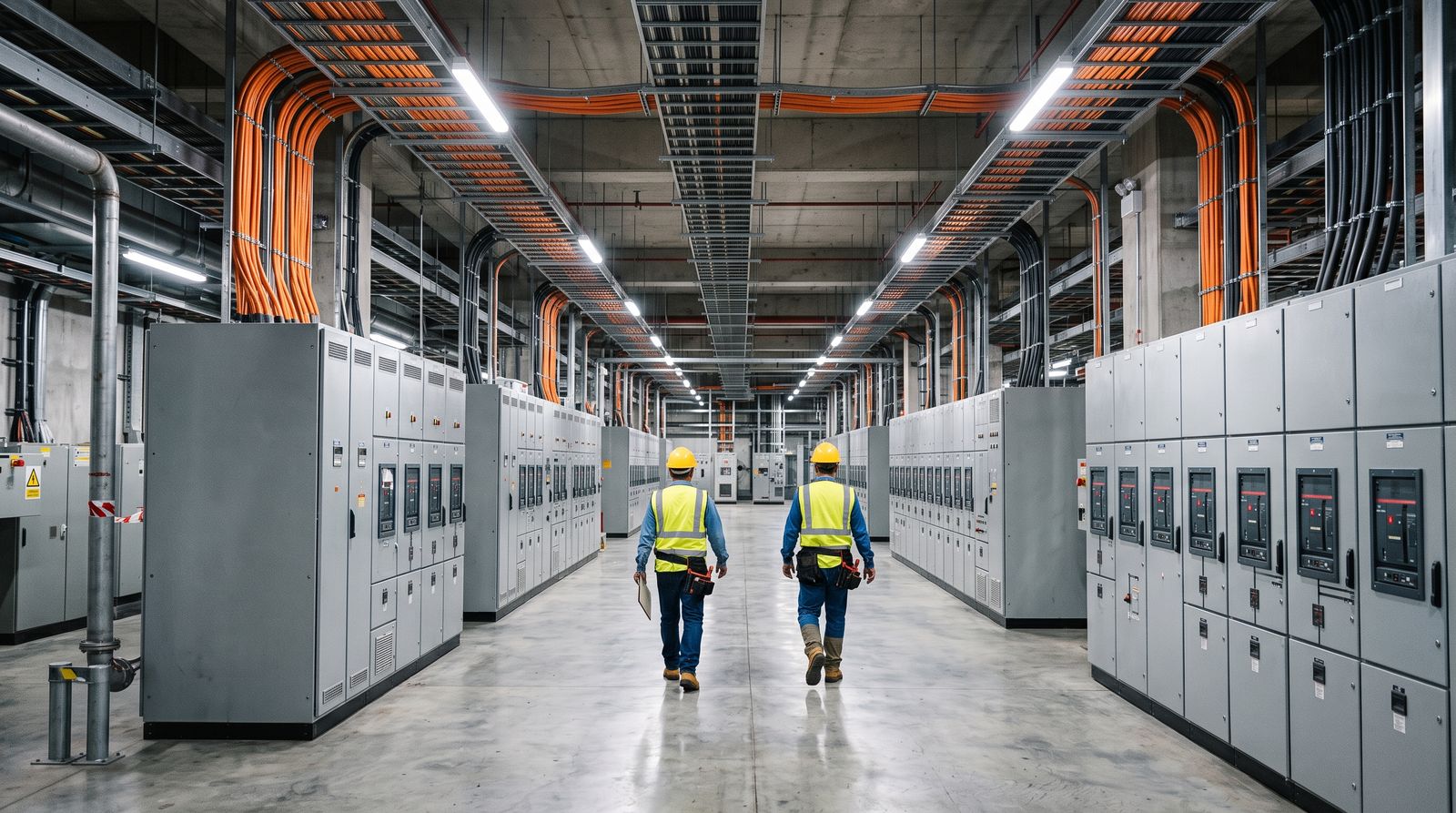
The segment detail is where the story lives. Electrical Americas did a record $4.0 billion at a 27.5% margin. Electrical Global did a record $2.5 billion. Eaton does not train models, does not own accelerators, and does not appear on anyone's list of AI stocks. It sells switchgear, busway, breakers and power distribution — the equipment standing between a utility feed and a rack of chips.
Thirty-two gigawatts
Eaton put a number on the demand: 32 gigawatts of data center capacity currently under construction in the United States, roughly 70% of it AI-related. Every one of those gigawatts needs an electrical system, and that system has to be specified, manufactured and installed years before the first server boots.
That lag is the structural advantage. The compute layer of the AI trade reprices weekly on model releases and chip roadmaps. The electrical layer reprices on construction schedules, which move slowly and are mostly already signed. Eaton is not forecasting AI adoption. It is reading a backlog.
Our take: A 27.5% margin on physical electrical equipment is the tell. Margins like that in an industrial business mean capacity is scarce and the customer is not shopping on price — a hyperscaler five months from energizing a building does not negotiate hard over switchgear. That pricing power lasts exactly as long as the shortage does. Track capacity additions across the sector, not order intake.
The picks-and-shovels trade has a lag
Eaton is not alone in this layer. Quanta added $4.5 billion to its revenue outlook in a single quarter, and MasTec paid $1.65 billion for an electrical contractor whose real customer is the AI data center. When several companies in the same slice of the stack all move the same direction at once, it is usually not company-specific execution. It is the slice.
The risk is symmetrical, and worth saying plainly. The same lag that makes today's revenue visible makes it slow to react if hyperscaler capex plans change. A project cancelled in 2027 shows up in Eaton's numbers in 2028 — and by then the stock will have moved. Bloom Energy's backlog question is the same question in a different jacket.
What to watch
- Backlog conversion, not backlog size. Orders are easy in a shortage; factory capacity is the binding constraint.
- Whether the 32 GW figure grows or stalls in next quarter's commentary. That number is the whole thesis.
- Electrical Americas segment margin. Any slip below 27% is the first sign the shortage is easing.
- Hyperscaler capex guides. They lead Eaton's revenue by roughly two years — which is both the opportunity and the exposure.