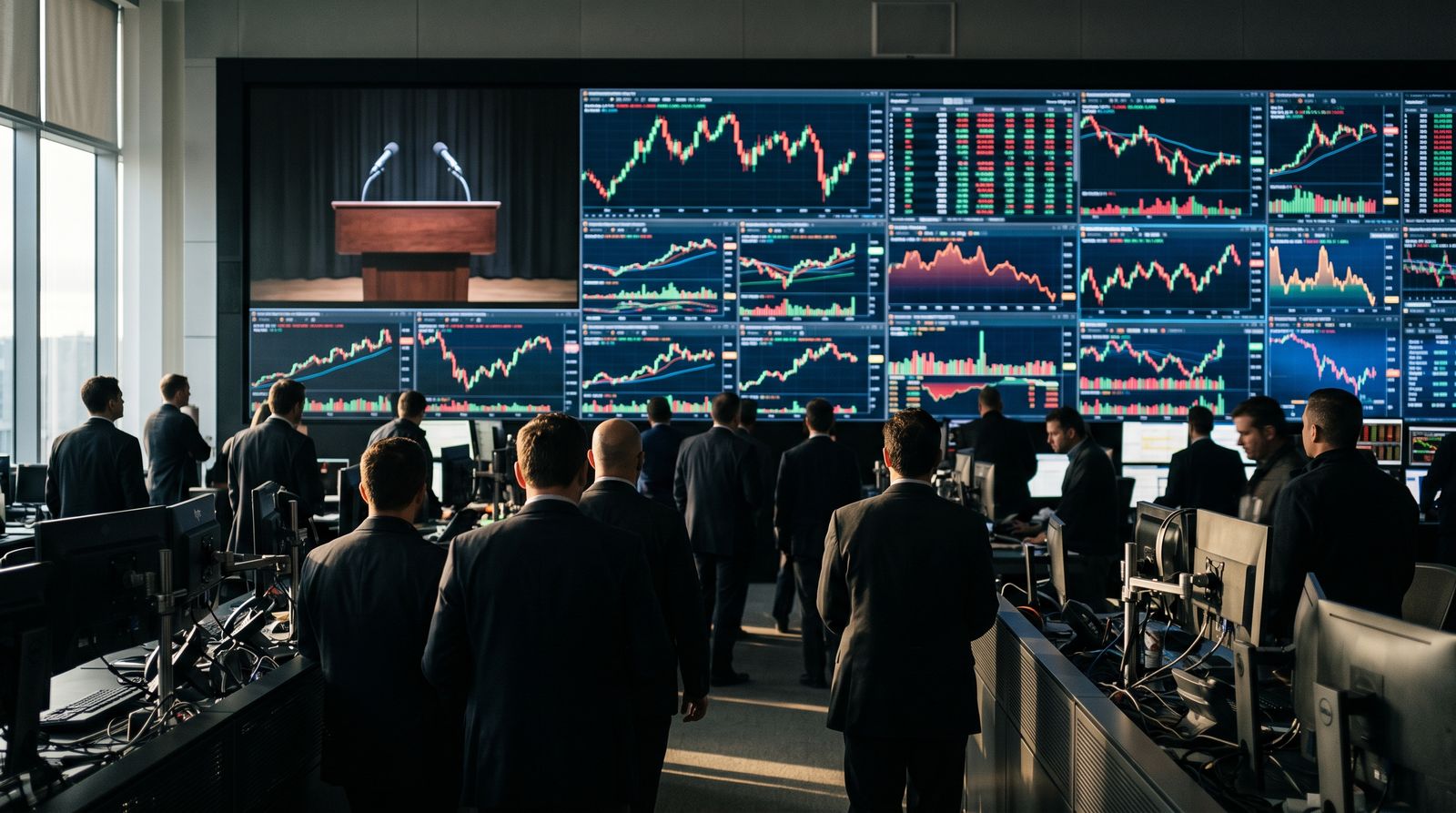
The Federal Open Market Committee meets Tuesday and Wednesday and announces at 2 p.m. ET on July 29. Chair Kevin Warsh takes questions at 2:30. There is no Summary of Economic Projections at this meeting, so the only forward guidance available is whatever Warsh says out loud.
Microsoft reports fiscal fourth-quarter results after the close the same day. Meta reports second-quarter results after the close the same day, with its call at 4:30 p.m. ET. Two of the largest AI capital spenders on earth open their books roughly two hours after the central bank tells the market what money costs.
Economists polled by FactSet expect a hold at 3.50%–3.75%, which would be the fifth consecutive meeting without a move. That is the consensus. It is not the story.
The repricing happened last week
Oil topped $100 a barrel on Thursday, and the rate curve moved with it. By Thursday, CME FedWatch showed roughly a 36.5% probability of a 25 basis point hike at this meeting against a 63.5% chance of a hold — about one in three. Further out, fed funds futures priced roughly an 82% chance of at least one hike by the September meeting, up from about 52% one week earlier.
That is a thirty-point swing in seven days, and it was not driven by a jobs print or a CPI surprise. It was driven by energy. Crude gave back around 4% on Friday on a report that Pakistan is pushing to restart US–Iran talks, with Brent settling near $96.78 — but the pump kept climbing for an eleventh straight day, which is exactly the lag that keeps a headline inflation print elevated after the barrel has already turned.
Markets spent the first half of this year erasing the rate-cut bet. The second half is now about whether they have to price the opposite.
Our take: AI capex is a duration trade wearing an equity costume. Every dollar of data center spending is justified by revenue that arrives years from now, which means its present value is unusually sensitive to the discount rate. Wednesday hands the market a hawkish repricing risk at 2 p.m. and the capex receipts at 4 p.m. Microsoft and Meta are two of the six names in Moody’s $785 billion tally. If Warsh sounds worried about energy pass-through and both companies then guide capex higher, that is not two separate headlines. It is the same headline twice.
The rest of the week is stacked behind it
Wednesday is the fulcrum, but the data does not stop. Tuesday brings the S&P Case-Shiller home price index and the Conference Board’s consumer confidence reading as the two-day FOMC meeting opens. Thursday brings the advance estimate of second-quarter GDP alongside weekly jobless claims — and Apple and Amazon both report after that close. Friday closes the week with the June personal consumption expenditures price index and the employment cost index.
PCE on Friday matters more than usual. It is the Fed’s preferred inflation gauge, it lands two days after a meeting with no projections attached, and it covers June — before the worst of the oil move. Whatever it prints, it is already stale relative to the barrel.
What to watch
- Dissents. A unanimous hold and a hawkish hold are different animals. Names in the dissent column tell you where September actually sits.
- The word “transitory,” or its 2026 equivalent. Whether Warsh treats energy as a pass-through shock or a broadening inflation problem is the whole September question.
- Capex guidance, not EPS. Microsoft and Meta beating on earnings is close to priced. The number that moves the group is next year’s spending plan.
- The gap between 2 p.m. and 4 p.m. If megacaps sell off on the Fed and then guide capex up, watch whether the bid comes back. That is the cleanest read available on whether the market still funds the buildout at a higher cost of money.
Four of the largest companies in the index report inside 48 hours, the central bank moves in the middle of it, and oil is sitting near triple digits. There is no version of this week that resolves quietly.