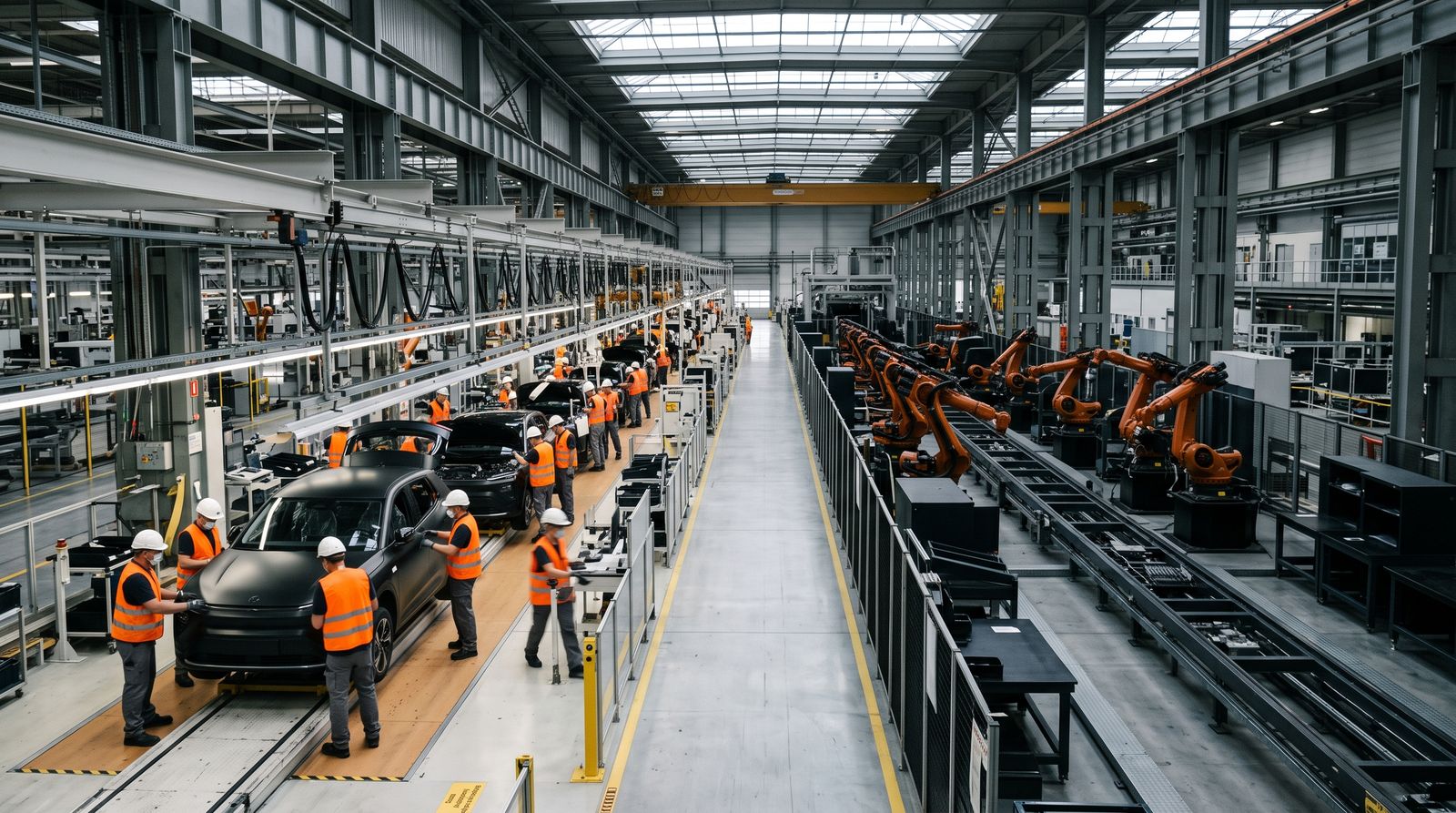
Ford and China’s Geely will share the Almussafes assembly plant outside Valencia through a joint venture, announced Thursday during a factory visit by Spanish Prime Minister Pedro Sánchez and Ford Europe president Jim Baumbick. Ford keeps 66%. Geely takes 34% for about €221 million — roughly $251 million — valuing the new company at around €650 million.
The structure is simple and the timing is slow. The venture takes over the plant in 2027, subject to regulatory approval, and the new metal arrives by the end of 2028: two Geely electric SUVs and a new multi-energy Ford crossover, alongside continued Kuga production. All 4,142 people currently employed there transfer into the joint venture. Unions and the regional business lobby backed it — not the usual reaction to a Chinese carmaker walking into a European plant.
They backed it because the alternative was worse. Almussafes has spent years building a single model in a building sized for several, and Ford Europe has been shrinking around it. A half-empty plant is a slow-motion closure announcement.
What Geely actually bought
Not a factory. A customs classification.
Geely-built electric vehicles shipped from China into the EU carry an 18.8% countervailing duty on top of the standard 10% import duty — a 28.8% stack, set when Brussels finalized its anti-subsidy case in late 2024 with definitive rates running from 7.8% to 35.3% depending on the manufacturer. A car assembled in Valencia carries none of it. And the Commission has since signaled it is preparing anti-subsidy duties on Chinese plug-in hybrids too, which makes an EU production base worth more, not less, over time — the same one-way ratchet American importers watched close on them Friday.
Against that, €221 million is close to a rounding error. A greenfield EV plant in Western Europe runs into the billions and takes years. Geely bought a trained workforce, a supplier base, port access and tariff-free status for less than a quarter of a billion euros — as a minority partner, which is the cheapest way into a market that has spent two years arguing about whether to let you in.
What Ford got
Ford converted a stranded asset into a partner-funded one without giving up control. At 66% it still runs the venture, and it gets a co-tenant absorbing fixed costs on a line it could not fill, cash at close, and a political win in a country where it has produced layoff headlines for years.
It also gets a competitor inside the building, learning European homologation, supplier terms and labor practice from the inside. Ford decided that risk is cheaper than the carrying cost of empty floor space. That trade tells you where Ford Europe thinks its volumes are going.
Our take: This is the template, and everyone in the industry knows it. Tariffs were supposed to keep Chinese EVs out of Europe; instead they repriced the cost of getting in, and €221 million turns out to be the number. Expect a queue: Europe is full of underused plants owned by companies that would rather book a partner’s money than a closure charge. The lesson generalizes past cars: when a trade barrier is built around where something is made rather than who makes it, the barrier becomes a real-estate problem, and real estate is for sale. If your moat is geography, price it accordingly — someone is already running the math on renting their way through it.
What to watch
- The regulatory review: The venture is subject to approval. Whether Brussels examines it under the EU’s foreign-subsidies rules — and what local-content or technology conditions come attached — sets the precedent for every deal that follows.
- Volume commitments: Nobody has published how many units Geely will build. Fixed-cost absorption at Almussafes only works at scale, and the 2028 start date leaves plenty of room for the plan to shrink.
- Who moves next: Other European plants running one model at partial capacity, with idle lines and a nervous works council, are the obvious candidates — and any EU move on plug-in hybrids changes the payback math for everyone.
Ford spent years trying to fill Almussafes with Ford products. It is filling it with someone else’s, and getting paid for the privilege. In a shrinking European market, that counts as a win.