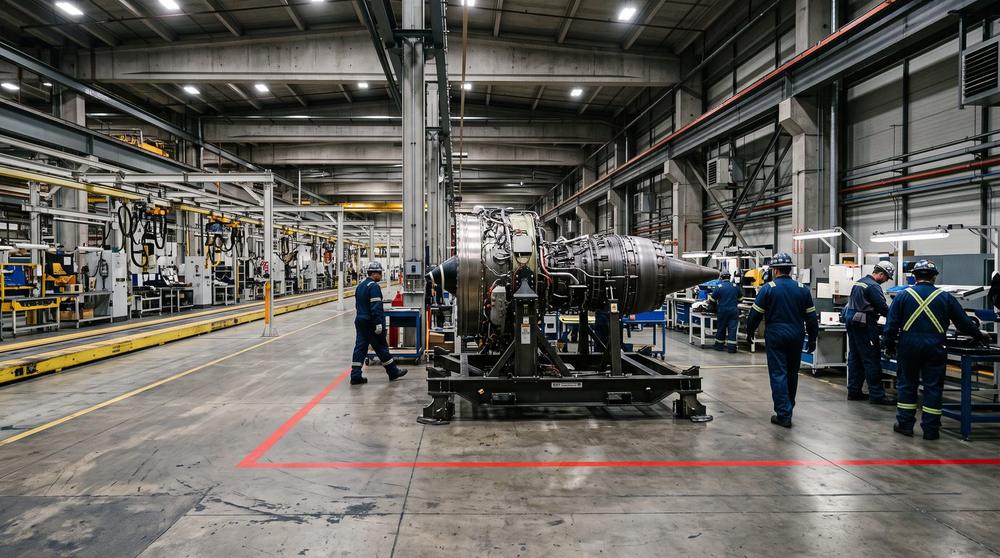
GE Aerospace booked $19.0 billion of orders in the third quarter, up 49% year on year, and raised its full-year outlook for revenue, operating profit and adjusted earnings. General Motors beat on the quarter, raised its cash-flow forecast by $2 billion, authorised a $20 billion buyback — and the stock fell.
Both companies reported before the open on the same Tuesday morning. Both beat. The difference is what each one is willing to say about next year, and the market read the distinction immediately.
GE Aerospace's quarter: GAAP revenue of $14.12 billion, up 16%; adjusted revenue of $13.29 billion, up 18%; adjusted earnings of $2.25 a share, up 36%; non-GAAP operating profit of $2.99 billion, up 30%, at a 22.5% margin. The orders line is the one that matters. A 49% jump in a business where orders convert to revenue over years is a statement about 2027 and 2028, not about the last ninety days.
GM beat, then narrowed the band
GM's numbers were strong on their own terms. Revenue of $50.0 billion, up 2.9%. Adjusted earnings of $3.70 a share, up 32.2%. Adjusted EBIT of $4.11 billion, up 21.6%, lifting the margin to 8.2% from 6.9%. North America did the heavy lifting: adjusted EBIT there rose 43.4% to $3.59 billion, with the margin up to 8.7% from 6.2%.
The guidance is where it gets interesting. GM narrowed full-year adjusted EBIT to $14.5–$15.5 billion from $14.0–$16.0 billion, and adjusted EPS to $12.75–$13.75 from $12.00–$14.00. The midpoint of the earnings range moved up 25 cents; the width of the range halved. Adjusted automotive free cash flow was the genuine raise — $11.5–$12.5 billion, up $2 billion at both ends from $9.5–$11.5 billion.
Then the board approved a new $20 billion repurchase authorisation with no expiration date, having just completed the $6.0 billion programme announced in January. Shares fell anyway.
Our take: Narrowing a range is not the same as raising one. GM told the market it has more confidence in a smaller number of outcomes, and that the extra cash is going to shareholders rather than into anything that compounds. GE told the market its order book grew by half. Those are two different answers to the same question — what do you know about 2028? — and only one of them is a growth story. A $20 billion authorisation is the move of a company with cash and no better use for it.
The rest of the industrial tape
The pattern held across the morning's prints. 3M posted adjusted earnings of $2.50 a share against $2.29 expected on about $6.6 billion of revenue, and raised its EPS outlook — helped by an expanded Amazon data-centre arrangement that came with a warrant on 3M's own stock. Northrop Grumman's sales of $11.1 billion came in roughly in line, but backlog climbed to $110 billion and the company lifted its full-year segment operating income view. Hasbro raised its full-year revenue growth forecast to 7–9%.
Against that, the index tape was split. Dow futures were up 0.14% at 52,254 before the bell while S&P 500 futures slipped 0.14% to 7,724 and Nasdaq futures dropped 0.50% to 29,574, with the weakness concentrated in semiconductors and AI data-centre names. Chip stocks had snapped a nine-day losing streak on Monday and were back in the red by Tuesday morning. The 10-year Treasury yield sat at 5.12%.
What to watch
- Whether GE's order growth is units or price. Aftermarket services carry a different margin profile than new engines. The split inside that 49% determines how much of it reaches earnings.
- GM's buyback pace. A $20 billion authorisation with no expiry can be executed fast or left on the shelf. The first quarter of actual repurchases will say which this is.
- The yield. At 5.12% on the 10-year, the discount rate is doing real work against long-duration growth stories — which is part of why an engine order book reads better right now than a compute buildout.
- Housing data. September starts, building permits and pending home sales land this week and are the cleanest read on whether 5%-plus long rates are biting the real economy yet.
Earnings season is only a few days old. So far the companies with order books are getting paid for them, and the companies without are paying shareholders instead.