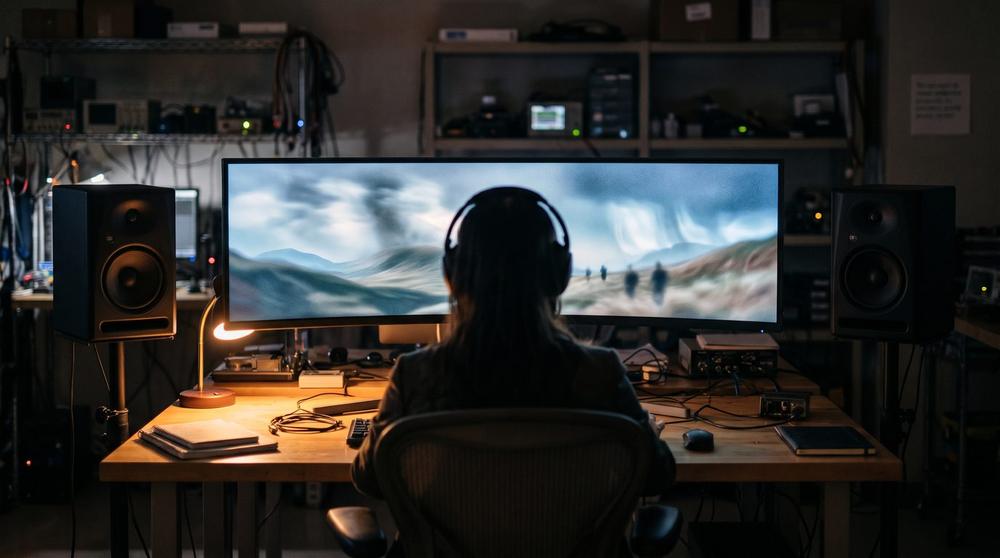
Google DeepMind released Genie 4 on Tuesday as a research preview for trusted testers. It generates interactive worlds from a text or image prompt, in real time, and it is the first of DeepMind’s real-time world models to generate its own audio natively — ambient sound, music and characters who talk back and react to what you do.
You steer it while it runs. Keyboard controls handle movement and camera; typing a prompt mid-simulation changes the weather, swings the camera, or drops a person or object into the scene. Gemini sits alongside as a planner: Gemini Omni anchors how things look and behave, and Gemini 3.8 Flash watches the frames, breaks a goal into steps and checks each one landed.
It holds a coherent scene for up to two minutes. That is double Genie 3, which arrived a little over a year ago without audio. It is also, still, two minutes.
Our take: DeepMind published no resolution, no frame rate and no benchmark numbers with this release — unusual for a model launch in 2026, and the clearest signal of where Genie 4 actually sits. What it did publish is a limitations list: visual detail and object permanence drift the longer a run goes or the more you edit it, and audio accuracy, legible in-world text, spatial accuracy and long-term consistency are all still open research. Read the two-minute ceiling as the product spec, not a footnote.
Who gets it, and when
Trusted testers now, by waitlist. Google AI Ultra subscribers get it through Project Genie in the coming weeks. Early access partners reach it through the Gemini API and Google AI Studio. No general release date, and no pricing.
Everything Genie 4 produces — video and audio — carries SynthID watermarking, and the rollout is staged behind internal safety evaluations. That is now the standard shape of a generative-media launch at Google, and worth noting precisely because it is becoming unremarkable.
Robotics is the tell
The demo that matters is not the playable world. In a research experiment tied to Gemini Robotics, a model DeepMind calls Gemini 4 Argon split a task into text captions that Genie 4 rendered live, and a separate demo showed Apptronik’s Apollo humanoid playing checkers inside a generated environment.
That is the commercial case. A robot policy needs millions of varied scenarios and cannot get them cheaply from the physical world. A world model that generates a plausible kitchen, warehouse aisle or stairwell on demand — with aerodynamics and collisions simulated, if not measured — is a training-data factory. Gaming, learning and film prototyping are the demos; simulation for embodied agents is the business.
Tejas Kulkarni, a research director at Google, framed the next step as “hybrid world models” — Gemini writing code and text while Genie simulates reality at different levels of abstraction. Diego Rivas, a DeepMind engineer who pointed to storyboarding and rapid ideation as an early use, was blunter about where the product is: “still early days for Genie 4.”
What to watch
- Whether benchmarks ever appear. A world model with no published fidelity or consistency metrics cannot be compared to anything. If Google keeps shipping Genie without them, that is a decision, not an oversight.
- The consistency horizon in the next release. Two minutes doubled from one. Robotics training needs minutes-to-hours of stable state, not seconds.
- Pricing when it leaves preview. Real-time video and audio generation is expensive to serve. The price Google sets tells you whether this is a product or a research vehicle.
- Apptronik and other robotics partners. A checkers demo is a demo. A partner reporting that simulated training transferred to hardware is the proof point.