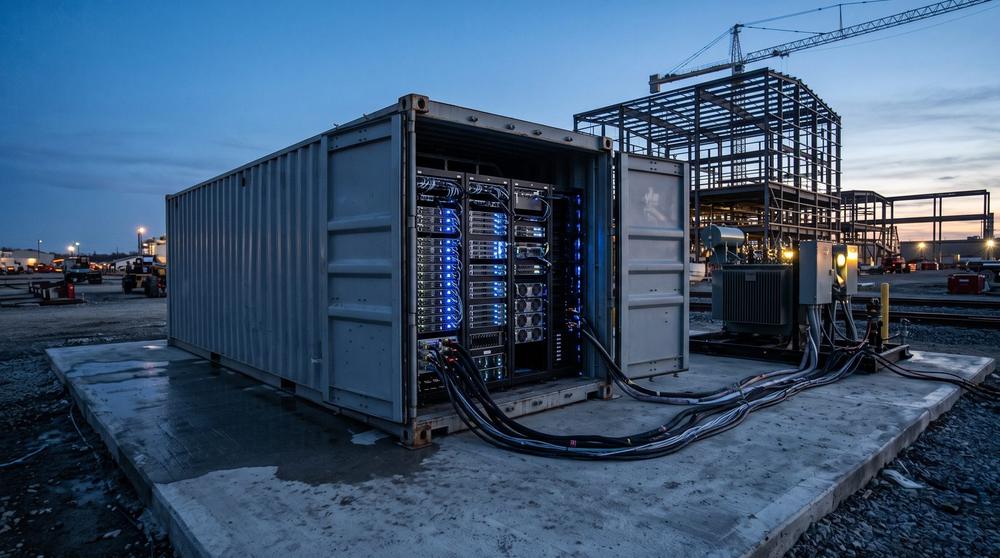
Nvidia used its Berlin GTC keynote on Tuesday to announce something that is not a chip. The DSX POD is a reference design for a complete AI data centre built inside a modular intermodal container — racks, networking, cooling and management hardware, integrated and validated at the factory, then trucked to site.
Nvidia’s own figure for what that buys: onsite deployment falls from roughly six months to as little as 14 days, once the site’s power, water and fibre are ready. ServeTheHome, which worked through the specifications at the show, counts seven Vera Rubin NVL72 racks inside each container, plus the networking and management gear to run them.
And Nvidia will not be building or selling them. The POD is a blueprint. Manufacturing goes to partners — Dell, HPE, Gigabyte, Delta and QCT were among the names at the show — who are expected to begin delivering worldwide in early 2027.
The constraint stopped being silicon a while ago
For two years the bottleneck in AI capacity has been migrating away from chips and towards everything that surrounds them. CBRE — a property services firm — is paying up to £760m for a contractor whose business is installing structured cabling inside data centres. Microsoft abandoned a UK site because the grid connection could not arrive before the 2030s.
A container does not fix the grid, and Nvidia is explicit that its 14 days starts after utilities are live. What it compresses is the part of the schedule that is labour and commissioning: electricians, pipefitters, coolant loops, cabling, burn-in, validation. That is the part running long across the industry, and the hardest part to buy more of, because it is people rather than equipment.
Our take: The decision worth studying is not the container — it is Nvidia declining to sell it. Nvidia has spent this cycle climbing the stack: chips, then boards, then racks, then full systems. Here it stopped at the drawing and handed assembly to five contract manufacturers. That is the correct move when the scarce resource is build capacity rather than margin, because licensing a validated design puts more PODs on more pads in 2027 than any single factory could. The cost of the trade is that the headline number now depends on somebody else’s factory discipline. “14 days” is Nvidia’s claim about a process Nvidia does not run.
What to watch
- Whether any partner publishes a price. A reference design with no list price says nothing about cost per megawatt, and cost per megawatt is the only figure that decides whether a POD beats a conventional build.
- Whether 14 days survives a real site. The figure is conditioned on utilities being ready — the condition that has been failing, not the installation.
- The efficiency claims. Nvidia says the wider DSX platform cuts cooling water use by up to 100% and delivers equivalent AI output on up to 30% less power. The water figure implies a fully closed loop; the company’s own 54 million litres a day saving is modelled on a 2GW deployment, not a single container.
- Slippage from early 2027. Five manufacturers starting at once is five chances for the date to move, and the first delivery quarter is the one to hold them to.
The strategic read is narrower than the keynote suggested. Nvidia is not entering the construction business. It is trying to make construction matter less — which is a tell about how badly construction has been hurting its customers. Its moat argument, meanwhile, took a hit last week from a different direction entirely.