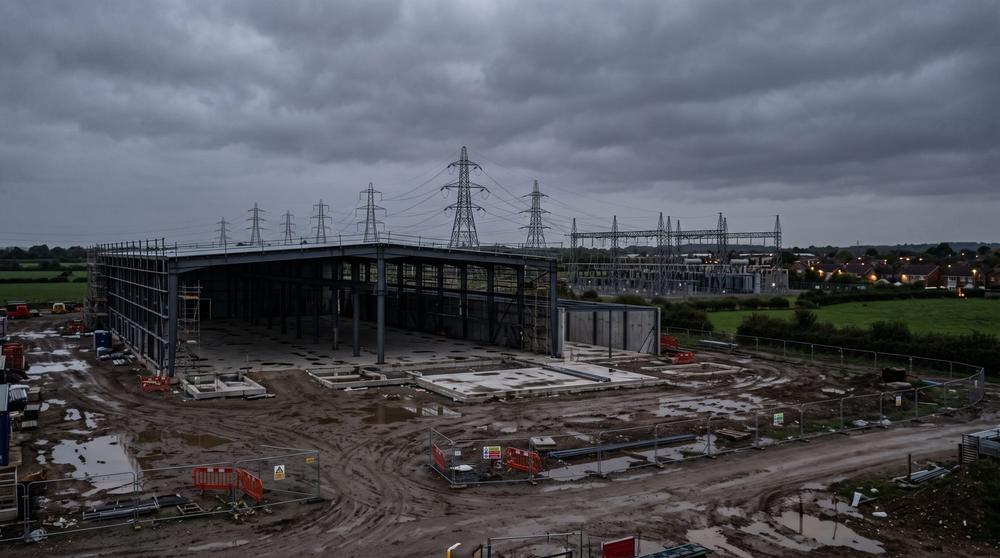
Microsoft has pulled out of its agreement to anchor Nscale’s first UK data centre, at Loughton in Essex, the Telegraph reported on Sunday. Microsoft had agreed in 2025 to rent 23,000 Nvidia AI chips at the site and was its only announced customer. The commitment formed part of the £22bn of UK investment Microsoft pledged around last year’s state visit.
Microsoft did not comment and gave no public reason. Nscale pointed at the grid. Its spokesman described an “unfortunate London-wide grid issue,” said the company “remain[s] committed to both the Loughton project and the UK,” and said the problem “has no impact on our other contracts.” Grid operators have told Nscale they do not expect to supply power to the site until the 2030s.
That is the number to hold on to. Not the 23,000 chips, not the cancelled lease — the delivery date on an electricity connection, quoted in decades rather than quarters.
The constraint moved
For three years the binding constraint on AI buildouts has been silicon. Nvidia allocation decided who could train what. The Loughton cancellation is one of a growing number of cases where the chips were available, the tenant was willing, the capital was committed — and the project stalled on an interconnection queue.
Britain has now produced two of them inside a year. OpenAI suspended plans for a Stargate facility with Nscale on Tyneside in April, citing UK electricity prices. Loughton makes it two, and this time the issue is not the price of power but the arrival of it.
It is also why the siting of new capacity has started to look strange. Anthropic’s first Canadian data centre sits at Point Tupper, Nova Scotia, with the developer paying for grid upgrades itself. Developers are no longer choosing locations for latency or talent. They are choosing them for whoever can energise a substation first, and increasingly paying to jump the queue.
Our take: Nscale is seeking a Wall Street listing at up to $35bn, against a private valuation of $15bn, on the strength of $103bn in contracted revenue — more than 40% of which comes from Microsoft. The Loughton contract is believed to be a small slice of that. The signal is not its size. It is that the largest counterparty in the book walked away from a site rather than wait, and the company found out from the grid operator rather than the customer. When a valuation rests on contracted revenue, every cancellation is a question about the discount rate applied to the rest of the contracts.
Timing
The news lands in a bad fortnight for AI infrastructure financing. The Australian developer Firmus cancelled a planned $20bn IPO earlier in October. CoreWeave’s 2032 bonds are yielding close to 15%. The chip index has just had its worst run since 2008, and Gartner said last week that $3.5tn of AI investment could be written off by 2030 if the returns do not arrive.
Nscale itself is two years old, founded by Josh Payne, backed by Nvidia and chaired into credibility by a board that includes Sheryl Sandberg and Sir Nick Clegg. Jensen Huang told a London audience on Wednesday it could become “the most valuable UK startup they have created in the last 10 years.” Four days later its anchor tenant was gone.
What to watch
- Whether the IPO range moves. A $35bn ask built on contracted revenue has to survive a cancellation by the counterparty behind 40% of it.
- Alternative power at Loughton. Nscale says it is exploring other sources. On-site generation is the only route that beats a 2030s grid date, and it changes the cost per megawatt materially.
- Whether Microsoft re-sites the 23,000 chips in the UK. If that capacity reappears elsewhere in Britain, the £22bn pledge holds. If it shows up in Europe, the pledge was about power availability all along.
- Connection-queue reform. Grid timelines are now a sovereign AI policy variable. Watch what Ofgem and NESO say about prioritising data-centre connections — and who gets bumped if they do.