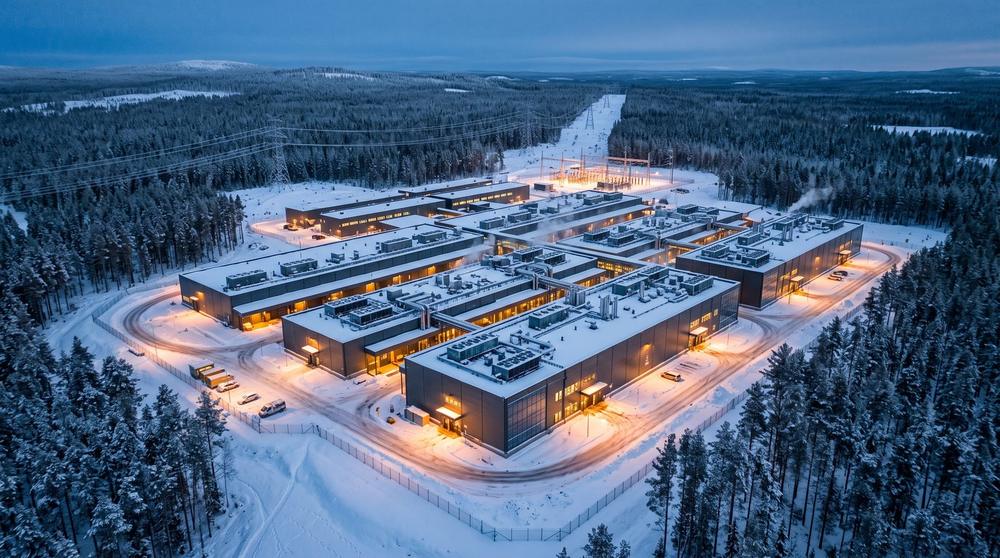
Google will spend at least €13 billion — about $15.1 billion — building AI infrastructure in Finland across 2027 and 2028, the company said Thursday. It is Alphabet’s largest European investment to date: three new data centres in the north of the country, plus electricity grid upgrades, clean energy projects and battery storage.
Bolted to it is a 22-year power purchase agreement with Fortum for up to half the output of the Loviisa nuclear plant. It is Google’s first nuclear supply deal outside the United States.
Finland put numbers on its side of the trade: roughly €3.6 billion added to GDP during the construction phase, and around 7,000 jobs supported annually once the sites are running. The capacity will serve Gemini, Search, Maps and YouTube.
The contract is longer than the buildings
Twenty-two years is not a procurement term. It is a financing term. A hyperscaler signing a two-decade offtake for half a nuclear plant’s output is doing something closer to what a utility regulator does — underwriting the economics of a generating asset far past the horizon any data centre design survives.
That inversion is the story. For a decade the constraint on compute was silicon. It is now electrons, and specifically firm electrons: power that shows up at 3 a.m. in February with no wind. Northern Finland offers three things at once — ambient cooling that runs below minus ten in winter, a stable grid, and an existing nuclear fleet with output to sell. Very few places on earth have all three, which is why the money is going there instead of Texas.
Our take: Read this as a power deal that happens to come with buildings. Google is not buying kilowatt-hours, it is buying a fixed price on kilowatt-hours through 2048, at a moment when everyone else building AI capacity is discovering that grid interconnection queues, not construction crews, set their delivery date. The competitive advantage in inference over the next five years will accrue to whoever locked in generation early and cheaply. Chips can be bought in a quarter. A 22-year nuclear offtake cannot — there are only so many plants, and each one can only be sold once.
What to watch
- Copycat PPAs in the Nordics. Sweden and Norway have the same cold-plus-firm-power profile. If a second hyperscaler signs a multi-decade Nordic nuclear contract inside six months, the scarcity is real and the pricing will move.
- Grid interconnection, not construction. The 2027–2028 timeline assumes transmission upgrades land on schedule. That is the slippage risk, not the concrete.
- What Fortum does with the certainty. Two decades of contracted revenue on half a plant changes what an operator can justify spending on uprates and life extension.
- Local politics. €3.6 billion of construction GDP buys goodwill. Three data centres competing with households for winter power tests how long it lasts.
The AI capex race has been narrated as a story about who can finance the buildings and who can marshal the compute. Increasingly it is a story about who signed the electricity contract first. Google just signed one that outlives most of the hardware it will ever plug in.