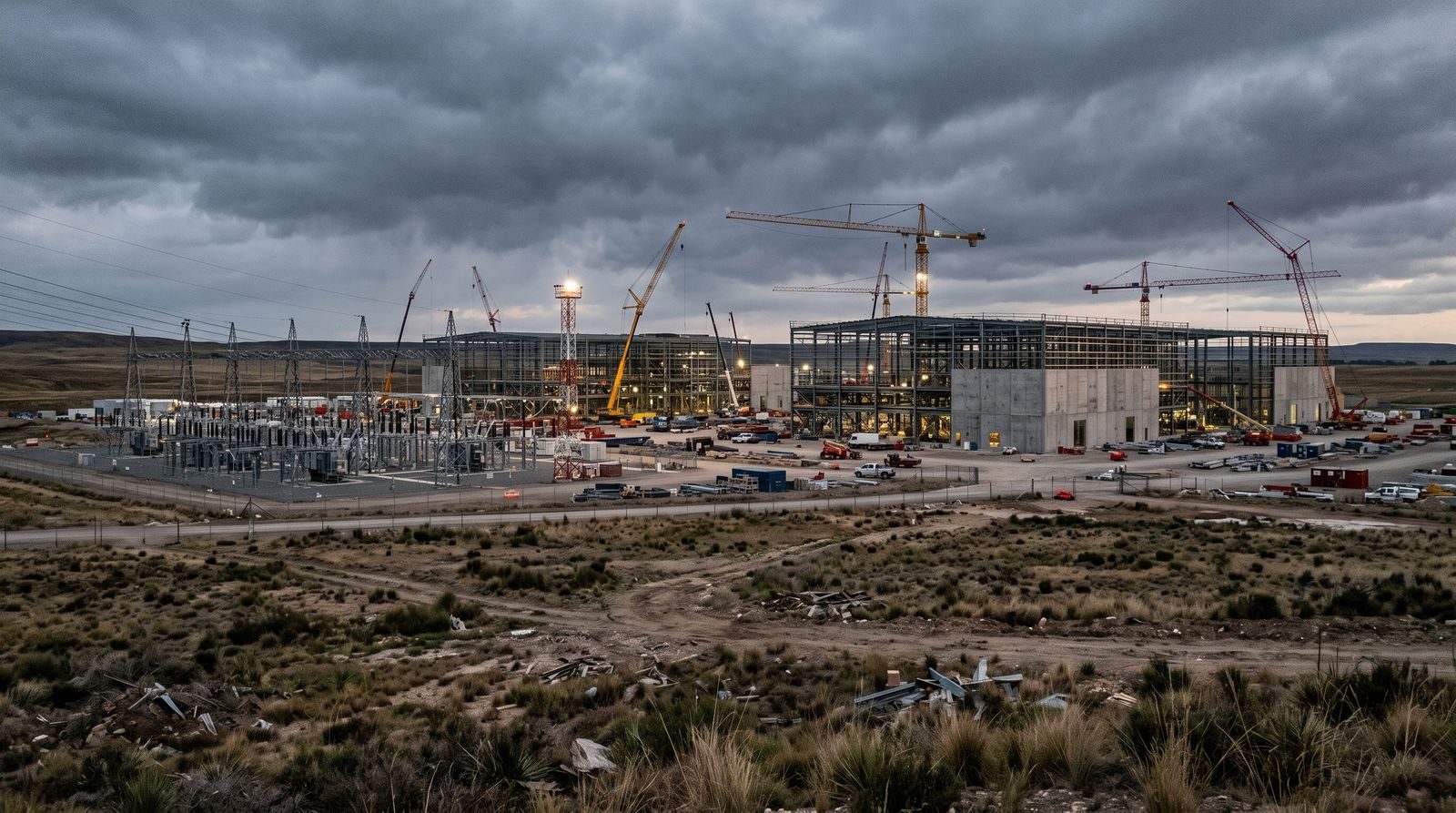
The AI buildout has quietly become a credit story. Hyperscalers have sold roughly $219bn of investment-grade bonds so far in 2026 according to J.P. Morgan Asset Management, including about $62bn issued in euros, sterling, Canadian dollars, Swiss francs and yen. Between 2022 and 2024, that cohort accounted for around 2% of all US dollar investment-grade supply. This year it is on track for roughly 9%.
The reason is arithmetic. Morgan Stanley’s widely cited estimate puts global data-centre investment through 2028 at about $2.9 trillion excluding power infrastructure, with roughly $1.4 trillion of that fundable from Big Tech operating cash flow. The remaining $1.5 trillion has to come from somewhere, and the somewhere is the bond market, private credit, and increasingly creative structures around both.
Wall Street expects total US investment-grade issuance of about $2.46 trillion in 2026, up 11.8% on 2025 by Barclays’ forecast, with net issuance rising a much steeper 30.2% to around $945bn. That gap between gross and net is the tell: this is not refinancing. It is new money.
The number that changed
Supply on its own is not a problem. Demand for high-grade paper has been strong all year. What moved is the ratio between them. Order books on hyperscaler bond deals were covered nearly five times over in February. By July, coverage on some deals had fallen below two times.
A book covered 2x still prices. But 5x means the issuer sets the terms and the spread grinds tighter through the day; 2x means the syndicate desk works for it and concessions get paid. Investors are not refusing the credit — these are among the strongest balance sheets in the index. They are refusing to hold an unlimited amount of it at any spread, which is what a 5x book effectively signals.
Our take: The equity market prices AI capex as a growth story. The bond market prices it as a duration and concentration story, and the bond market is the one writing most of the cheques from here. Watch coverage ratios, not spreads. Spreads tell you what the last deal cost; coverage tells you what the next one will.
The concentration problem
A handful of issuers moving from 2% to 9% of an index in two years creates a problem that has nothing to do with credit quality. Every investment-grade fund benchmarked to that index now owns more technology-sector duration than it did, whether or not anyone made a decision to. The top five hyperscalers are projected to issue around $300bn a year in coming years, against roughly $175bn in 2026.
The financing is also migrating off the public curve. Apollo’s $9bn non-voting cheque and the structures behind deals like Crusoe’s $13bn compute contract with Jane Street are the same phenomenon in private clothing: capital that wants the infrastructure cash flows without the equity risk, and does not need a public rating to get there.
What to watch
- September supply. Dealers have guided to $175bn–$250bn of US investment-grade issuance this month. The upper end of that range against a rising rate path is the real test.
- Coverage ratios on the next hyperscaler deal. Below 2x sustained would be the first genuine sign of indigestion.
- Non-dollar issuance. $62bn equivalent in other currencies is a lot of borrowing done specifically because the dollar book was full.
- The rate path. With hike odds now above 50% for this month, every week of delay costs issuers real coupon.
None of this says the buildout stops. It says the buildout now has a financing cost that moves independently of how well the models work — and that is a variable the AI story did not have eighteen months ago.