Ionic Digital — the company assembled in 2024 out of the mining hardware of the bankrupt crypto lender Celsius Network, and listed directly on Nasdaq on 28 July — filed its first earnings report as a public company after Wednesday’s close. Total revenue was $48.6 million, up 31% year over year.
Inside that number, the business swapped itself out. Cryptocurrency mining brought in $4.8 million, down from $37.2 million a year earlier — an 87% collapse. Digital-infrastructure leasing brought in $43.8 million, up from exactly nothing. “Digital infrastructure leasing represented 90% of second quarter revenue,” chief executive Andy Stewart said in the release, “marking our transition from a bitcoin miner to an HPC and AI infrastructure company.”
The line worth staring at is the one underneath. Delivering that $43.8 million of leasing revenue cost $209,000 in direct costs, excluding depreciation. Delivering the $4.8 million of mining revenue cost $3.1 million. Same company, same land, same substation — and roughly a 99.5% cash gross margin on one line against about 36% on the other.
The loss is mostly not operating
Ionic still reported a $35.3 million net loss for the quarter, against net income of $31.9 million a year earlier. Almost none of that is the business. Loss before tax was $8.1 million, and it contains a $28.2 million non-cash mark-down on the bitcoin the company holds. The remaining gap is a $27.2 million provision for income taxes. Strip both out and adjusted EBITDA was $37.6 million, against $3.8 million a year ago.
The rest of the balance sheet is unusually clean for this corner of the market: $415.7 million of cash at 30 June, 2,882 bitcoin carried at $168.7 million, and no outstanding borrowings. Capital expenditure in the quarter was $5.8 million. Full-year guidance was reaffirmed at $190–195 million of revenue, 90–92% of it from leasing, with adjusted EBITDA of $137.5–142.5 million.
What was actually sold
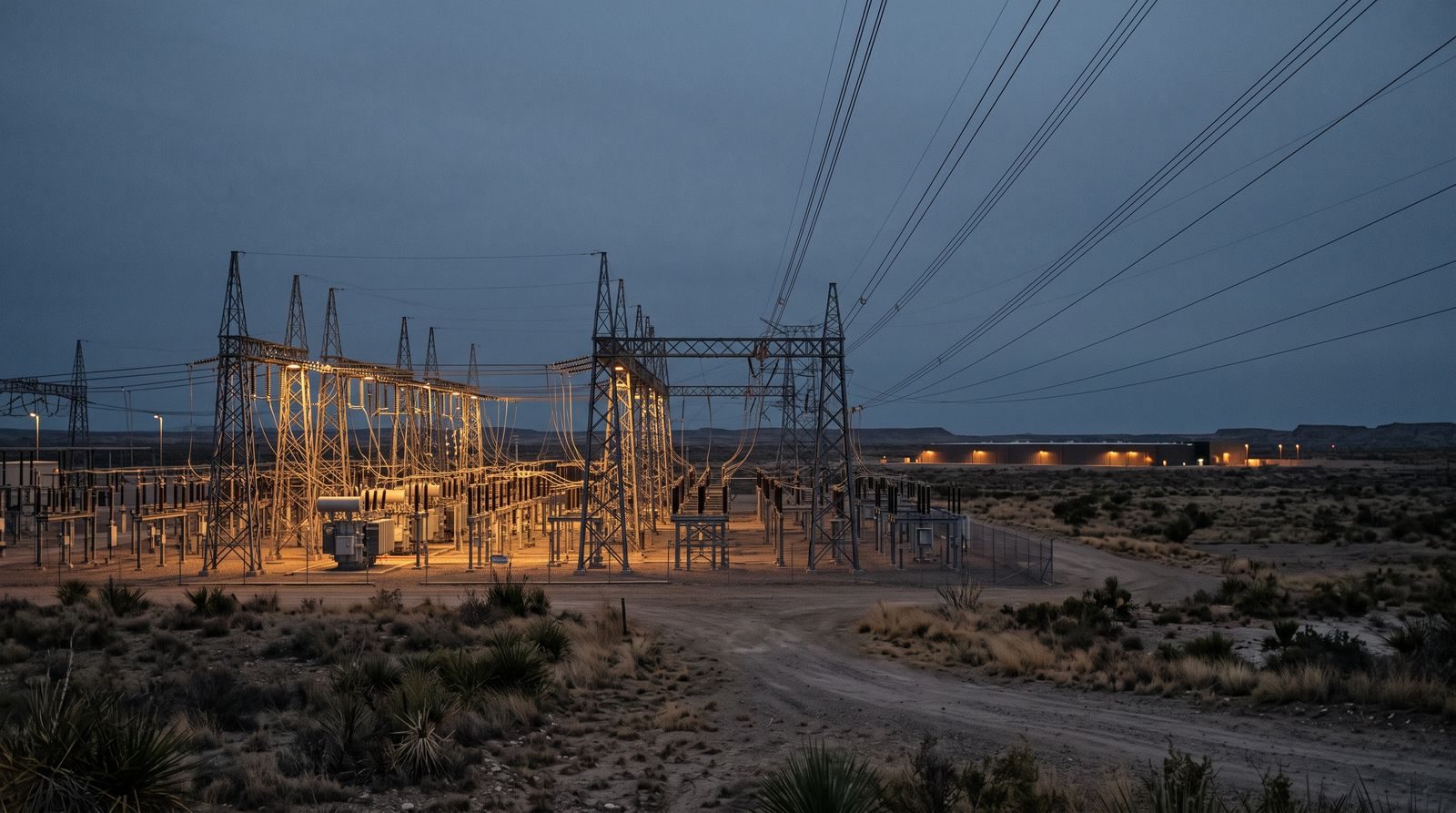
Ionic did not build an AI business. It rented out an electrical connection. Its Ward County campus in West Texas has been energized since 2023; 234 MW of that capacity is now contracted, and cash payments under the lease started in August.
The expansion is where the moat sits. Capacity to grow Ward County to 700 MW was contracted with the interconnecting utility in 2021, and ERCOT approved the initial 234 MW phase in 2022. Ionic’s request for the additional 466 MW, the company says, advances that existing agreement rather than joining the interconnection queue as a new request — and it argues the site’s existing energization satisfies ERCOT’s definition of Base Load. Transformers are ordered, the EPC contract is signed, and energization is targeted for the end of 2027, subject to ERCOT approval and two utility projects still under construction. At Midland, another 112 MW is being converted into data centres built for AI workloads while the machines there keep mining.
Our take: The AI buildout has two scarce inputs and only one of them is chips. A 2021 utility contract and a 2022 ERCOT approval are worth far more today than they cost, because the queue behind them is now years long. That is what Ionic sold, and the 99.5% cash margin is the proof — a landlord’s margin, not an operator’s. It is also the risk. Landlords have one number that really matters, and it is tenant concentration. Ionic’s revenue is now essentially one Ward County lease, and the $35.3 million loss is a reminder that a bitcoin balance sheet still swings the reported result even when the operating business is boring on purpose.
What to watch
- ERCOT’s treatment of the incremental 466 MW. The whole 700 MW story rests on whether an energized 2021 agreement can be advanced rather than re-queued.
- The Midland conversion. 112 MW moving from mining to AI is the test of whether the Ward County result repeats or was a one-site event.
- Texas policy. Ionic publicly backed Governor Abbott’s data-centre reliability push on 17 August and committed to the PUCT and ERCOT audit process. Large flexible loads in ERCOT are now a political question, not only an engineering one.
- Who the second tenant is. Management says it is targeting “metro-scale sites closer to the enterprise” for inference and agentic demand. Until one is signed, the revenue line has one customer.
The broader pattern is now hard to miss. Core Scientific leased roughly 530 MW to AMD. TeraWulf signed a 20-year deal with Anthropic. Ionic Digital just reported 90% of its revenue from leasing megawatts it originally secured for a completely different industry. The crypto cycle spent four years building energised industrial sites next to cheap power. It turns out that was the product.