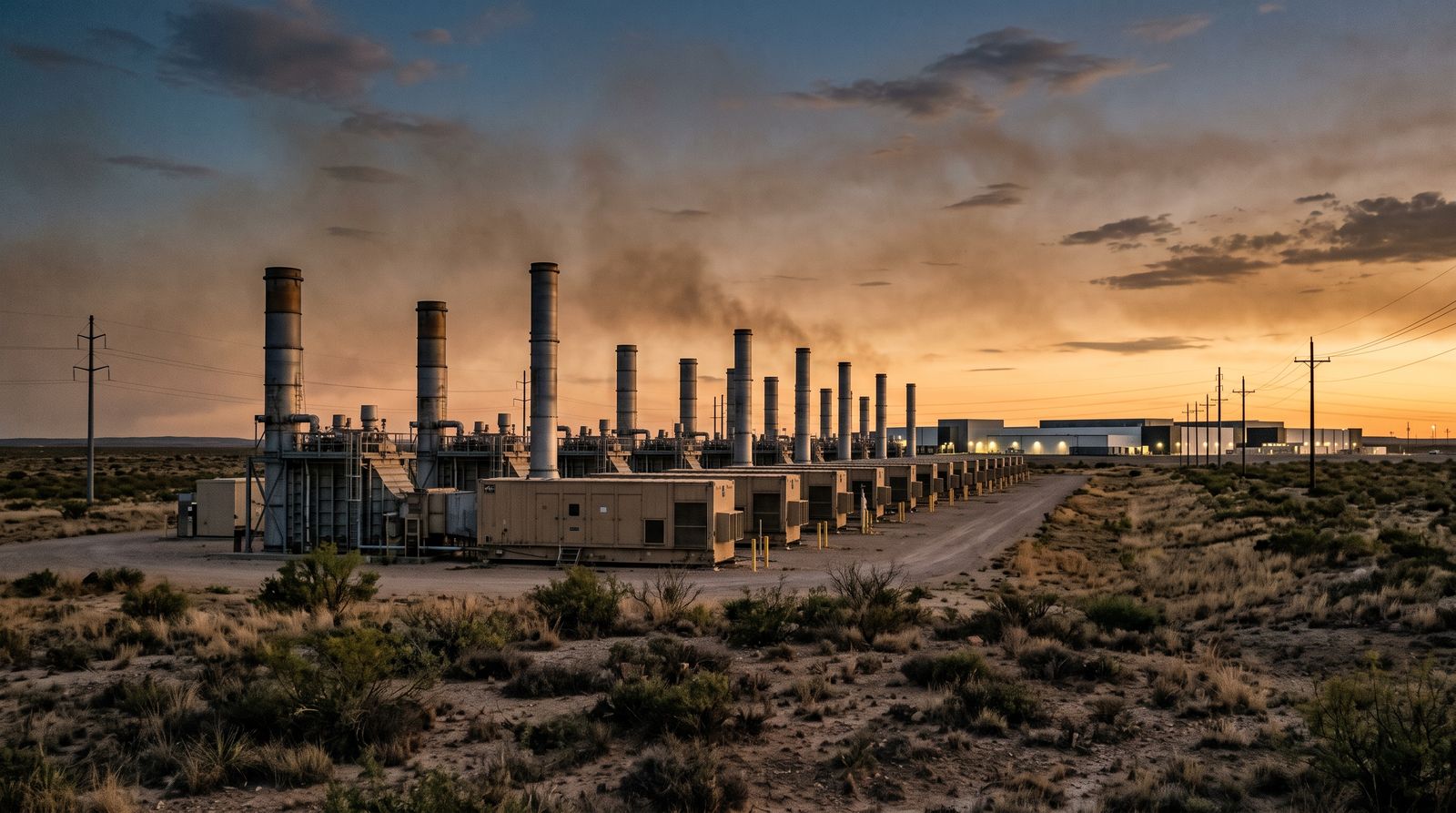
The New York Times reported Saturday that Amazon is the customer behind GW Ranch, a natural gas plant taking shape on ranchland in Pecos County, Texas. Pacifico Energy is the developer. The Texas Commission on Environmental Quality issued its air permit in January: 35 gas turbines, 7.65 gigawatts of generation, and authorisation to release up to 33 million tons of greenhouse gases a year. Amazon acquired the site and will buy the power directly.
Thirty-three million tons would make it the largest single source of climate pollution in the United States. The current holder of that title is Plant Miller, the Alabama Power coal station that has topped the EPA’s facility-level greenhouse gas list for nine consecutive years. Miller emitted roughly 16.6 million tons in 2023. Amazon’s permitted ceiling is about twice that — for a power station whose entire output is spoken for by one data center campus.
Amazon did not dispute the arrangement. A spokesperson said the campus will “be powered by new on-site generation that won’t raise electricity costs for Texas families.” On the 2019 pledge to reach net zero by 2040, the same spokesperson said: “The world looks different now than when we co-founded the climate pledge” — while adding, “Our commitment hasn’t changed.”
Our take: A permit is a ceiling, not a forecast. Plants almost never run at their authorised maximum, and this one is designed to connect to the grid once interconnection allows. But the size of the ceiling is the story. Nobody applies for the largest power-generation air permit ever issued in this country expecting to use a quarter of it. The real signal is structural: in 2026 the fastest route to powering AI is to build your own plant, behind your own meter, and never enter the utility queue at all.
Off-grid is the whole point
Interconnection is the binding constraint on AI buildouts, not capital. Queues run years, and every megawatt requested arrives attached to a public rate case. Generating on-site for a single private customer routes around both. New York froze new hyperscale data center construction statewide in July over exactly this friction — the buildout meeting the ratepayer. GW Ranch is the other answer to that problem: if you never touch the grid, nobody who pays a power bill gets a vote.
It is also the logical end of a trend the sector has been running for a year. Meta more than doubled its Louisiana megasite to 5 gigawatts and $50 billion. Google’s power bill grew 37% in a year. Electricity stopped being a line item and became the product spec.
The ledger Amazon is carrying into this
Amazon’s own sustainability report put 2025 emissions at 80.9 million metric tons of CO2 equivalent, up 16% on the year. Purchased-electricity emissions rose 34%. Supply-chain emissions rose 20% and now account for 76% of the total. Measured against the 2019 baseline of the Climate Pledge, the footprint is up roughly 58%. Amazon added more data center capacity in 2025 than any other company on earth, including more than 1.2 gigawatts in the fourth quarter alone.
Net zero by 2040 is fourteen years away. A gas plant built today is a thirty-year asset.
What to watch
- Actual reported emissions, not the permit. EPA facility-level data is the scoreboard. The first full operating year tells you whether 33 million tons was a ceiling or a plan.
- Whether the “won’t raise costs” claim survives the fuel market. Sidestepping the power grid does not sidestep gas: 7.65 gigawatts of new burn is a material call on Permian supply, and gas prices do reach households.
- Copycats. If off-grid generation clears faster than interconnection, every hyperscaler with a balance sheet runs the same play — and the state regulators who just discovered their leverage lose it.
- The language in Amazon’s next sustainability report. “The world looks different now” is how a pledge gets renegotiated before it gets dropped.
For two years the AI power race has been described as a competition for chips. It is now also a competition for permits — and unlike chip allocations, permits are public documents.