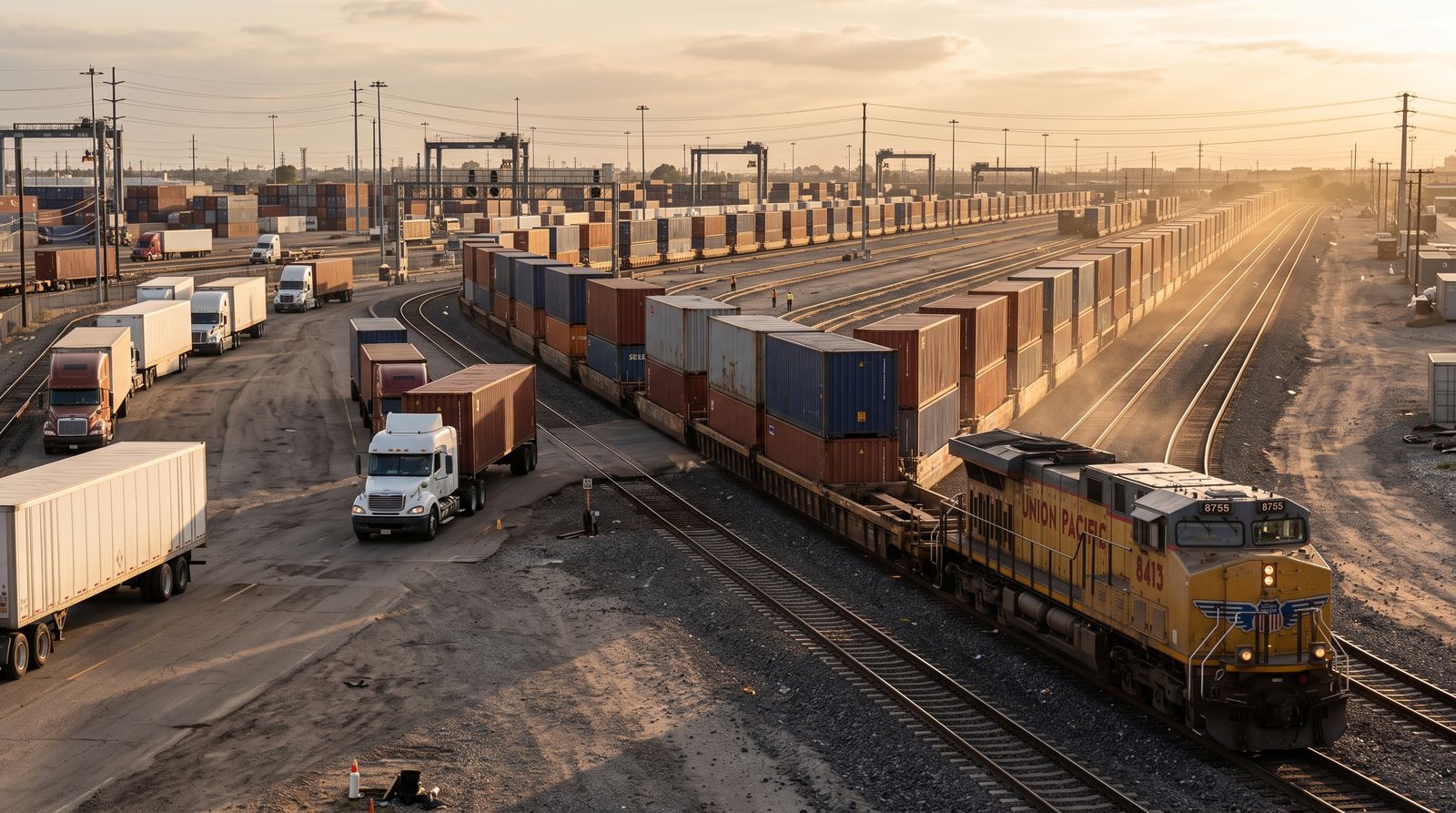
After Wednesday’s close, J.B. Hunt — the country’s biggest intermodal carrier and freight’s favorite economic thermometer — posted a second quarter that beat on essentially every line. Revenue rose 19% year over year to $3.5 billion against expectations of about $3.26 billion. Earnings came in at $1.91 a share, 60 cents higher than a year ago and well clear of the roughly $1.70 Wall Street wanted, with operating income up 32% to $259 million. Shares jumped 8.6% in after-hours trading — on top of a 52-week run that had already nearly doubled the stock.
The engine was intermodal, the business of moving containers on rails. Segment revenue climbed 22% to $1.75 billion as loads grew 10% and revenue per load rose 11%. The growth skewed east — volumes there jumped 16% versus 5% on transcontinental lanes — and most of the per-load gain came from fuel surcharges; strip fuel out and yields rose just 1%. Volume is the signal, though: U.S. Class I railroads grew intermodal carloads 8% in the quarter, which means Hunt outgrew the very network it rides on. The segment’s operating ratio improved 190 basis points to 91.4%, and the dedicated trucking unit added 9% revenue growth of its own, reaching $921 million.
The detail that matters most sat further down the release. Hunt’s brokerage arm — the spot-market middleman that matches shippers’ freight with third-party trucks — posted its first operating profit in 14 quarters. Revenue surged 49% on 19% more loads and 26% higher revenue per load, even as the cost of buying outside truck capacity jumped 54%. That combination — a broker making money while paying dramatically more for trucks — only happens when demand is real and capacity is genuinely tightening. On the same day Pentair’s dealers simply stopped ordering, the part of the economy that physically moves goods said the opposite: stuff is flowing again.
Our take: Freight is the economy’s EKG — it moves quarters before the official statistics do, which is why the four-year freight slump was this recovery’s most stubborn holdout. A 10% jump in loads plus 26% brokerage pricing is that slump breaking, and the bill lands on everyone who ships anything: three years of cheap trucking was a quiet subsidy for American business, and freight analysts already expect truckload and LTL rates to hit new highs in Q3. If you run a business that ships, lock contract rates before bid season reprices you. There’s an inflation angle too — June’s wholesale-price decline leaned on cheap gasoline, and rising freight rates push the other way, with a lag. And note the market’s tell: a stock that had nearly doubled in a year still popped 9% on the print. Even the bulls had the slope wrong.
What to watch
- Contract-rate season: tonight’s earnings-call commentary. Ex-fuel intermodal yields rose just 1% because of the shift to shorter eastern hauls — if management signals real bid-season pricing power on top of the volume, the Q3 rate-spike thesis gets teeth.
- The read-across: Knight-Swift, Schneider, Old Dominion and the railroads report over the next two weeks, in an earnings season already stacking records. Rail intermodal volume grew 8% industry-wide last quarter; if the truckers echo Hunt’s numbers, this is a cycle, not a company.
- Brokerage stickiness: purchased-transportation costs rose 54% — capacity is repricing faster than contracts. Watch whether the new profit survives a full quarter of that squeeze, or whether the margin gets bid right back out.