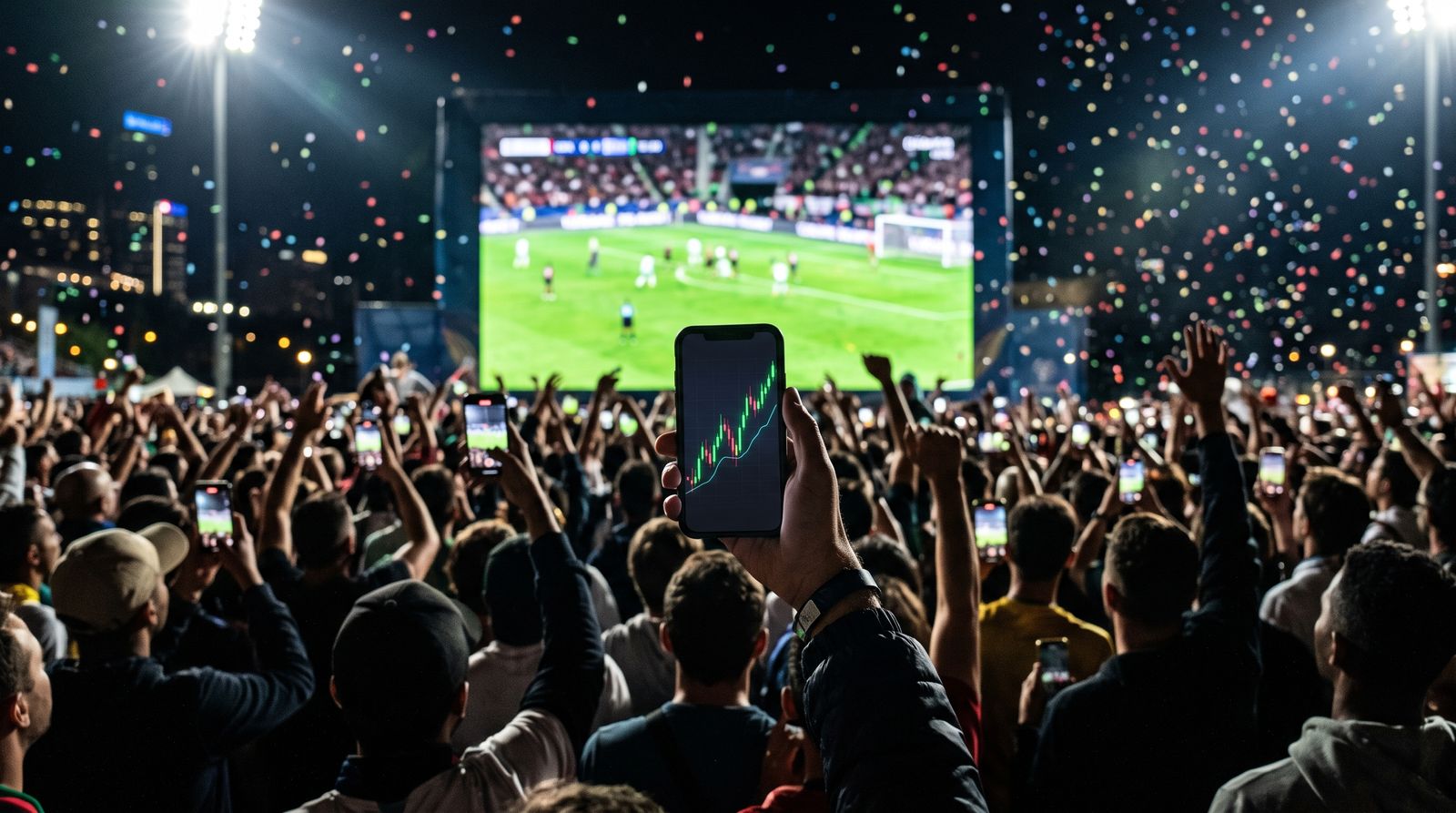
When Spain and Argentina kick off today’s World Cup final, the biggest pot won’t be FIFA’s prize money. As of Saturday, more than $1.27 billion had been traded on Kalshi’s tournament-winner market — the largest amount ever staked on a single event in the prediction platform’s history, per Fortune and The Lines. CNBC reports Kalshi added roughly 3 million new users over the course of the tournament, helped by an official FIFA partnership that put the exchange’s odds in front of a global audience.
The tournament-wide numbers are the real story. Kalshi took in about $40 billion in World Cup trading across the event, The Lines reports — against roughly $4 billion in comparable handle for sportsbooks like FanDuel and DraftKings. The gap isn’t product genius; it’s geography. As a federally regulated exchange, Kalshi operates in every state except court-ordered geofences in Michigan and Nevada — including California, Texas and Florida, where conventional sports betting is either illegal or locked to a single tribal operator. Kalshi’s structure is peer-to-peer: traders bet against each other, the winner takes the pot, and Kalshi clips transaction fees regardless of the outcome.
That scale cuts both ways. Sports now account for roughly 80% of all trades on Kalshi, according to NPR — an awkward statistic for a company whose legal survival rests on the argument that it is a financial exchange, not a sportsbook. For calibration: the Super Bowl brought Kalshi about $1 billion, and the NBA Finals roughly $2 billion across an entire series. One soccer match beat the Super Bowl. States and sportsbooks fighting Kalshi in court now have their exhibit, and adverse rulings could mean fines or clawbacks on the very volume being celebrated today.
Our take: The World Cup settled the product argument — give a betting product national distribution and it out-handles the regulated incumbents ten to one. But Kalshi’s edge is regulatory, not technological, and a $40 billion sports quarter makes “we’re not a gambling site” a hard sentence to deliver with a straight face. Arbitrage this visible invites the referee. The next final Kalshi plays won’t be on a pitch — it will be in a courtroom, and the trophy is access to California, Texas and Florida.
What to watch
- The court docket. Michigan and Nevada already won geofences. Every new ruling either widens the moat or drains it.
- The sports mix. If sports volume stays near 80% after the tournament ends, the “event contracts” framing gets harder to defend.
- The dead calendar. The sports slate mostly empties until college football in late August — the first clean read on how much of Kalshi’s new user base sticks around.
- The incumbents’ counter. Sportsbooks are rolling out prediction-market products of their own rather than waiting for the courts.
This tournament kept producing business stories bigger than the soccer — a 48-team field that still delivered the world’s top four seeds, kickoffs in 100-degree heat that turned matches into physiology experiments. Kalshi’s record is the same pattern as Robinhood’s always-on stock market: the infrastructure of speculation is being rebuilt faster than the rules governing it. Today it just got its biggest single-day stress test.