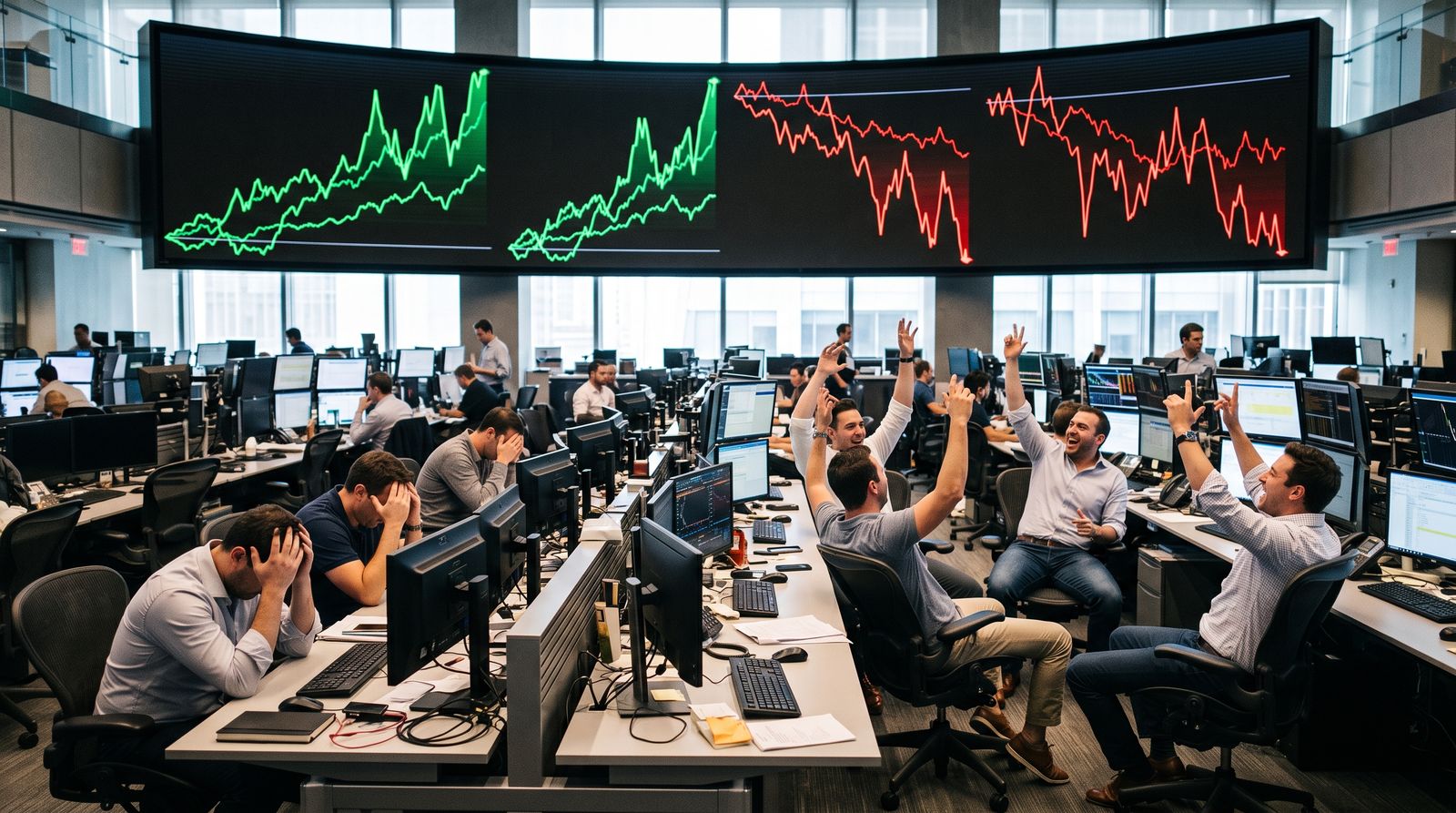
Thursday, Microsoft closed up more than 15% and added close to $450 billion in market value — the largest single-day gain in market capitalization any company has ever posted, past Nvidia’s $441 billion on April 9, 2025. The move took Microsoft to roughly $3.35 trillion. The trigger was an Azure guide of 45% constant-currency growth against a Street looking for about 41%.
Friday, Amazon ran as high as 13% after AWS grew 37% year over year, its fastest since 2021 and well past the roughly 31% expected. Apple went the other way: down about 7%, and as much as 9.5% intraday — its worst since April 2025 — after guiding September-quarter revenue growth to 9–11% against 12% consensus, citing advanced-chip and memory supply constraints. Services revenue of $30.74 billion and Greater China both came in light.
Now look at the index. By late Friday morning the Dow was up about 0.4%, the S&P 500 about 0.7%, the Nasdaq about 1.3%. For the month of July, the S&P was down roughly 0.6%. Four of the largest companies on earth moved seven to fifteen points in 48 hours, and the benchmark that holds them moved less than one.
Dispersion is the story, not direction
A flat index used to mean a quiet market. It does not mean that this week. It means the winners and losers inside the index are cancelling each other out — and they are cancelling at a scale with no modern precedent, because a single name is now large enough to set a record for one-day value creation and still get absorbed by the tape in an afternoon.
The sorting rule is legible. The market has stopped trading “AI” as one bloc and started separating the companies collecting AI revenue from the companies paying for AI capacity. Azure at 45% and AWS at 37% are receipts. Apple’s supply-constrained guide is a bill — the memory and advanced-chip shortage that pays the sellers is a cost line for anyone building hardware. Same theme, opposite sign.
Our take: If you own the index, you are not diversified out of this fight — you are holding the average of it, and the average is hiding the risk rather than reducing it. The practical read: stop using the S&P’s daily move as your gauge of whether it was a big day. It was a very big day. Check what you actually own, and know which side of the earner/payer line each position sits on before the next print sorts it for you.
The bond market is doing half the sorting
None of this is happening in a vacuum. The 30-year Treasury yield sat near 5.22% on Friday, a level last seen in 2007, and the 10-year touched 4.737% intraday, its highest since January 2025 — the aftershock of a hawkish Fed hold with three dissents. Higher long rates are a discount-rate machine: they punish cash flows that arrive in 2030 and reward cash flows printing now. That is precisely the axis the market sorted along this week.
It is not confined to mega-caps, either. Friday also saw Monolithic Power up about 15%, GoDaddy down about 23%, Reddit off roughly 9.6% despite better-than-expected results, and Coinbase down about 5%. Double-digit single-name moves on an unremarkable index day are the signature of a market repricing individual businesses rather than a macro regime.
What to watch
- The 30-year, not the 10-year. Long rates above 5% are what compress the multiple on distant AI payoffs. That is the transmission line into equity dispersion.
- Supply constraints as a two-sided trade. Memory and advanced packaging shortages are revenue for suppliers and margin pressure for device makers. Check which side each holding is on.
- Capex language on the next round of calls. The market rewarded Microsoft for shifting the conversation from what it spends on AI to what it earns from AI. Expect every AI-adjacent management team to attempt that pivot — and expect it to work only where the revenue line backs it.
- Correlation, not volatility. Index vol looks calm because correlation is falling. If correlation snaps back up while single-name moves stay this large, the index stops absorbing them.
Records tend to arrive loudly. This one arrived on a day the benchmark barely moved.