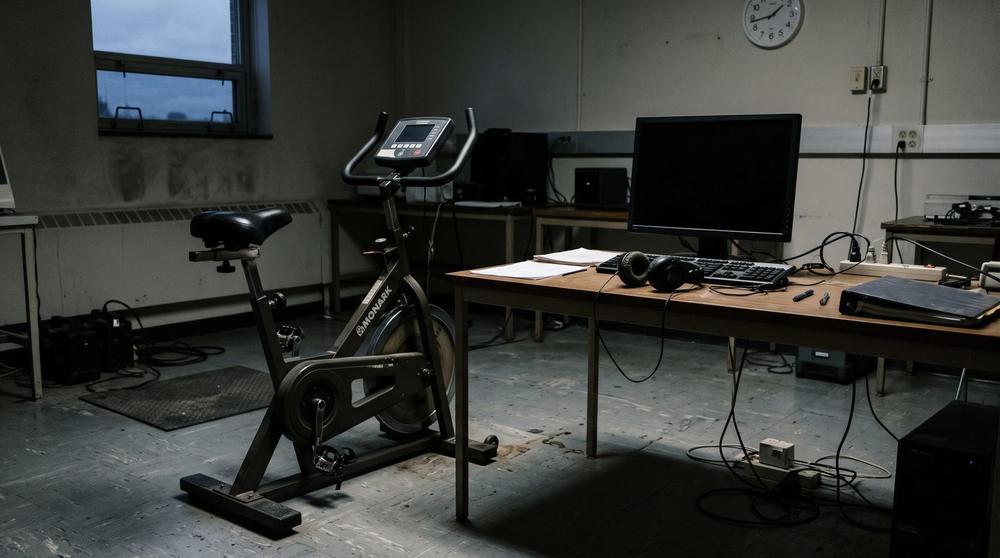
A randomised crossover trial published in PLOS ONE on November 16 did something useful and unglamorous: it fatigued people mentally, then tested whether what you do in the next 15 minutes makes any difference. Simon O’Brien, Thomas Mullen and Nick Dobbin at Manchester Metropolitan University put 12 healthy young adults (7 male, 5 female, 24.2 ± 1.3 years) through a 30-minute Stroop test three times over two weeks, each time followed by a different recovery: 15 minutes of light cycling at 30–40% of heart-rate reserve, 15 minutes of guided body-scan meditation, or 15 minutes of sitting quietly.
The fatigue was real and it was measurable. Go/No-Go reaction time went from 309 ms at baseline to 350 ms after the Stroop task — a 41 ms slowdown, p < 0.001. Perceived mental fatigue roughly doubled on a 100-point scale, 24.9 to 50.8, p < 0.001, with the largest effect size in the study (ηp² = 0.497).
Then everything came back. Reaction time returned to 317 ms and perceived fatigue to 26.7 — neither significantly different from baseline (p = 0.500 and p = 0.821). And the recovery you chose made no difference the study could detect. The intervention main effect on reaction time was p = 0.698; the time-by-intervention interaction, p = 0.436. Every between-condition change-score confidence interval included zero.
Our take: The headline most outlets will reach for — “cycling, meditation and doing nothing all work equally” — is not what this says, and the authors go out of their way to block it. Three sentences from the paper do the work. First: absence of evidence for a superior strategy “should not be interpreted as evidence of absence.” Second: the design “cannot separate the effect of each modality from the passage of time” — passive sitting was a condition, not a no-recovery control, so the real finding may simply be that 15 minutes passed. Third, on power: with n = 12 set by feasibility, their own simulation gives 0.61 power at the observed effect size and reaches 0.81 only for interactions about 25% larger. No equivalence testing was run. The usable takeaway is narrower and more useful: a half-hour of hard cognitive work measurably slows you down, and a quarter-hour later you are roughly back. That is a scheduling fact, not a recovery protocol.
The strength numbers go in the bin, and the authors put them there
Knee extensor force dropped from 377 N to 340 N after the Stroop task (p = 0.013 for the time effect). Reductions across measures ran 8.1–23%. The paper states these fall within the standard error of measurement for a handheld dynamometer and “should not be interpreted as a genuine physiological effect of mental fatigue on force production.”
That is a research team deleting its own most shareable number. Anyone citing “mental fatigue cuts strength up to 23%” from this paper is citing a measurement-error band.
Working memory didn’t move, and that means less than it looks
N-back accuracy showed no effect of time (p = 0.196), sitting at 87.5% at baseline and 87.1% after fatigue. The authors flag a ceiling effect and say the null result “should not be interpreted as evidence that working memory was unaffected by mental fatigue.” A test most participants were already near the top of cannot detect decline.
Two design limits are worth carrying with every figure above. Recovery order was randomised but not counterbalanced, and the models carried no period term — so practice effects across the three sessions cannot be separated from condition. And the Functional Movement Screen scores were graded by the unblinded researcher who delivered the recovery, with 36 of 108 observations rescored blind for agreement.
What to watch
- An actual no-recovery arm. Until a trial includes continued work as a comparator, “rest beats nothing” is untested here. All three conditions were rest of some kind.
- Equivalence testing, not null-hypothesis testing. The claim people want — that modality doesn’t matter — requires a trial designed to show equivalence. Effect sizes here ran dz 0.02–0.46, which is compatible with meaningful differences in either direction.
- A harder cognitive test. Go/No-Go caught the 41 ms. The N-back ceiling means the question of working-memory cost is still open.
- Populations that aren’t 24-year-old physically active students. The authors name this as the first external-validity limit. Shift workers and regular meditators were excluded by design.
- Repeated or longer bouts. One 30-minute Stroop and one 15-minute recovery tells you nothing about a day of back-to-back cognitive load.