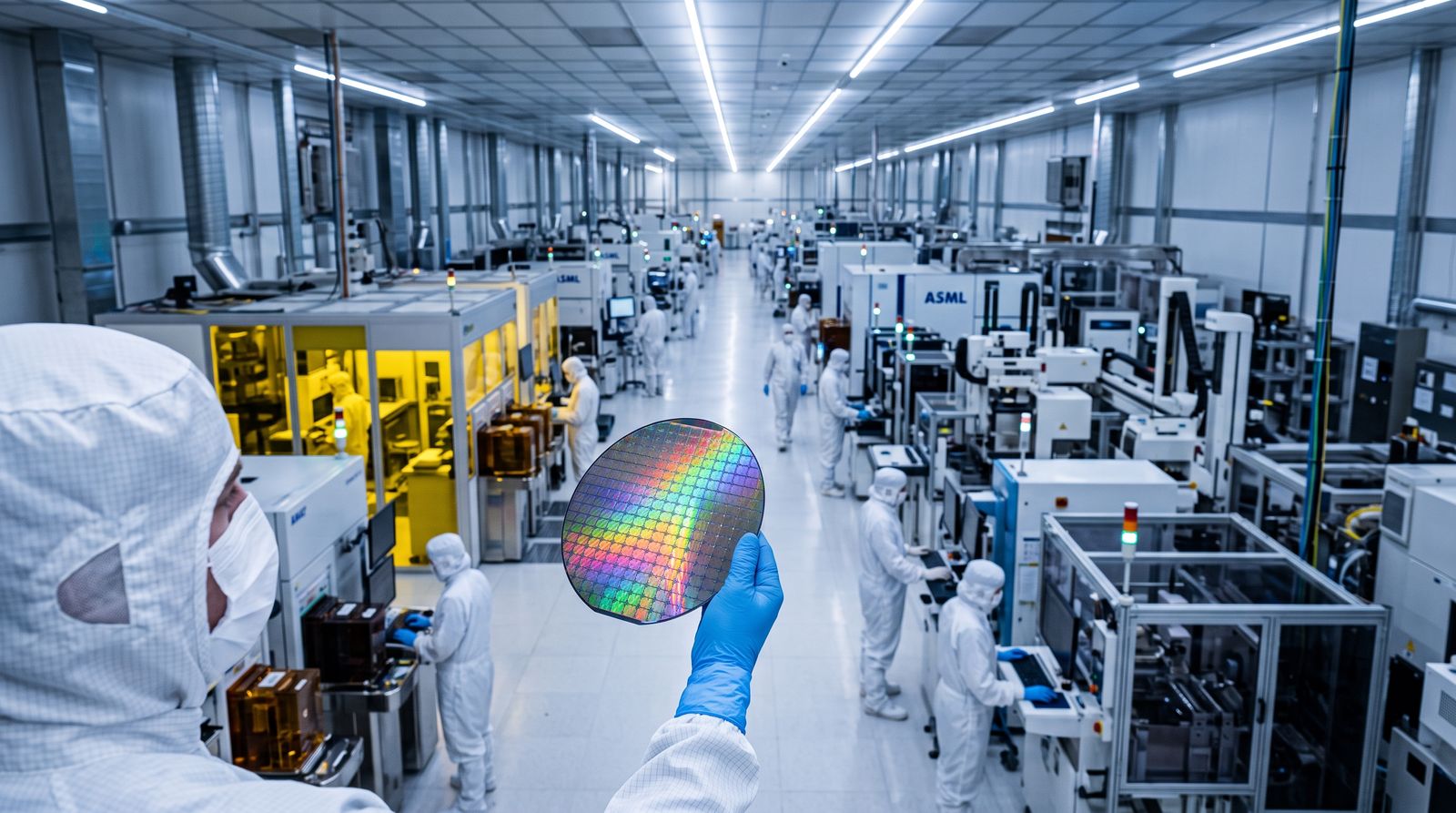
Micron said Thursday it will invest more than $250 billion in U.S. manufacturing and research through 2035 — a roughly $50 billion jump over the $200 billion plan it unveiled just last June, which had itself already been raised. To mark it, the company poured the first concrete at its semiconductor campus in Clay, New York, more than a quarter ahead of the original schedule. About $3 billion of the total goes toward shoring up the domestic supply chain, including $500 million to help fund GlobalWafers’ raw-silicon wafer plant in Sherman, Texas. The stated goal: build 40% of Micron’s DRAM on American soil.
The number is enormous. The reason behind it is bigger. High-bandwidth memory — the stacked DRAM that sits shoulder-to-shoulder with every AI accelerator — is in acute short supply, and Wall Street now expects that crunch to run into 2027. Durable pricing power is a rare gift in a business famous for brutal boom-and-bust cycles, and investors pounced. Micron climbed about 8%. Western Digital and Seagate jumped roughly 7%, SanDisk and Marvell added around 6–7%, and the enthusiasm carried into Samsung and SK Hynix — the Korean memory giant pricing its record U.S. IPO the very same day.
There’s a policy tailwind, too. Micron has secured up to $6.4 billion in CHIPS Act support — with $275 million finalized for its Virginia operations — and is leaning hard into Washington’s domestic-chip push. But strip away the politics and the story gets simpler. Memory used to be the least glamorous, most cyclical corner of the chip world. AI turned it into a chokepoint. Micron is spending a quarter-trillion dollars to own it.
Our take: Memory is the pick-and-shovel trade the market spent years underpricing. Everyone watches the models; the real constraint is what feeds them — power, and now memory. A $250 billion, ten-year commitment is a bet that AI demand outruns supply long enough to pay it back. The tell isn’t the headline figure — it’s that a company repeatedly burned by memory’s down-cycles is confident enough to pour concrete a quarter early. That only happens when customers are begging for capacity.
What to watch
- HBM pricing into 2027. The entire thesis rests on the shortage lasting. If it eases early, the memory rally cools just as fast.
- SK Hynix’s Nasdaq debut Friday. Demand reportedly ran seven times the shares on offer — a live referendum on how long investors think the boom lasts.
- CHIPS Act cash. How much of the $6.4 billion actually lands, and how quickly, will set the pace of the build-out.
- Supply lock-ins. Watch whether Nvidia, AMD, and the hyperscalers sign long-term memory deals to hedge against the crunch.
For all the attention lavished on frontier models this week, the AI trade keeps rewarding the unglamorous layer underneath — the power bills and data-center leases that turn ambition into compute. Memory just joined that list, and Micron is wagering a quarter-trillion dollars that it stays there.