Merck and Moderna said Wednesday morning that INTerpath-001, the first randomised Phase 3 trial ever run on an individualised mRNA cancer vaccine, hit both of its endpoints. Patients who received intismeran autogene alongside Keytruda had statistically significant improvements in recurrence-free survival and in distant metastasis-free survival against patients who received Keytruda alone.
The trial enrolled 1,137 patients with stage IIB to IV melanoma that had already been surgically removed — the population where the cancer is gone today and the only question is whether it comes back. Volunteers were randomised to up to nine doses of the personalised vaccine plus Keytruda, or Keytruda by itself, over roughly a year.
Moderna shares more than doubled on the news, at one point trading up more than 100% in what Forbes called the biggest single day in the company’s history. Merck climbed to an all-time high. Detailed results go to an upcoming medical meeting; both companies say they are already talking to regulators about filings.
Why a doubling was even available
Moderna is the more dramatic chart because Moderna is the more damaged company. The COVID franchise that made it a household name has been shrinking for three straight years, and the market had repriced it as a business searching for a second act. Wednesday was the first hard evidence that the second act exists and is late-stage.
Merck’s move is smaller in percentage terms and arguably larger in dollars. Keytruda loses US exclusivity in 2028. It is the best-selling drug in the world, management has guided to roughly $35 billion of peak sales, and the company is in the middle of a $3 billion cost-cutting programme explicitly designed to fund what comes after it. A combination regimen that makes Keytruda work better — and that is protected by its own patent estate rather than the expiring one — is the single most valuable thing Merck’s pipeline could have produced.
Our take: The scientific headline is that mRNA finally cleared a randomised Phase 3 in oncology after a decade of promising Phase 2s. The business headline is narrower and more useful: this is a patent-cliff answer disguised as a cancer breakthrough. Merck did not find a Keytruda replacement — it found a reason to keep prescribing Keytruda inside a regimen it will still own in 2029. Moderna, meanwhile, gets to stop being a COVID company. Both of those things are worth more than the trial data alone, which is why the stocks moved before anyone had seen a hazard ratio.
The part nobody has priced yet
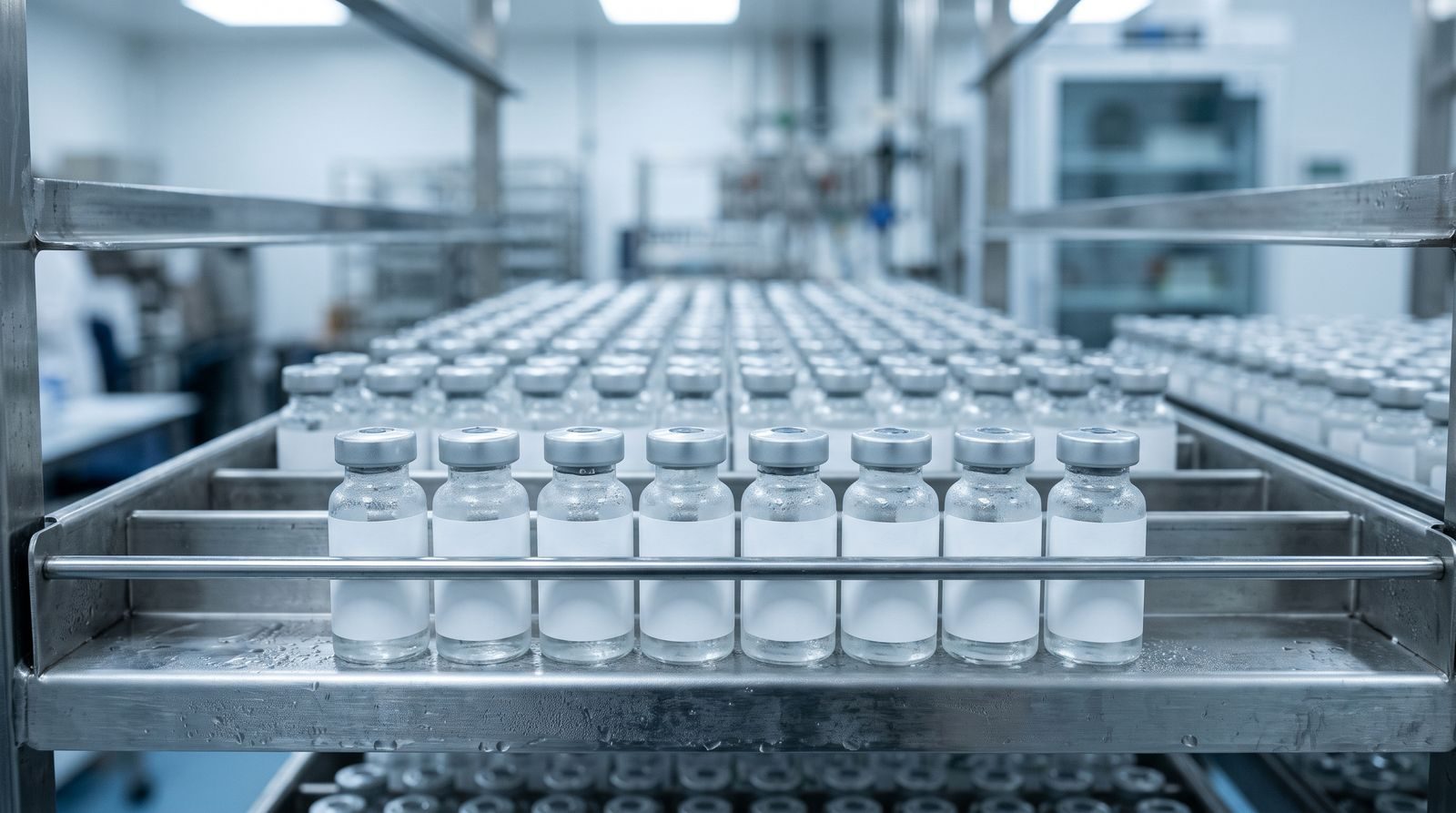
Intismeran is not a vaccine in the sense most people use the word. Each dose is built for one patient, from the specific mutation profile of that patient’s own tumour. That means sequencing the tumour, designing the mRNA, manufacturing a bespoke product, and shipping it — per person, at scale, inside a clinical timeline that has to be short enough to matter.
Nothing in Wednesday’s announcement tells you what that costs, how fast it runs, or how many patients a year the supply chain can absorb. Moderna has spent years building manufacturing capacity for a product that turned out not to need it. Whether that capacity converts into individualised oncology manufacturing is the question that decides whether this is a good drug or a good business.
The earlier Phase 2b readout, KEYNOTE-942, gives some sense of the size of the prize: five-year data presented at ASCO this year showed a 49% reduction in the risk of recurrence or death and a 59% reduction in the risk of distant metastasis or death versus Keytruda alone. Phase 3 will not necessarily replicate that. It only has to replicate enough of it.
What to watch
- The actual numbers. “Statistically significant” is a press release. The hazard ratios at the medical meeting are the story, and they set the price.
- Filing timing. Both companies say regulator conversations have started. A 2026 submission and a 2027 approval is a very different model from a 2028 one, given what happens to Keytruda that year.
- Manufacturing disclosure. Cost per dose and turnaround time from biopsy to first injection. Until those are public, the revenue estimates are guesses.
- The other tumour types. Melanoma is the proof of concept. The INTerpath programme runs into lung, kidney and bladder cancers, and those markets are multiples larger.
- Whether the sector follows. A first randomised Phase 3 win validates an entire class. Every neoantigen platform just got a comparable.
One trial does not make a category. But for ten years the argument against personalised cancer vaccines has been that nobody had ever proven the benefit in a properly randomised late-stage study. That argument ended Wednesday morning. What replaces it is a much more ordinary set of questions about cost, capacity and timing — and those are the ones that decide who actually gets treated.