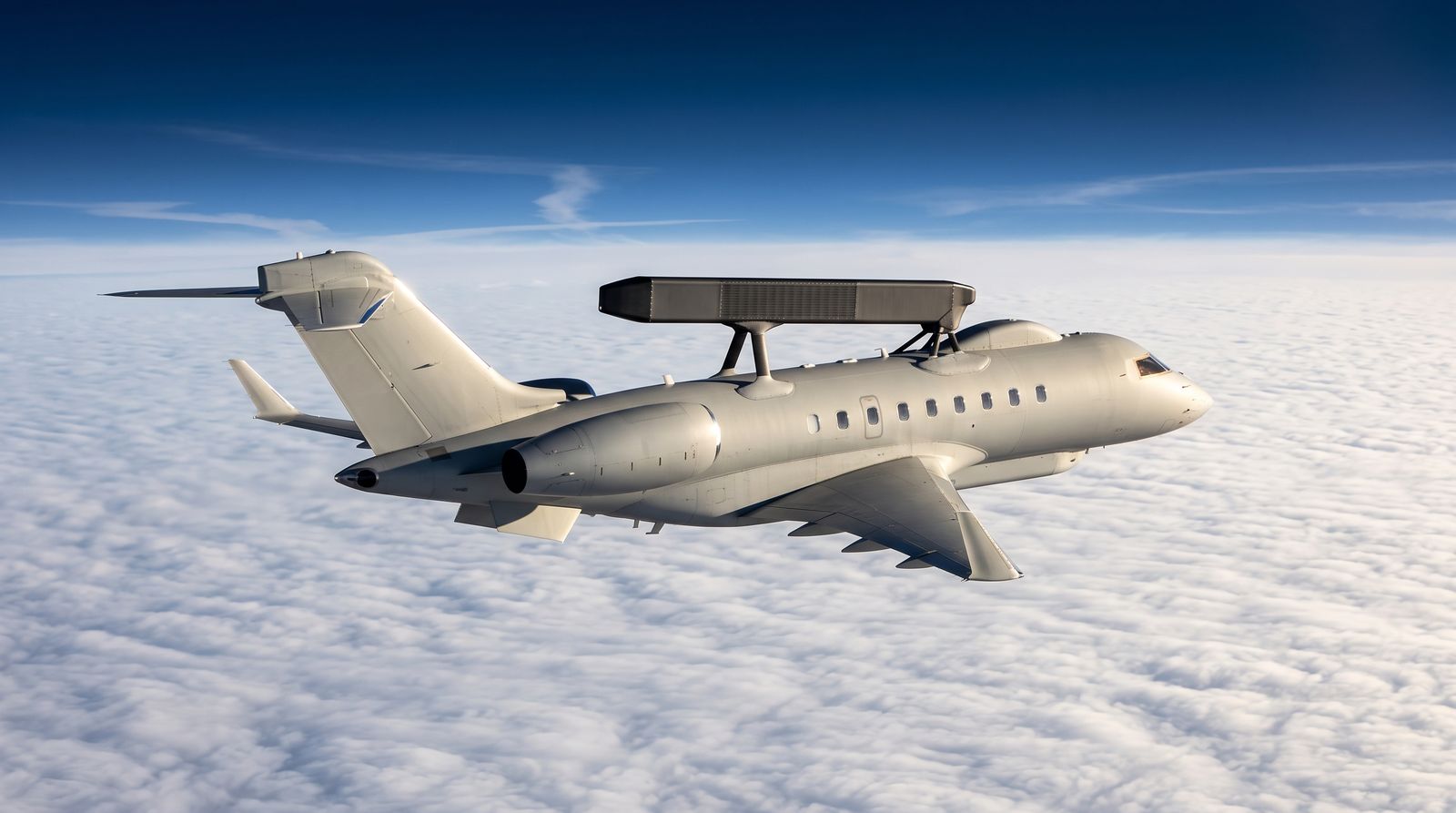
NATO on Tuesday named Sweden’s Saab as its provisional choice to replace the alliance’s aging fleet of Boeing-built E-3A AWACS radar planes, backing the Saab GlobalEye over an American rival in a program the alliance values at roughly $4.5 billion. Secretary General Mark Rutte announced the selection at NATO’s Defence Industry Forum in Ankara. Up to 10 aircraft are on the table, at a per-plane price the two sides put between $400 million and $450 million.
The machine is a tell in itself. Saab mounts its Erieye extended-range radar and a multi-domain command-and-control suite on a Bombardier Global 6500 — a Canadian business jet, not a converted airliner — which keeps it cheaper to buy and fly than the flying-radar-dome AWACS it replaces. Deliveries could begin around 2030 if a contract is signed soon. Eleven members are pooling the money: Belgium, Canada, Denmark, Germany, Latvia, Lithuania, Luxembourg, the Netherlands, Norway, Romania and Sweden.
Investors read it instantly. Saab shares climbed about 5% on the news, extending a run that already had Morgan Stanley double-upgrading the stock two notches to “overweight” and lifting its price target to SEK 700 from SEK 540 — on the argument that a win like this isn’t yet baked into consensus numbers. For Boeing, it’s the mirror image: the company that built the AWACS NATO has flown since the 1980s just lost the contract to replace it.
Our take: This is a procurement line item, but the signal is strategic. Europe keeps choosing European — even under open pressure to buy American — because “strategic autonomy” has stopped being a conference slogan and become a purchasing rule. A $4.5 billion contract that lands in Stockholm instead of St. Louis is the clearest tell yet that the continent’s rearmament wave is also an industrial-policy wave, and Saab is its stock-market face. The lesson for any supplier: when the customer decides that who owns the supply chain matters as much as the spec sheet, the incumbent’s logo stops being a moat.
It isn’t signed. NATO made a provisional selection and now opens formal negotiations, so price, timeline and workshare are all still live — and an “up to 10” order can shrink. But the direction is set, and it rhymes with everything else moving through European industry right now, from record checks into homegrown deep tech to a fresh wave of aviation dealmaking. The backdrop is a defense-spending surge that this week’s renewed Middle East tension only hardens.
What to watch
- The signature. A provisional pick isn’t a contract. Watch for a firm order and where the final per-plane price lands inside that $400–450 million band.
- Boeing’s next move. Losing the AWACS replacement is a reputational dent in Europe. Where does Boeing Defense go to win it back?
- Saab’s capacity. Ten aircraft by the early 2030s is a step-change in output. The 2030 delivery promise rides on a supply chain that has to scale fast.
- The next “buy European” call. Air-defense, drone and munitions contracts are queued across the alliance. This one sets the tone.